
Why Coweta County Homeowners Keep Asking This Question
Every roofer in the Newnan area fields the same call from a worried homeowner: there's a stain on the ceiling, or a shingle blew off in a windstorm, and the question underneath it all is whether this is a quick fix or the start of something bigger. With the swing between humid Georgia summers and the occasional ice event in winter, roofs across Coweta County and the south side of metro Atlanta take a steady beating year after year, and that wear doesn't always show itself until a small leak forces the issue.
The honest answer is that most roofs can take several repairs over their lifetime before anything more drastic is needed. But there's a real point where the math flips, where another patch costs you money without solving the underlying problem. Knowing where that line sits, and reading your own roof against it, saves homeowners from both overspending on premature replacement and from throwing good money after a roof that's already done.
What Actually Wears a Roof Out
Asphalt shingles are built to shed water and block UV light, and both jobs degrade the material over time. Sun exposure bakes the oils out of the asphalt, granules wash away in heavy rain, and freeze-thaw cycles in winter stress the seals between shingles. None of this happens overnight, which is exactly why the failure point sneaks up on homeowners who've never had a reason to get up close to their own roof.
Granule Loss and UV Breakdown
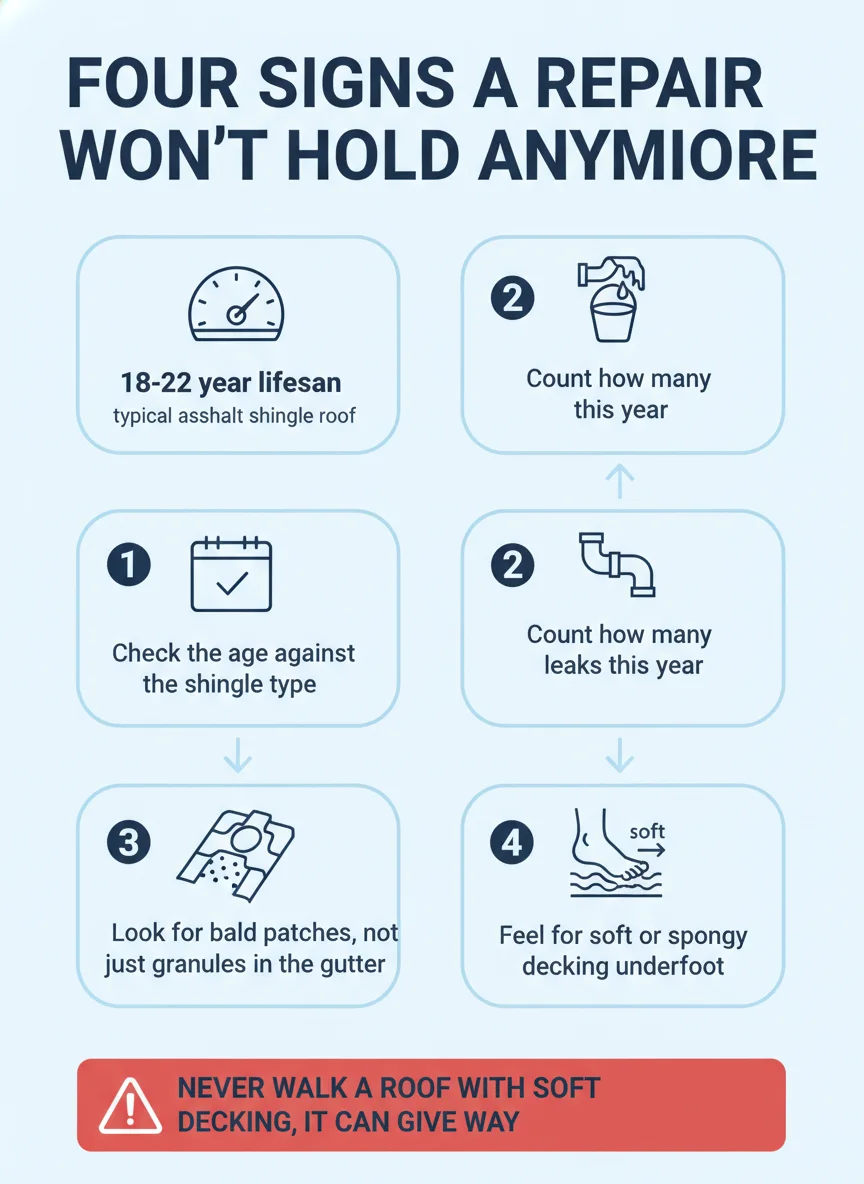
Every asphalt shingle sheds some granules as it ages, and finding a few in the gutter after a storm is normal. The concern is bald patches, spots where the black asphalt mat shows through because the protective granules are gone entirely. Once that happens, UV rays hit the shingle directly and the material becomes brittle, which is when cracking and curling tend to follow close behind.
Bald patches rarely show up in just one place. If you spot them while walking the yard or looking from a ladder, check a few other slopes of the roof too. Widespread bald spots across multiple sections, rather than one isolated patch, usually means the whole roof is reaching the end of its UV life together, not just one unlucky shingle.
Repeated Leaks in Different Spots
A single leak around a chimney or a vent pipe is often a flashing problem, and flashing is one of the easier things to repair without touching the rest of the roof. The pattern that should worry you is leaks showing up in different rooms, or the same spot leaking again within a year of being fixed. That tells you water is finding multiple paths in, which points to general wear rather than one bad seal.
Keep a simple record if you've had more than one leak. Note the date, the room, and roughly where on the roof it seems to be coming from. If you bring that history to an inspection, it helps a roofer tell the difference between a few unrelated incidents and a roof that's failing across the board.
| Situation | Repair Likely Fits | Replacement Likely Needed |
|---|---|---|
| One leak near a single penetration | Yes, isolated flashing or sealant fix | No |
| Roof near or past 18-22 years old | Short-term only | Yes, material is near end of life |
| Leaks in 2+ separate rooms this year | Rarely holds long-term | Yes, likely widespread wear |
| Soft or spongy decking underfoot | No, surface patch won't fix wood below | Yes, decking replacement required |
The Roof Deck Matters as Much as the Shingles
Shingles get all the attention because they're what you see, but the wood decking underneath is what actually holds the roof together and keeps water out of your attic. When decking stays dry, it can outlast two or three rounds of shingle wear. When it's been soaking up moisture from a slow leak for months or years, it softens, and a soft deck changes the entire conversation from repair to replacement.
You can sometimes catch early decking damage from inside the attic, looking for dark staining, sagging insulation, or daylight coming through at a seam. From the ground, a roofline that looks slightly wavy instead of straight is often a sign the decking has already started to give way in one or more spots, and that's not something a surface repair touches.
Step-by-step: How to Evaluate Your Own Roof Before Calling Anyone
You don't need to get on the roof yourself to get a reasonable read on its condition. Most of this can be done safely from the ground, a ladder at the eave, or your attic.
- Find the install date: Check old invoices, a transferable warranty card, or ask a previous owner if you bought the house. This tells you where the roof sits against its expected lifespan.
- Walk the perimeter: Look up from several angles around the house for bald patches, curling edges, or shingles that look a different color or texture than the rest.
- Check the gutters: A handful of granules after a storm is normal, but a steady buildup of granules every time it rains points to accelerating wear.
- Go into the attic: Look for staining, daylight through the decking, or a musty smell, all of which suggest moisture has been getting in for a while.
- Note leak history: Write down every leak you've had in the past two years, including the room and rough location, so a roofer can see the pattern.
- Count the layers: If you know your roof already has two layers of shingles from a past layover, factor that into any repair decision, since a third layer usually isn't an option.
- Get it looked at: Bring what you've found to a roof repair visit or a full roof replacement and installation consultation so a trained eye can confirm what you're seeing.
What a Roofer Actually Finds When They Get on the Roof
A homeowner's walk-around gives a good first impression, but a roofer climbing up with a flashlight and a few decades of pattern recognition sees things that aren't visible from the yard. That's the real value of an in-person look before committing to either a repair or a full tear-off.
Flashing Failures in Multiple Locations
Flashing, the metal strips sealing roof penetrations like chimneys, skylights, and wall intersections, fails one spot at a time at first. A roofer checking several penetrations often finds that if one piece of flashing has failed, others installed at the same time are close behind. Replacing flashing in isolation makes sense once; replacing it three or four times over a couple of years is a sign the whole roofing system is aging out together.
This is also where storm damage gets tricky to diagnose on your own. Wind can lift flashing just enough to let water in without visibly displacing it, so a roof that looks fine from the ground can still be letting moisture in around every edge. A dedicated storm and hail damage repair inspection after a bad weather event catches this before it turns into a bigger repair.
Decking Rot Discovered Mid-Repair
Sometimes a homeowner calls for what looks like a small repair, a few missing shingles after a windstorm, and the crew finds rotted decking once the shingles come off. This isn't a bait-and-switch, it's just something that's genuinely invisible until the surface layer is removed. It's also one of the clearest signals that the roof overall has been absorbing water for longer than anyone realized.
When this happens, the honest move is a straight answer about what the repair will actually cost to do right versus what a full replacement would run, so you can compare the two with real information instead of guessing. A roof that needed its decking replaced once is also more likely to need it again elsewhere soon, since the original leak point was rarely the only weak spot.
What You Can Check Yourself, and What Needs a Licensed Roofer
Plenty of this evaluation is safe to do without ever touching the roof itself. Walking the yard, checking gutters, looking through the attic, and pulling together your leak history are all things any homeowner can handle in an afternoon. None of that requires a ladder on the roof itself or any specialized tools.
What you shouldn't do is climb onto the roof to inspect it closely, especially if you already suspect soft decking or widespread wear. A compromised roof surface can give way under weight that it would normally support fine, and a fall from roof height is a serious risk that isn't worth the savings of skipping a professional visit.
A licensed roofer brings a few things you can't replicate from the ground: experience telling cosmetic wear apart from structural wear, tools to check moisture levels without tearing into the deck blindly, and the ability to safely get close enough to flashing and valleys to see failures that aren't visible from a ladder. If you're already seeing two or more of the signs above, that visit is worth scheduling before the next heavy rain finds the gap on its own.
Making the Call With Real Information
The goal of all this isn't to talk every homeowner into a full replacement. Plenty of roofs with a single, contained problem get a clean repair and another several good years out of the existing shingles. The goal is making sure the decision gets made with the actual condition of the roof on the table, age, leak pattern, decking, and flashing, rather than reacting to whatever's visible this week.
If you're working through this checklist and more than one or two items are raising flags, that's the point to get a second set of eyes on it rather than scheduling another one-off patch. Griffintegrity Roof & Remod has been walking Newnan and Coweta County homeowners through exactly this decision for 10 years, and a straight answer costs nothing more than the time it takes to get on the roof and look.
Frequently asked questions
How do I know if my roof needs repair or a full replacement?
It usually comes down to how many separate problems you're fixing and how old the roof already is. One isolated leak near a vent pipe is a repair. Multiple leaks in different rooms, widespread bald spots, or a roof already near the end of its expected lifespan point toward replacement instead.
Does the age of my house tell me the age of my roof?
No, and this trips up a lot of homeowners. A house built in 1998 could have had its roof replaced in 2015, or it could still have the original covering. The only reliable way to know the roof's real age is a past invoice, a transferable warranty document, or a visual inspection that estimates wear.
Is a roof with one layer of old shingles already on it harder to repair?
It can be, because a prior layover hides the condition of the decking underneath and limits how a patch can be tied in. If your roof already has two layers of shingles, most manufacturers and local code won't allow a third, which pushes a future repair toward a full tear-off regardless of the damage's size.
What does soft or spongy decking mean?
It means water has been getting into the wood sheathing under the shingles long enough to weaken it, and it's a sign the damage goes past the surface layer. A spongy spot usually can't be patched on its own, since the wood underneath needs to be replaced, not just the shingles covering it.
Can I repair a roof section by section instead of replacing the whole thing?
Sometimes, if the damage is contained to one area and the rest of the roof is in solid shape for its age. But if the shingles are uniformly worn across the whole roof, a section repair will look mismatched and age differently, and you'll likely be back for another repair within a year or two.