
Why Shingle Grade Matters More Than It Looks Like It Should
Walk the aisle of any building supply store in Coweta County and you'll see three or four shingle grades stacked side by side, all roughly the same color, all claiming to protect a home from the same Georgia weather. The grade printed on the wrapper, three-tab, architectural, or designer, tells you more about what's underneath than the color chip ever will. It affects how the shingle handles wind, how long it typically lasts, and how the finished roof looks from the street.
For homeowners across Newnan, Peachtree City, and the surrounding towns, this choice usually comes up once every couple of decades, which is exactly why it feels unfamiliar. Understanding the construction difference between the grades before a crew shows up with samples makes the conversation a lot shorter and the decision a lot more confident.
What Actually Separates the Grades
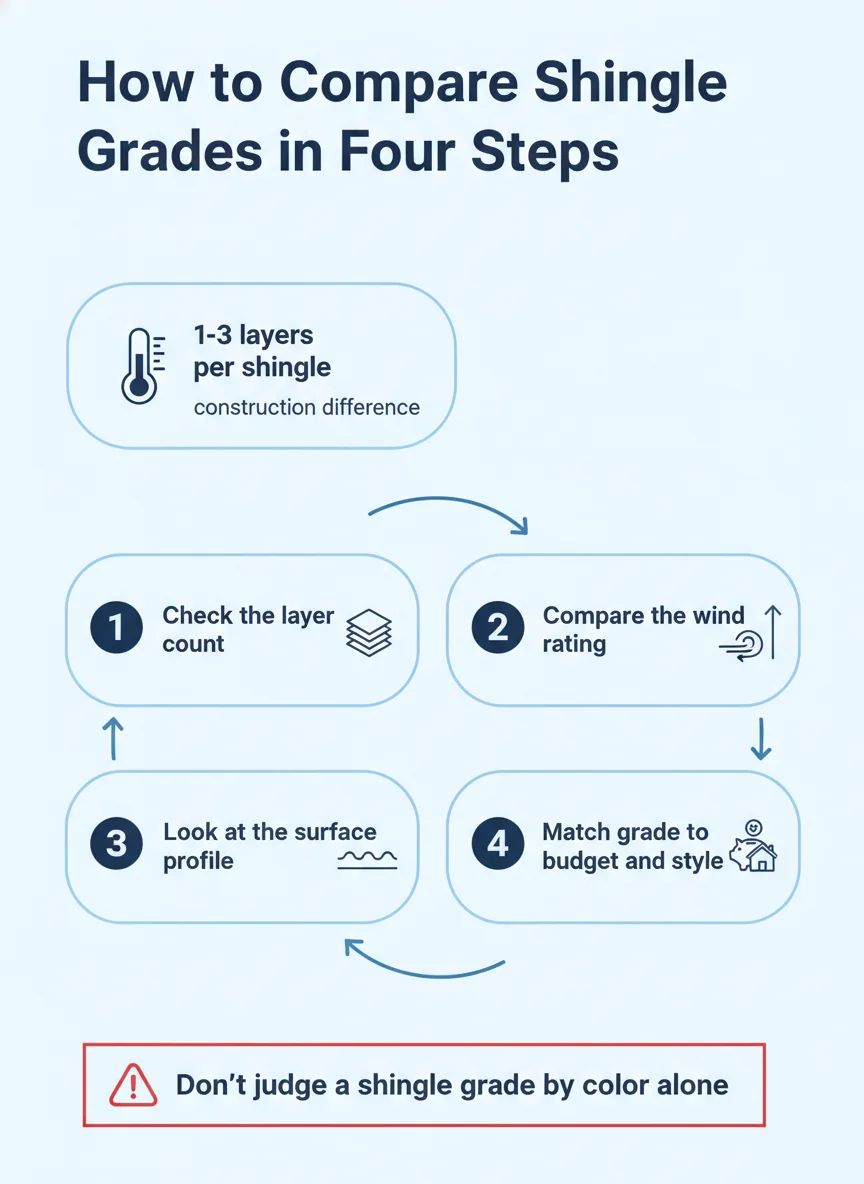
The core difference between shingle grades comes down to construction: how many layers are laminated together, how heavy the shingle is per square, and how the surface is shaped. Everything else, including the wind rating and the expected service life, follows from that basic build.
Three-tab shingles: the flat, single-layer original
A three-tab shingle is cut from a single flat layer of asphalt and fiberglass, with slots creating the illusion of three separate tabs. It's lightweight, uniform, and has been the default American roofing product for decades. The flat profile gives a roof a clean, simple look that still shows up on older homes and some budget-conscious new builds.
Because it's a single layer, a three-tab shingle generally carries a lower wind rating and a shorter expected lifespan than a laminated product in public manufacturer data. It's also lighter per square, which can matter on older framing that wasn't built for a heavier roof covering.
Architectural shingles: the laminated, dimensional standard
Architectural shingles, sometimes called laminated or dimensional shingles, are built from two or more layers bonded together, which creates a thicker edge and a shadow-line look when viewed from the ground. That extra mass is the whole story: more material means more resistance to wind uplift and generally a longer service life than a three-tab shingle in manufacturer testing data.
This is the grade most homes in the region install today. It's become close enough in material cost to three-tab that the heavier build and longer rated lifespan make it the practical default rather than a splurge, which is part of why Roof Replacement & Installation jobs lean toward it almost by default now.
| Feature | Three-Tab | Architectural / Designer |
|---|---|---|
| Construction | Single flat layer | Two or more laminated layers |
| Typical wind rating | Lower, per manufacturer data | Higher, per manufacturer data |
| Surface look | Flat, uniform tabs | Dimensional, shadow-line texture |
| Common use today | Budget projects, outbuildings | Most residential replacements |
What a Designer Shingle Actually Adds
Designer shingles sit a tier above standard architectural shingles. They're still a laminated, multi-layer product, but they're engineered and cut specifically to mimic a premium look, most often natural slate or wood shake, in a lightweight asphalt package. The extra layers and shaping add visual depth that a standard architectural shingle doesn't attempt.
The jump from architectural to designer is mostly about aesthetics rather than a dramatic leap in protection. If the goal is a historic or high-end look on a home where the roofline is highly visible, a designer shingle earns its keep. If the priority is straightforward protection at a reasonable weight, a standard architectural shingle does that job well.
Step-by-Step: How to Work Through a Shingle Grade Decision
Most homeowners land on the right grade faster by working through the same short checklist a contractor runs mentally on every quote.
- Confirm your budget range: Know roughly where you want to land before samples come out, since grade is one of the biggest line-item swings on a project.
- Ask about wind rating: Request the manufacturer's published wind rating for each grade you're considering, since that number varies by product line.
- Look at the roofline from the street: Stand across the road and picture a flat profile versus a dimensional one; the difference reads clearly from a distance.
- Check any HOA restrictions: Some neighborhoods specify a shingle profile or color family, so confirm before you fall in love with a sample.
- Ask what the crew installs most: A crew that installs one grade regularly usually has a tighter, more consistent process with it.
- Get the grade in writing: Make sure the exact product line and grade are named on your written estimate, not just 'shingles.'
What You'll Notice Once the Grade Is Chosen
On the roof itself
A three-tab roof reads flat and uniform from the ground, with evenly spaced tab lines running across the field. An architectural or designer roof shows depth and shadow, especially in low morning or evening light, because the layered tabs sit at slightly different heights across the surface.
Up close, the difference is just as obvious. A laminated shingle feels noticeably heavier in hand and has a textured, almost cobbled edge where the layers meet, while a three-tab shingle feels thin and flat all the way to the edge.
On the quote
Grade is one of the clearest line items separating competing estimates, so if two quotes for the same house look very different, check the shingle grade line first. A lower number sometimes just means a lighter product, not a better deal.
A detailed quote should name the exact grade and product line, not just say 'shingles,' and should spell out the manufacturer warranty that travels with that grade. That's the kind of detail worth reading closely before signing anything.
What a Homeowner Can Handle and What Needs a Licensed Crew
Researching grades, comparing wind ratings, and deciding on a look are all things a homeowner can do from a laptop before a single contractor shows up. Picking up a sample board at a supply store and holding it against your siding to check the color match is a perfectly reasonable DIY step too.
The installation itself is where a licensed crew earns its fee, since a laminated shingle still has to be nailed at the manufacturer-specified pattern, aligned so the shadow lines run straight, and tied into flashing and underlayment correctly for the wind rating to mean anything in practice. A beautiful shingle installed loosely performs like a cheap one.
If a section of the roof is already showing signs that it's past the point of a simple patch, that's usually the moment the grade conversation becomes practical rather than theoretical, since a full replacement is when the shingle choice actually gets made.
Bringing It Back to Your Roof
Most homes across Newnan, Sharpsburg, and the surrounding towns are re-roofed with architectural shingles today, with designer grades reserved for homes where a premium look matters more than squeezing out extra budget. Three-tab still has a place on simpler structures, but it's increasingly the exception rather than the rule.
Whichever grade fits the house and the budget, the construction behind the label is worth understanding before samples get spread across the hood of a truck, and Griffintegrity Roof & Remod Inc walks homeowners through that comparison on every quote.
Frequently asked questions
What is the difference between three-tab and architectural shingles?
Three-tab shingles are a single flat layer cut into even tabs, while architectural shingles (also called laminated shingles) are built from two or more layers bonded together for a thicker, dimensional look. That extra layer generally gives architectural shingles a longer service life and a higher wind rating in public manufacturer data, which is a big reason they've become the standard choice for most homes.
Are designer shingles worth the extra cost?
It depends on what you're after. Designer shingles are premium architectural shingles styled to mimic slate or cedar shake, so the added cost buys a specific look rather than a dramatic jump in durability over a standard architectural shingle.
Do three-tab shingles still get installed on homes today?
They're far less common than they used to be, mostly because architectural shingles now cost close to the same while offering a heavier build. Three-tab shingles still show up on budget-driven projects, outbuildings, and some HOA-restricted neighborhoods that specify a flat profile.
How long do architectural shingles last compared to three-tab?
Industry lifespan figures generally put architectural shingles ahead of three-tab shingles, largely because the laminated construction sheds water and resists wind uplift better. Actual lifespan always depends on installation quality, attic ventilation, and local weather exposure, not the shingle grade alone.
Can I mix shingle grades on one roof?
Technically a roof can carry one grade on the main field and another on a lower-visibility section, but most homeowners stick to a single grade so the roofline reads as one cohesive surface. Mixing grades is more common on additions where matching the exact original shingle isn't possible.