Why the Class 4 Label Keeps Coming Up in Georgia
If you've gotten more than one roofing quote lately, there's a decent chance at least one of them mentioned Class 4 or impact-resistant shingles. Georgia sits in a part of the country that sees its share of severe thunderstorms and the occasional hail event, so it's a fair question for any homeowner in Coweta County or across the wider metro Atlanta area to ask: is this rating real, and does it matter for my house?
The short answer is that Class 4 is a real, standardized lab rating, not a marketing phrase a salesperson made up. But like most ratings, it only tells you one specific thing, and it's easy for that one thing to get stretched into a bigger promise than the test actually supports. Understanding what's being tested, and what isn't, is the difference between an informed upgrade decision and paying for a label without knowing what you're buying.
What Does the Rating Actually Test?
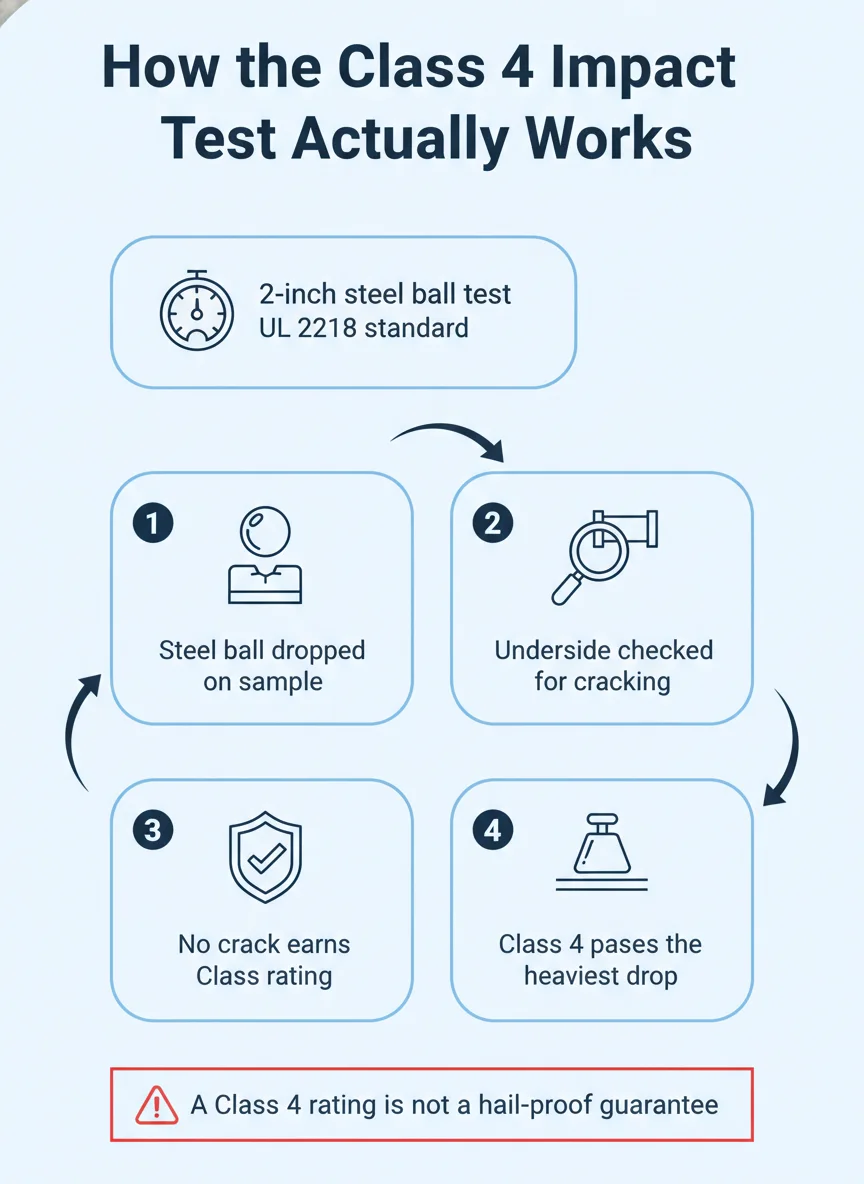
Impact ratings for roofing materials come from a standard called UL 2218, developed by Underwriters Laboratories. It sorts shingles into four classes, Class 1 through Class 4, based on how much force a sample can absorb without the backing cracking on the underside.
The Steel Ball Drop Test
In the test, a steel ball is dropped from a set height onto a shingle sample, and a lab technician examines the underside for any fracture in the fiberglass mat. Class 4, the highest tier, requires the shingle to survive a drop with a two-inch steel ball, the largest size used in the standard, without cracking.
It's a repeatable, controlled test, which is exactly its strength and its limitation. A lab drop from a fixed height onto a flat sample isn't identical to hail falling at an angle, in wind, onto a roof with multiple layers, flashing, and ridges. The rating tells you the shingle performed well under a specific, standardized stress, not that it's immune to every real-world storm.
Classes 1 Through 3, and Why Class 4 Gets the Attention
Classes 1 through 3 use smaller steel balls and lower drop heights, so they represent lighter impact resistance. Most standard asphalt shingles aren't separately rated at all, since impact resistance testing is optional for manufacturers and adds cost to the product line.
Class 4 gets singled out in sales conversations because it's the ceiling of the scale and because some insurers tie their impact-resistant discount specifically to Class 4 products. That insurance angle is often the real reason homeowners start asking about the rating in the first place, more than the shingle itself.
| Factor | Standard Shingle | Class 4 Shingle |
|---|---|---|
| UL 2218 rating | Usually untested | Passes 2-inch steel ball drop |
| Typical construction | Standard fiberglass mat | Reinforced or modified mat and surfacing |
| Insurance discount | Not applicable | Some insurers offer one, policy dependent |
| Hail performance | Can crack or bruise under impact | More resistant to cracking, not immune to damage |
What's Different About the Shingle Itself
Class 4 shingles typically get their impact resistance from a modified or reinforced mat underneath the surface granules, sometimes combined with a different asphalt formulation designed to flex rather than fracture under impact. The visible surface can look nearly identical to a standard architectural shingle in the same color line, which is part of why it's hard to identify by sight alone.
Because the reinforcement changes the manufacturing process, Class 4 products usually cost more per square than the standard version of the same shingle line. That's the trade-off homeowners are weighing: a higher material cost up front against the possibility of a smaller insurance bill or less granule loss over the roof's life.
Step-by-Step: How to Find Out What's On Your Roof Right Now
Before deciding whether a Class 4 upgrade makes sense, it's worth confirming what's already installed. A lot of homeowners assume they have standard shingles, or assume they have Class 4, without ever actually checking.
- Check closing documents: Look through your home purchase paperwork or the original roofing invoice for the shingle brand and product line, which is usually listed by name.
- Look for the product wrapper: If any leftover shingle bundles were left in the attic or garage after installation, the wrapper usually states the product name and whether it carries an impact rating.
- Find the shingle stamp: Manufacturers print identifying marks on the back of each shingle, which a roofer can read from a sample pulled during an inspection.
- Ask for a visual inspection: A roofer on-site can often identify the product line by its shape, surface pattern, and mat thickness even without paperwork.
- Call the manufacturer: With a product name in hand, the shingle manufacturer's customer service line can usually confirm whether that specific line carries a Class 4 rating.
- Request it in writing: If an insurance discount is the goal, ask your insurer exactly what documentation they require to apply it, since requirements vary by company.
What You'll Actually Find When You Check
If the Roof Already Has Class 4 Shingles
If your paperwork or a roofer confirms Class 4 shingles are already installed, the next move is simple: call your insurance agent and ask whether your current policy is applying any available discount. It's common for this detail to get missed at renewal time if nobody flagged it when the roof was installed.
It's also worth keeping that documentation somewhere easy to find, since you'll want it again at your next renewal, at resale, or any time you file a claim and need to establish what was on the roof before the damage occurred.
If the Roof Has Standard Shingles
If you find out your current roof is standard, non-rated shingles, that's not an emergency and it's not evidence of a bad installation. The vast majority of roofs in Georgia are built with standard shingles, and plenty of them perform fine for their full service life without ever taking a Class 4 hit.
The more useful question becomes timing: is your roof getting close to the point where a full roof replacement is coming up anyway? If so, that's the natural moment to price out a Class 4 upgrade, rather than tearing off a roof early just to add the rating.
What You Can Check Yourself vs. What Needs a Roofer
Homeowners can handle the paperwork search on their own: digging through closing documents, old invoices, or receipts is something anyone can do from the kitchen table. Calling the shingle manufacturer with a product name in hand is also something you can do directly, and most manufacturers are set up to answer that question over the phone.
Where it gets harder without a professional is physical identification. Reading a manufacturer stamp off the back of a shingle, or judging mat thickness and surfacing by sight, takes someone who's handled a lot of different product lines and can tell them apart. Climbing onto a roof to pull a sample also isn't something to attempt without the right footing and equipment.
If you're already planning a replacement or dealing with storm damage, a licensed roofer can fold the identification question into the same visit as the inspection, which saves you a separate trip and gets you a straight answer alongside a broader look at the roof's condition.
Deciding Whether the Upgrade Is Worth It for Your Home
There's no universal right answer here. A homeowner planning to stay in a house for another fifteen or twenty years, in an area that sees regular severe weather, has a different calculation than someone who expects to sell in a few years. The insurance discount question matters too, but it only pays off if your specific insurer actually offers one and you confirm it before assuming it into the math.
If you're weighing a Class 4 upgrade against a standard shingle during a planned replacement, it's worth reading up on how shingle grades differ more broadly before narrowing in on impact resistance alone, since grade and impact rating are related but separate decisions. Griffintegrity Roof & Remod can walk through both options and what each one means for your specific roof during a free quote.
Frequently asked questions
What does Class 4 impact resistant mean on a shingle?
It means the shingle passed the highest level of the UL 2218 steel-ball drop test, which simulates impact from large hail without the backing cracking. It's a lab test on a small sample, not a field guarantee that the shingle will never show a mark after a real storm.
Do Class 4 shingles really stop hail damage?
They resist cracking and granule loss better than standard shingles in the lab test, but no shingle is hail-proof. Large enough hail at the right angle can still bruise or dent any roofing material, Class 4 included.
Will Class 4 shingles lower my homeowners insurance premium?
Some insurers offer a discount for impact-resistant roofing, but the amount and eligibility vary by company and policy, so it's worth asking your agent directly rather than assuming a specific savings. Get it in writing before you count on it as part of the decision.
How can I tell if my roof already has Class 4 shingles?
Check your closing paperwork or the original installation invoice first, since the shingle brand and product line are usually listed there. If you don't have paperwork, a roofer can often identify the product from the shingle's shape and the manufacturer stamp printed on the back.
Are Class 4 shingles worth the extra cost?
That depends on how long you plan to stay in the home, whether your insurer offers a meaningful discount, and how much weight you put on reduced maintenance over the shingle's life. It's a reasonable upgrade to ask about when you're already planning a full [roof replacement](/services/roof-replacement-installation), less so as a standalone project.