Why Metal Roofing Keeps Coming Up in Georgia
Drive through Coweta County or anywhere in the south metro Atlanta area and you'll spot more standing seam roofs than you would have ten years ago, on farmhouses, modern builds, and additions alike. Part of that is looks. Part of it is that Georgia summers are brutal on a roof, and metal handles heat, heavy rain, and wind gusts differently than asphalt shingles do.
Metal roofing isn't one product though. The style you pick, how it's fastened, and the panel profile all change how the roof performs and what it asks of you down the road. Before you commit to a quote or compare bids, it helps to know what you're actually comparing.
How Standing Seam and Screw-Down Panels Actually Work
Both styles are metal, usually steel or aluminum, formed into long panels that run from the ridge to the eave. Where they differ is how the panels attach to the roof deck, and that one detail drives most of the cost and maintenance differences between them.
Standing Seam: Hidden Fasteners, Raised Ribs
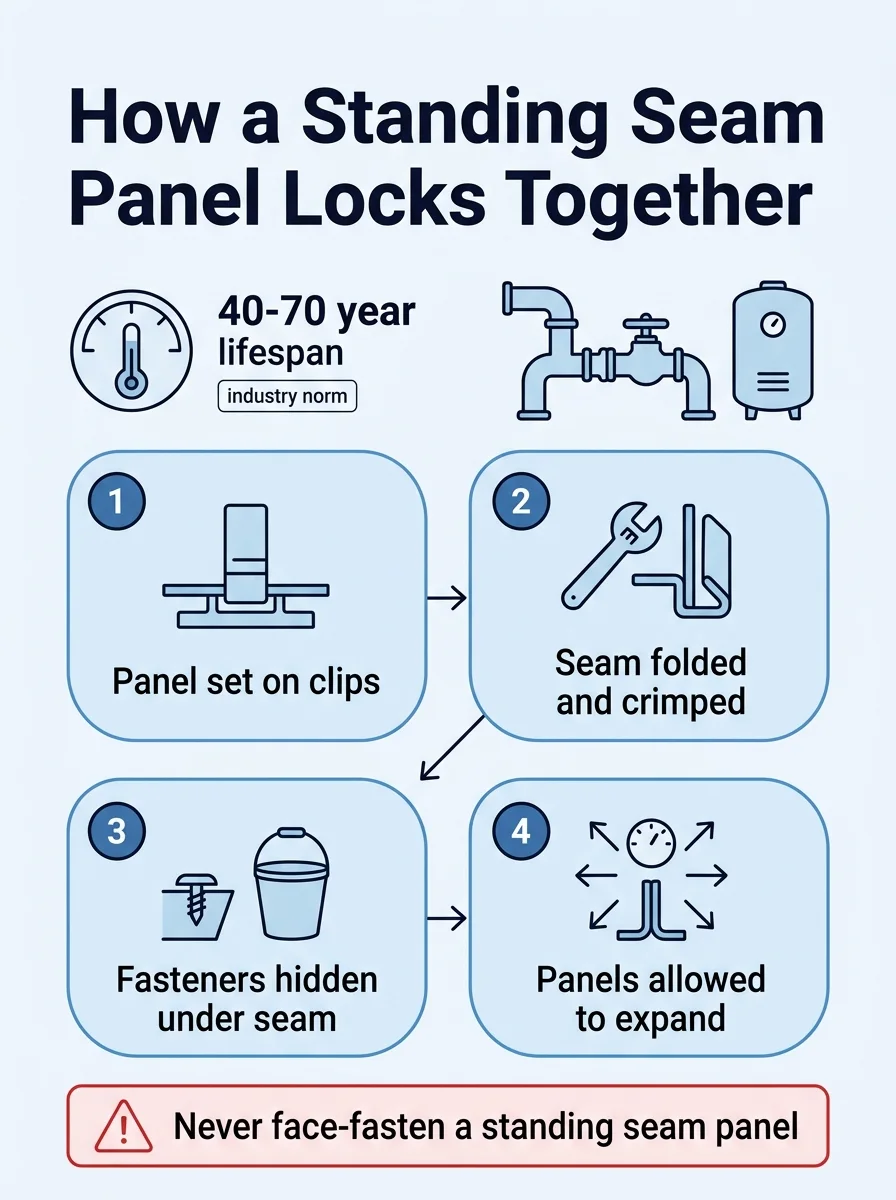
Standing seam panels have raised vertical seams that interlock or get mechanically crimped together, and the fasteners that hold the panel to the roof sit underneath that seam, completely hidden from weather. Because nothing punctures the flat part of the panel, there's no exposed screw head for water to work its way around over the years.
The panels are also engineered to float on clips rather than being pinned rigidly to the deck, which lets the metal expand and contract with temperature swings without buckling or popping fasteners loose. That's a real advantage in Georgia, where a roof can sit in blazing July sun and then cool fast during an evening storm.
Screw-Down (Exposed Fastener): Lower Upfront Cost, More Upkeep
Screw-down panels are attached with exposed screws driven straight through the flat part of the panel into the decking or framing below, usually with a rubber washer under each screw head to seal the hole. It's a simpler installation, which is part of why this style costs less upfront than standing seam.
The tradeoff is that those washers degrade with age and sun exposure, and once they do, each screw hole is a potential leak point. A screw-down roof isn't a bad choice, it's common on barns, outbuildings, and some lower-slope porch roofs, but a homeowner who chooses it should expect to have the fasteners checked and occasionally re-torqued or replaced over the roof's life.
| Factor | Standing Seam | Screw-Down |
|---|---|---|
| Fasteners | Hidden under the seam | Exposed through the panel face |
| Long-term upkeep | Minimal, panels float on clips | Washers and screws need periodic checks |
| Typical upfront cost | Higher | Lower |
| Common use | Full home roofs, visible elevations | Outbuildings, porches, budget projects |
What's Actually Under a Metal Roof
A metal roof on a house is a layered system, not just panels nailed to rafters. Underneath the metal sits a solid roof deck (usually plywood or OSB), then a high-temperature underlayment made to handle the heat a metal surface can build up in direct sun, then the panels themselves attached with clips or fasteners depending on the style.
Flashing at valleys, chimneys, and roof-to-wall transitions does most of the actual water management, since that's where two roof planes meet and water wants to find a way in. A metal roof is only as good as its flashing details, which is part of why installation quality matters as much as the panel choice itself.
Step-by-Step: How a Metal Roof Goes On
A metal reroof follows a similar sequence to a roof replacement and installation project, with a few extra steps specific to the material.
- Tear off old roofing: The existing shingles or old roofing material come off down to the deck so the crew can check the wood underneath for rot or soft spots.
- Repair the deck: Any damaged decking gets replaced before anything new goes down, since metal needs a solid, flat surface to lay correctly.
- Install high-temp underlayment: A synthetic, heat-rated underlayment goes over the deck to protect against moisture and handle the surface temperature metal roofs can reach.
- Set panels and clips: Panels are run and locked into place, either with hidden clips for standing seam or fasteners for screw-down.
- Flash penetrations and edges: Vents, chimneys, valleys, and roof edges get custom-formed flashing to keep water moving off the roof instead of into it.
- Final inspection and cleanup: The crew walks the finished roof, checks seams and fasteners, and clears debris and old material from the property.
How a Metal Roof Holds Up Over Time
Wind, Hail, and Heavy Rain
Metal panels are rigid and interlocked (or securely fastened in the case of screw-down), which generally makes them more wind-resistant than individual shingles that can lift at the edges. Heavy rain sheds fast off the smooth panel surface rather than working under tabs the way it can on an aging shingle roof.
Hail is a different story depending on the metal's gauge. Thicker panels resist denting better than thin ones, and denting is cosmetic in most cases rather than a leak risk, since the panel's protective coating is what actually keeps water out. If hail is a regular concern for a property, it's worth asking about panel gauge specifically rather than assuming all metal roofing performs the same.
Noise, Heat, and Everyday Living
The noise concern homeowners bring up most is rain on a metal roof, and in a typical residential installation with solid decking and underlayment, it's much quieter than people expect. The myth comes from open pole barns and carports where panels sit over bare framing with nothing to absorb sound.
On heat, metal reflects more solar radiation than dark asphalt shingles, which can ease the load on attic insulation and cooling systems during a Georgia summer. Over the decades, metal roofing also resists the curling, granule loss, and UV breakdown that eventually retire an asphalt roof, which is a big part of why it's commonly rated for a much longer service life industry-wide.
What a Homeowner Can Check vs. What Needs a Pro
A homeowner can reasonably do a visual check from the ground after a storm, looking for panels that look lifted, dented in a way that seems severe, or flashing that's visibly pulled away from a wall or chimney. Keeping gutters clear so water actually leaves the roof system, rather than backing up at the eave, is also well within a homeowner's reach.
Anything involving getting on the roof itself, re-sealing a fastener, or replacing a section of panel should go to a licensed roofer. Metal roofing has its own fastening patterns, flashing geometry, and expansion requirements, and a well-meaning patch job by someone unfamiliar with the system often creates a new leak path instead of closing one.
This is also where getting an honest answer matters. A straightforward repair, like resealing a few fasteners on a screw-down roof, is a different job and a different price range than a full reroof, and a good contractor will tell you which one you actually need rather than defaulting to the bigger job.
Choosing the Right Metal Roof for Your Home
There's no single right answer between standing seam and screw-down. A standing seam roof makes sense on a home where the roof is highly visible, where the owner wants the lowest possible long-term maintenance, or where the roof's slope and shape suit the panel style well. A screw-down panel can be a reasonable, lower-cost option for a porch roof, detached garage, or outbuilding where upkeep is less of a concern.
Before deciding, it's worth looking at your home's pitch, how long you plan to stay in the house, and what the roof's current condition actually is, since a roof already past the point of simple repair changes the calculus. Homeowners in Newnan and throughout the surrounding towns who want a second opinion on whether metal makes sense for their house can talk it through with Griffintegrity Roof & Remod before deciding.
Frequently asked questions
Is a metal roof worth it in Georgia?
For homeowners planning to stay in a house long-term, many find the tradeoff worthwhile because metal sheds heat, handles wind well, and typically outlasts asphalt shingles by decades. The right call depends on the roof's pitch, your budget, and how long you plan to own the home.
What is the difference between standing seam and screw-down metal roofing?
Standing seam panels interlock with hidden fasteners and no exposed screws, while screw-down (exposed-fastener) panels are attached with visible screws through the panel face. Standing seam costs more upfront but needs far less long-term fastener maintenance.
Is a metal roof noisy in the rain?
Not usually, as long as it's installed over solid decking and underlayment like a typical residential metal roof, since those layers absorb most of the sound. Exposed panels over open framing with no decking are the setup that actually sounds loud.
Does a metal roof attract lightning?
No, metal roofing does not attract lightning any more than other roofing materials, and if a strike does occur, metal is noncombustible and conducts the charge safely to the ground rather than igniting. This is a common myth, not an engineering concern.
Can you put a metal roof over existing shingles?
It's sometimes possible depending on the local code and the condition of the existing roof deck, but most roofers recommend a full tear-off so the deck can be inspected and the new roof installed on a clean, solid surface. A tear-off also avoids trapping moisture between layers.