
Why the Adjuster Appointment Matters So Much
In Coweta County and across the south side of metro Atlanta, wind and hail events roll through often enough that most homeowners will deal with an insurance claim on their roof at some point. The adjuster appointment is the single appointment that shapes everything after it. Whatever the adjuster documents that day becomes the basis for what the insurance company agrees to pay, so a rushed or incomplete inspection can mean real damage gets left off the estimate entirely.
Homeowners often assume the adjuster works for them the same way their own roofer does. The adjuster actually works for the insurance company, and their job is to assess the claim accurately according to the policy, not to advocate for the largest possible payout. That's not a knock on adjusters, most are trying to do a fair job, but it's exactly why having someone on your side who knows roofing inspect the property alongside them levels the playing field.
What Actually Happens During the Inspection
The adjuster's visit usually runs anywhere from twenty minutes to over an hour depending on the size of the property and the extent of damage. They'll walk the roof, check gutters, fascia, and any siding or window damage, and document everything with photos and measurements. Understanding the two main things they're looking for helps you know what to point out if it gets missed.
The Test Square Method
Most adjusters use a test square, a marked section of roof, often around 10 feet by 10 feet, to count hail hits or wind damage in a representative area rather than walking every inch. The number of impacts found in that square gets extrapolated to estimate total damage across the roof. Where that square gets placed can swing the outcome significantly, since roof slopes facing the direction a storm came from typically show more damage than sheltered slopes.
This is one of the clearest reasons to have a roofer present. A roofer who has walked hundreds of storm-damaged roofs knows which slopes tend to take the worst hits and can make sure the test square gets placed somewhere that actually reflects the damage, not just the easiest spot to reach from the ladder.
Documentation and Photos
Beyond the test square, the adjuster photographs soft metal components like vent boots, flashing, and gutters, since these often show hail impact more clearly than shingles and help confirm that damage is recent and storm-related rather than general wear. They'll also note any interior damage you've reported, like water stains or active leaks.
Your own photos matter here too. If you documented damage right after the storm, dated photos of debris, fallen branches, or visible roof damage from the ground help corroborate the timeline and support the claim being tied to a specific event rather than gradual deterioration.
| Scenario | Roofer Present | Homeowner Alone |
|---|---|---|
| Test square placement | Positioned on the worst-hit slope | Often placed wherever is easiest to access |
| Hidden damage (flashing, vents) | Checked and pointed out | Easy to miss without roofing experience |
| Scope disagreement | Can request supplement with documentation | May accept the first number given |
| Report accuracy | Cross-checked against roofer's own notes | Relies entirely on adjuster's assessment |
What Your Roofer Actually Does on the Roof That Day
A roofer attending the adjuster meeting isn't there to argue or pressure anyone, their job is to make sure nothing gets overlooked. That typically means walking the roof ahead of or alongside the adjuster, pointing out damage on multiple slopes, and comparing notes on what each of you found. If the roofer already inspected the property and documented damage beforehand, that report gives the adjuster a second reference point.
A roofer who is a certified insurance specialist also understands claim terminology and how estimates are built, line by line, so if something looks off in the final scope, they can explain specifically what's missing rather than just saying the number feels low. That kind of clarity is the difference between an insurance claim that moves smoothly and one that drags on for months.
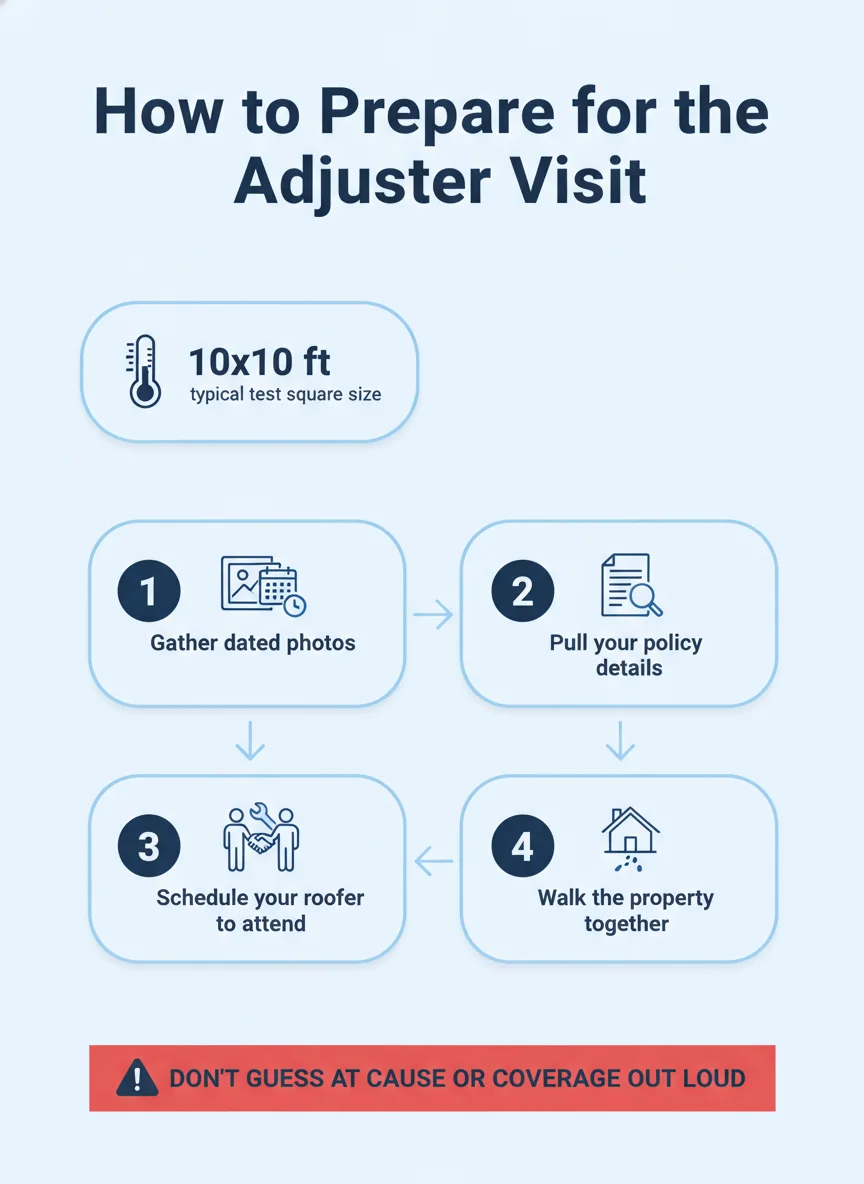
Step-by-Step: Preparing for the Adjuster Visit
A little preparation before the appointment keeps the visit efficient and reduces the chance anything important gets missed.
- Document damage early: Take dated photos of roof damage, debris, and any other property damage as soon as it's safe to do so after the storm.
- Pull your policy: Have your policy number and coverage details on hand so you can answer the adjuster's questions quickly.
- Schedule your roofer: Arrange for your roofer to be on site at the same time as the adjuster, not before or after.
- Note the storm date: Confirm the exact date of the storm or event so it matches what you report to the insurance company.
- Walk the property together: Let your roofer and the adjuster walk the roof and exterior together, comparing findings slope by slope.
- Ask questions on site: If something is unclear about what's covered or how it was measured, ask before the adjuster leaves rather than after.
- Get the estimate in writing: Request a copy of the adjuster's scope and compare it against your roofer's own written estimate.
Reading the Result: When the Numbers Match and When They Don't
When Estimates Line Up
When the adjuster's scope and your roofer's estimate are close, the claim usually moves quickly from there. Your roofer can confirm the materials and scope of work match what's needed to properly replace the roof, and you move into scheduling once the insurance payment is settled.
Even in a smooth case, it's worth having your roofer review the final paperwork, since insurance scopes sometimes leave out secondary items like flashing, fascia, or gutters that were damaged alongside the main roof surface.
When Estimates Diverge
If the numbers are far apart, that's usually a sign the test square missed the worst damage, or that certain components weren't fully accounted for. In most cases, there's a process for submitting supplemental photos or documentation and requesting the insurer take another look. This isn't unusual and doesn't mean anyone did anything wrong, it just means more information needs to go on record.
A roofer experienced with claims can put together that supplemental documentation clearly, pointing to specific slopes, components, or photos that support the larger scope, which tends to move the conversation along faster than a homeowner going back and forth with the insurer alone.
What You Can Handle Yourself vs. What Needs a Pro
Homeowners can absolutely handle the early steps themselves: taking photos right after a storm, noting the date, and pulling together policy information before calling anyone. None of that requires climbing on the roof or any special expertise, just a phone and a few minutes.
Getting on the roof itself is a different matter. Walking a sloped roof safely, especially one with potential hail or wind damage, isn't something most homeowners should attempt, and a misstep can turn a roof claim into a liability issue. That part belongs to a licensed roofer who has the equipment and experience to do it safely and knows what they're looking at once they're up there.
The claim negotiation itself is also better handled with a roofer involved, simply because interpreting adjuster scopes and knowing what a proper repair or replacement actually requires takes familiarity most homeowners only gain by going through this once or twice, while a roofer does it regularly.
Heading Into the Appointment
The adjuster appointment doesn't have to feel like a gamble. Homeowners who document damage early, understand what a test square is, and bring a roofer along tend to come out of the process with a more accurate, more complete claim, and a lot less back and forth afterward.
If a storm has left you staring at your roof wondering what to do next, Griffintegrity Roof & Remod can walk the property with you before the adjuster ever shows up.
Frequently asked questions
Should my roofer be there when the insurance adjuster inspects?
Yes, having your roofer on site with the adjuster is one of the biggest factors in how thorough and accurate the inspection turns out. A roofer who does this regularly knows what the adjuster is measuring and can point out damage that's easy to miss from the ground or a quick walk of the roof.
What is a test square and why does the adjuster use one?
A test square is a marked-off section of roof, commonly around 10 feet by 10 feet, that the adjuster uses to count damage in a representative area rather than inspecting every square foot. The count in that square gets used to estimate damage across the whole roof, so where the square gets placed matters.
What should I have ready before the adjuster arrives?
Have your policy information, the date of the storm or event, and any photos you've taken of damage both on the roof and around the property, including fencing, siding, or vehicles. Dated photos help establish when damage occurred, which supports your claim.
What if my roofer's estimate doesn't match the adjuster's?
It's common for an initial adjuster estimate to differ from a roofer's estimate, and in most cases there's a process to submit supplemental documentation or request a second look. A straightforward roofer will walk you through exactly where the estimates diverge and why before anything gets signed.
Do I need to be home for the adjuster appointment?
You don't always have to be present, but it's strongly recommended, especially if your roofer is attending in your place or alongside you. Having an extra set of eyes representing your interests, rather than leaving the adjuster to inspect alone, tends to produce a more complete report.