
A Denial Letter Isn't the Final Word
Across Coweta County and the south side of metro Atlanta, plenty of homeowners open a claim after wind or hail and get back a letter that says denied, or a check that doesn't come close to what repairs actually cost. It feels final because it's printed on insurance company letterhead, but a denial or a low payout is really just one adjuster's assessment on one day, and assessments can be challenged.
What matters right now is understanding why the claim came back the way it did, because the reason listed on the paperwork determines which path forward actually works. Reopening a denied claim with the wrong argument wastes time, so the first move is always reading the denial reason carefully before doing anything else.
Why Do Insurers Deny or Underpay Roof Claims?
Most denials and underpayments trace back to a handful of recurring reasons: the damage gets labeled wear and tear instead of storm-caused, it gets called cosmetic rather than functional, the adjuster's scope missed slopes or sections of the roof, or the insurer points to old damage that predates the storm event being claimed. Each of these has a different fix.
Wear and Tear vs. Storm Damage
Insurance policies cover sudden damage from a specific event, not the slow deterioration that happens to every roof over the years. An adjuster who sees granule loss, curling, or soft spots may attribute them to age rather than the storm, even if the storm is what actually caused or accelerated the failure.
The counter to this is documentation that ties the damage to a specific date, like bruising patterns consistent with hail size and direction, or fresh creases in metal consistent with recent high wind. A contractor who inspects regularly can often point to the difference between a roof that's simply old and one that took a clear hit.
Missed Slopes and Old Damage
A common underpayment pattern is an adjuster who inspects the front-facing slope thoroughly but gives a quick glance to the back or side slopes, missing damage that a full walk of the roof would catch. If your contractor's inspection turns up damage the insurer's scope doesn't mention at all, that's a straightforward gap to raise.
Insurers will also sometimes point to damage they believe existed before the claimed event, especially on older roofs. This is harder to argue around without documentation, which is part of why keeping photos or records of a roof's condition over time is useful even before a storm happens.
| Outcome | What It Usually Means | Your Next Move |
|---|---|---|
| Full denial | Insurer says no covered damage exists, or calls it wear and tear | Request the adjuster's report and get a second inspection |
| Partial denial | Some damage approved, other areas or slopes excluded | Compare scopes line by line and file a supplement for what's missing |
| Underpaid approval | Damage is approved but the dollar value is too low | Submit a supplement or invoke the appraisal clause if values still disagree |
The Paperwork That Actually Drives the Outcome
Every claim dispute comes down to comparing documents: the adjuster's written report and scope of damage against your own contractor's inspection and estimate. The adjuster's report should list what was examined, what was found, and the dollar value assigned to each repair item. If that report is vague or incomplete, that's your opening.
A supplement is a formal request to add items the original scope missed, submitted with photos and a cost breakdown. The appraisal clause, found in most homeowners policies, is a separate process both sides can invoke when they agree damage happened but can't agree on value, and it involves each side naming an independent appraiser to settle the number.
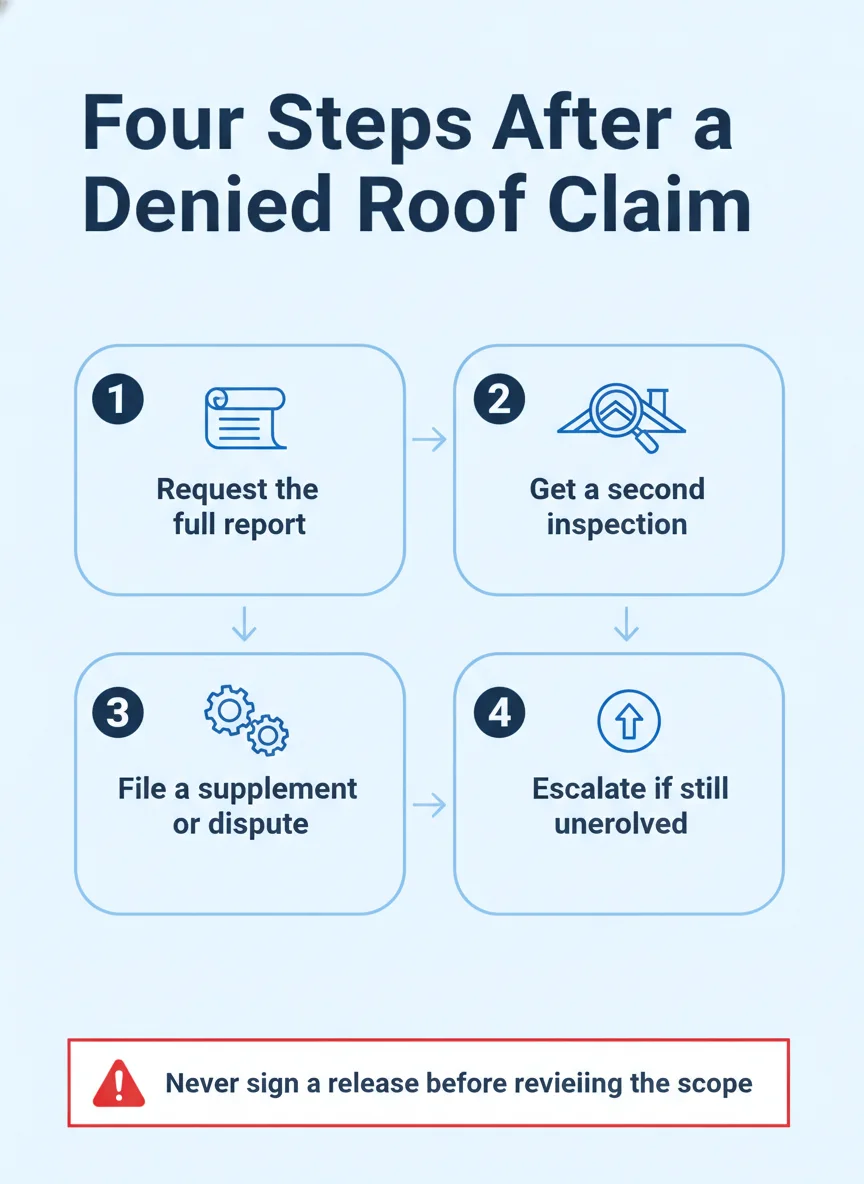
Step-by-Step: What to Do After a Denial or Low Payout
Work through these in order. Most disputes resolve in the first two or three steps without needing to escalate further.
- Read the denial reason: Get the specific reason in writing, not just the word 'denied.' Everything after this depends on knowing exactly what the insurer's position is.
- Request the full report: Ask your insurer for the complete adjuster report and photos, not just the settlement letter. Compare it against what's actually on your roof.
- Get a second inspection: Have a licensed contractor walk the roof and document every slope. Significant gaps between their findings and the insurer's scope are your strongest evidence.
- File a supplement: Submit the missing items with photos and a written estimate. This is the most common and often fastest way to correct an underpayment.
- Request appraisal if values still disagree: If both sides agree damage exists but can't agree on cost, invoking the appraisal clause in your policy brings in independent appraisers to settle it.
- Consider a public adjuster: For larger or more contested claims, a public adjuster works on your behalf to negotiate scope and value directly with the insurer.
- File a state complaint if needed: If you believe the claim was handled unfairly or in bad faith, your state's insurance department has a formal complaint process as a last resort.
What Does a Lowball Payout Actually Look Like?
Underpayments rarely show up as a single obvious number. They're usually buried in the details of the scope, which is why a side-by-side comparison with a contractor's estimate matters more than the bottom-line total.
Partial Denials on Mixed Damage
A claim that covers storm damage to the roof deck and shingles but denies related damage to siding, fascia, or gutters from the same event is a common partial denial pattern. If the same storm caused all of it, that connection needs to be documented and submitted together rather than treated as separate claims.
Our storm and hail damage repair team documents the full scope of storm-related damage across the roof, siding, and gutters during an inspection, since insurers are more likely to approve related items when the connection is clear in the paperwork from the start.
Depreciation and Recoverable Holdbacks
Many policies pay actual cash value first and hold back a depreciation amount until repairs are completed, releasing the rest afterward. If your first check looks low, check whether it's a full settlement or just the first of two payments, since that distinction alone explains a lot of confusion.
Recoverable depreciation only gets released once the work is done and the final invoice is submitted, so keeping that paperwork organized matters as much as the repair itself.
What a Contractor Can Do, and What They Can't
A licensed roofing contractor can inspect your property, document damage with photos and measurements, meet an adjuster on site to walk the roof together, and write a detailed estimate that supports a supplement request. This is often enough to move a denial or close a scope gap without further escalation.
What a contractor cannot do is act as your legal representative in a dispute, negotiate your policy's coverage terms, or guarantee a specific settlement outcome. Those limits are exactly why the appraisal clause and public adjusters exist as separate options when a dispute goes beyond documentation.
What a good contractor should always do is give you a straight read on whether the damage looks storm-related or not before encouraging you to pursue a claim at all, since pushing a claim that isn't likely covered wastes your time and can affect future premiums for no benefit.
Getting a Fair Outcome in Coweta County
Denials and underpayments are frustrating, but they're a normal part of the claims process rather than a sign that nothing can be done. Homeowners in Newnan and the surrounding towns who push back with documentation and a second opinion regularly see denials reversed and supplements approved.
If you're not sure where your claim stands or what the adjuster's report actually means, reading up on the roof insurance claim timeline in Georgia can help you see where things went sideways. Griffintegrity Roof & Remod Inc can walk your roof, compare it against your insurer's scope, and tell you plainly whether the numbers add up.
Frequently asked questions
Why do insurance companies deny roof claims?
Insurers most often deny roof claims by classifying the damage as wear and tear, pre-existing, or cosmetic rather than storm-caused. A denial letter should state the specific reason, which tells you exactly what needs to be challenged or documented differently.
What does it mean if my roof claim was underpaid?
An underpaid claim usually means the adjuster's scope missed slopes, left out related damage like siding or gutters, or applied depreciation you believe doesn't apply. A line-item comparison between your contractor's estimate and the insurer's scope usually shows exactly where the gap is.
Can I get a second inspection after a roof claim denial?
Yes, most policies allow you to request a re-inspection, and a licensed contractor can meet the adjuster on site to walk the damage together. This is one of the most effective ways to get an initial denial reconsidered.
What is the appraisal clause in a homeowners policy?
The appraisal clause is a dispute-resolution process built into most homeowners policies that lets you and your insurer each hire an independent appraiser to agree on the value of the damage. It's typically used when both sides agree damage exists but disagree on the dollar amount.
Should I hire a public adjuster for a denied roof claim?
A public adjuster can be worth considering on larger or more complicated disputes, since they work for you rather than the insurance company and can negotiate scope and value on your behalf. For straightforward denials, a re-inspection with your contractor often resolves things without that added layer.