
Why nail length matters more than most homeowners realize
Nail length sounds like a detail that only a crew foreman should care about, but it's one of the biggest reasons a shingle roof holds up for decades or starts failing within a few years. The nail is the only thing physically connecting a shingle to the deck below it. If it's too short, it never bites into solid wood. If it's too long, it can blow through the underside of the deck and catch on insulation or create a path for moisture. Either way, the shingle above it isn't doing its job the way it was designed to.
For homeowners across Coweta County and the south side of metro Atlanta, this question usually comes up during a quote or after a windstorm pulls up a row of shingles that look fine otherwise. Understanding what drives nail length helps you ask better questions of any roofing contractor and spot a rushed job before it becomes a leak.
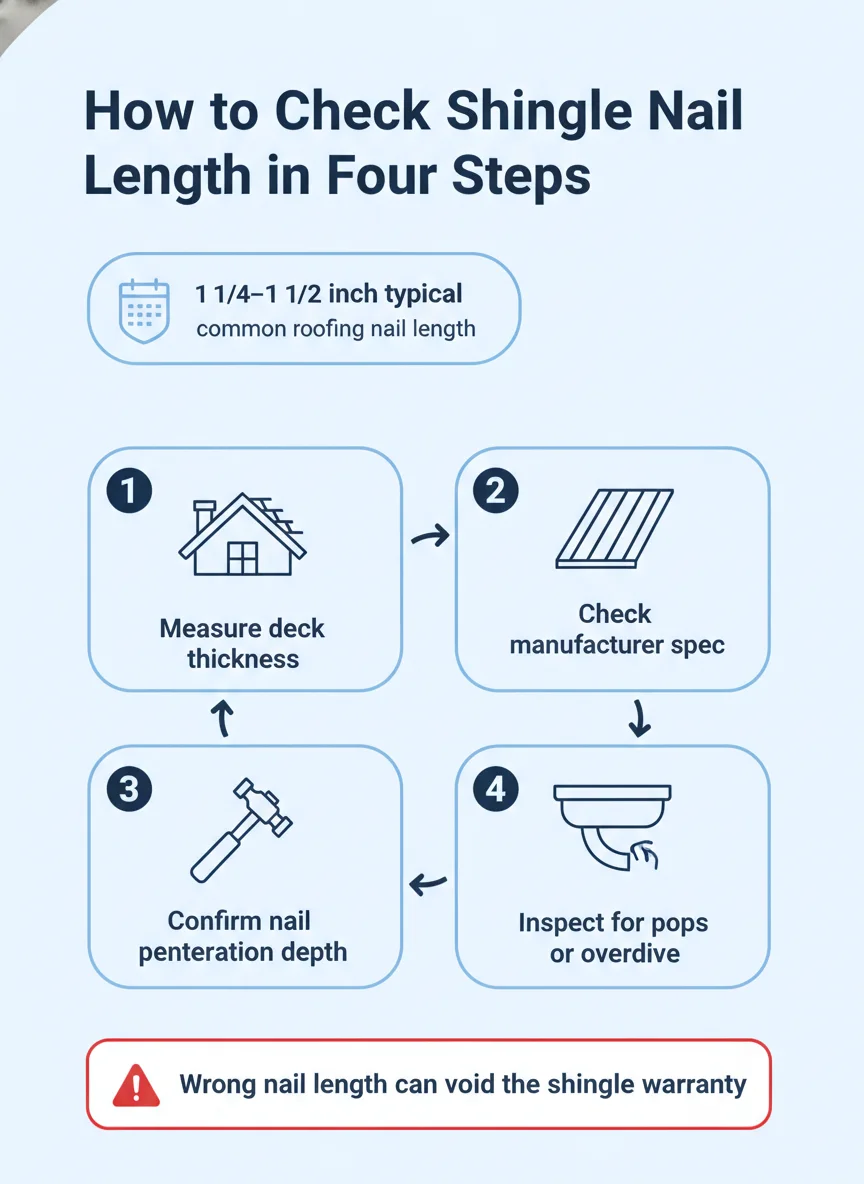
What actually determines the right nail length
Nail length isn't a single fixed number. It depends on how thick the roof deck is, how many layers of shingles are already on the roof, and what the shingle manufacturer specifies for that particular product. Get any one of those wrong and the fastening fails even if the nail itself is driven straight and at the right pressure.
Deck thickness and layer count
Most residential roof decks use plywood or OSB sheathing in a standard thickness range, and the nail needs to penetrate through the shingle, through any underlayment, and at least three-quarters of an inch into solid wood to hold properly. On a single-layer tear-off and replace, that's a straightforward calculation. On a roof-over where a new layer goes on top of an old one, the nail has to be long enough to clear both layers and still get full penetration, which is one more reason most roofers recommend a full tear-off before a new roof installation rather than stacking layers.
Thinner decking, common on older homes or additions built to minimum code at the time, narrows the margin for error even further. A nail sized for a thicker deck can blow through on a thinner one, and a nail sized correctly for the thinner deck may not be long enough if a second shingle layer gets added later.
Manufacturer specifications
Shingle manufacturers publish minimum nail specifications for their products, and those specs are what the warranty is actually built around. A shingle installed with the wrong fastener length can void the manufacturer's material warranty even if every other part of the installation is correct, because the manufacturer can't guarantee wind resistance or sealing performance outside their tested fastening pattern.
This is part of why working with a contractor enrolled in a manufacturer's preferred network matters. That status typically requires passing a workmanship inspection, which includes checking that crews are using the fastener length and pattern the manufacturer actually specifies, not just whatever is already loaded in the nail gun.
| Deck situation | Typical nail length range | What to watch for |
|---|---|---|
| Single-layer tear-off, standard deck | 1 1/4 inch | Full penetration into solid wood, not just the sheathing surface |
| Roof-over, second layer added | 1 1/2 inch or longer | Enough length to clear both layers and still seat in the deck |
| Thin or older deck | Depends on deck thickness | Risk of nails poking through underside of deck |
| Metal panel roofing | Longer fasteners with sealing washers | Different fastener type entirely, not a standard roofing nail |
The fastener itself: what a roofing nail is built to do
A roofing nail isn't the same thing as a framing nail or a general construction fastener. It has a wide, flat head designed to hold the shingle tab flush without tearing through the asphalt mat, and it's typically galvanized so it resists rust over the life of the roof. The shank is often ring-shanked or screw-shanked on higher-wind installs, which gives it more pull-out resistance than a smooth shank.
The head diameter matters almost as much as the length. A nail with too small a head can pull through the shingle during a wind event, which looks identical from the ground to a shingle that simply blew off, but the underlying cause is a fastener problem, not a wind problem. This is one reason an inspection after storm or wind damage often turns up fastening issues that predate the storm itself.
Step-by-step: how a roofer sizes and checks nail length on a real job
On a properly run job, nail length isn't guessed on the fly. It's confirmed before the first shingle goes down and spot-checked as the job progresses.
- Measure deck thickness: The crew confirms sheathing thickness and whether any old layers remain before ordering material, since this sets the minimum nail length needed.
- Check manufacturer specs: The shingle product's published fastening instructions are pulled to confirm both nail length and head diameter requirements for that specific line.
- Load the right fastener: Nail guns are set up with the correct length for that job rather than reused from the last roof, since deck conditions vary house to house.
- Set nail placement: Nails go into the manufacturer's specified nailing zone on each shingle, usually just below the self-sealing strip, not above it or too close to the edge.
- Spot-check penetration: A few nails are pulled or probed during the job to confirm they're seating fully into solid deck material rather than just catching the surface.
- Final walk and cleanup: The finished roof gets a visual pass for nail pops, missed strikes, or exposed heads before the crew calls the job done.
What goes wrong when nail length is off, and how to spot it
Nails too short
A nail that doesn't reach solid deck material will back out over time as the roof expands and contracts with temperature changes. You'll often see this as a small raised bump under a shingle, sometimes called a nail pop, or as a shingle tab that lifts in wind even though the roof is relatively new. On older roofs it can show up as a trail of small leaks that seem to move around after rain, because the water is finding the path of least resistance around a loose fastener rather than coming straight through one spot.
If you're seeing granules collecting at downspouts or small raised dots across sections of the roof, it's worth having someone look at the nailing pattern specifically, not just the shingles themselves.
Nails too long or overdriven
A nail that's too long, or one that's driven with too much pressure, can punch through the underside of the deck. From the attic this sometimes looks like small sharp points poking through the sheathing. It's rarely a leak risk by itself, but it can snag insulation, create a path for pests, and on occasion rust and drip condensation back down during humid weather.
Overdriven nails, where the head cuts into the shingle mat, are a more common problem than overlong ones. A nail gun set too hard can crush the shingle around the nail head, which breaks the seal and gives wind a place to start lifting the tab, even if the length itself was correct.
DIY checks vs. calling a roofer
A homeowner can do a limited visual check from the ground or a ladder: look for raised bumps in a grid pattern across the shingles, granule loss concentrated in lines rather than spread evenly, or shingle tabs that lift in wind along the same section every time. These are signs worth flagging, but they're not something to climb up and fix yourself.
Confirming actual nail length and penetration requires pulling back shingles or getting into the attic to check from underneath, both of which carry real risk of causing new damage if done without the right tools and experience. It also requires knowing what the specific shingle manufacturer's fastening spec actually calls for, which varies by product line.
This is squarely a licensed roofer's job, not a weekend project. A proper roof repair visit should include checking the fastening pattern in the affected area, not just replacing the shingles that are visibly damaged, since a nail problem in one spot is often present in neighboring shingles too.
Getting it right the first time
Nail length is a small detail with an outsized effect on how long a shingle roof actually lasts and whether the manufacturer's warranty holds up if something goes wrong down the road. It's worth asking any contractor quoting your home what fastener length and pattern they plan to use and whether it matches the shingle manufacturer's spec for your deck situation, not just a generic answer. For homes anywhere in Newnan or the surrounding towns, getting the fastening right the first time is a lot cheaper than diagnosing nail pops and lifted tabs a few years later, and it's a detail Griffintegrity Roof & Remod checks on every installation, not just the ones that come with a complaint.
Frequently asked questions
What size nail is used for asphalt shingles?
Most asphalt shingle installs use roofing nails in a range around 1 1/4 to 1 1/2 inches, but the correct length depends on deck thickness and whether there's an existing layer of shingles underneath. A roofer confirms the exact length against the shingle manufacturer's published spec before starting the job.
Can nails that are too short cause a roof leak?
Yes, a nail that doesn't reach solid deck material can back out over time as the roof expands and contracts, which loosens the shingle and lets water find a path underneath. This often shows up as a small raised bump or a lifted shingle tab rather than an obvious puncture.
Does nail length affect my shingle warranty?
It can. Manufacturers publish minimum fastening specifications as part of the product's installation requirements, and using the wrong nail length or pattern can affect warranty coverage even if every other part of the install looks correct.
How many nails go into each shingle?
Standard asphalt shingles typically use four to six nails per shingle depending on the manufacturer's spec and the local wind exposure, with additional nails often required in higher-wind areas or steeper roof pitches. The pattern and placement matter as much as the count.
How can I tell if my roof has a nailing problem?
Look for small raised bumps arranged in a grid pattern across the shingles, shingle tabs that lift in wind in the same spot repeatedly, or granule loss concentrated in lines rather than spread evenly across the roof. Any of these is worth a professional look rather than a guess from the ground.