
Why Gutters Matter More Than They Get Credit For
A gutter system looks simple from the ground, just a trough and a few downspouts, but it's doing one specific job every time it rains: moving a large volume of water off the roof edge and away from the house before it can get into the walls, the foundation, or the crawlspace. Across Coweta County and the towns around metro Atlanta, homes see a real mix of heavy spring downpours and slow winter rain, and both put that system to work. When gutters are doing their job, nobody thinks about them. When they fail, the signs show up somewhere else first, a stained soffit, a damp basement wall, or mulch washed out along the foundation.
The trouble is that gutter failure is gradual and mostly invisible from the driveway. A hanger pulls loose an inch at a time. A seam opens a hairline crack that only leaks during a hard rain. By the time you can see a problem standing on the ground, water has usually already been finding its way somewhere it shouldn't for a while. That's why a twice-a-year check, not just a glance after a big storm, catches issues while they're still small and cheap to fix.
What Actually Causes Gutters to Fail?
Gutter failure almost always comes down to one of a few mechanical issues: the system loses its pitch, the hangers give out, a seam opens up, or a downspout gets blocked. Each of these has a different cause and a different fix, which is why a real inspection looks at more than just whether there are leaves in the trough.
Pitch and Hangers
Gutters are installed with a slight slope so water runs toward the downspout instead of sitting still. Over years of expansion, contraction, and the weight of wet leaves, that pitch can shift, and sections start holding standing water instead of draining it. Standing water adds weight, which stresses the hangers holding the gutter to the fascia board.
Hangers are the metal brackets that do the actual holding, and they're usually the first thing to fail. Spikes can back out of a softened fascia board, and the lighter hanger styles used on older installs can simply bend under sustained weight. Once a hanger or two lets go, the whole section sags, which makes the pitch problem worse and speeds up the next failure.
Seams, Downspouts, and Debris
Seamless gutters cut down on leak points dramatically, but any system still has seams at the corners and at the downspout connections, and sealant at those joints does wear out over time. A slow drip at a corner seam is easy to miss until it stains the fascia or soffit below it.
Downspouts fail a different way, usually by clogging rather than leaking. Leaves and grit settle at the elbow joints, and once a downspout is blocked, water backs up the entire run, overflows the trough, and pours down right next to the foundation exactly where you don't want it. A clogged downspout can look like a gutter problem when it's really just a blockage a few feet down the pipe.
| Failure Point | What You'll Notice | What Usually Fixes It |
|---|---|---|
| Lost pitch | Standing water, mosquitos breeding in the trough | Re-hang and re-pitch the affected run |
| Pulled hangers | Visible sag, gutter pulling away from fascia | Replace hangers, sometimes the fascia board too |
| Open seams | Drip stains on soffit or siding below a joint | Reseal or replace the section |
| Blocked downspout | Overflow at the top even with light rain | Clear the blockage, add a guard if recurring |
What Gutter Guards Actually Do
Gutter guards are covers or mesh inserts designed to keep larger debris, leaves, pine straw, and twigs, out of the trough while still letting water in. They cut down significantly on how often a gutter needs to be physically cleared out by hand, which matters most on homes with heavy tree coverage overhead. They don't make a gutter maintenance-free, and they don't fix an existing pitch or hanger problem underneath them.
The other thing guards don't do is stop fine debris. Seed pods, grit, and shingle granules are small enough to get past most guard styles, and over several seasons that material can build up on top of the guard or settle in the bottom of the trough anyway. A guarded gutter still deserves a look twice a year, it just needs less frequent hands-on clearing in between.
Step-by-Step: The Twice-a-Year Gutter Check
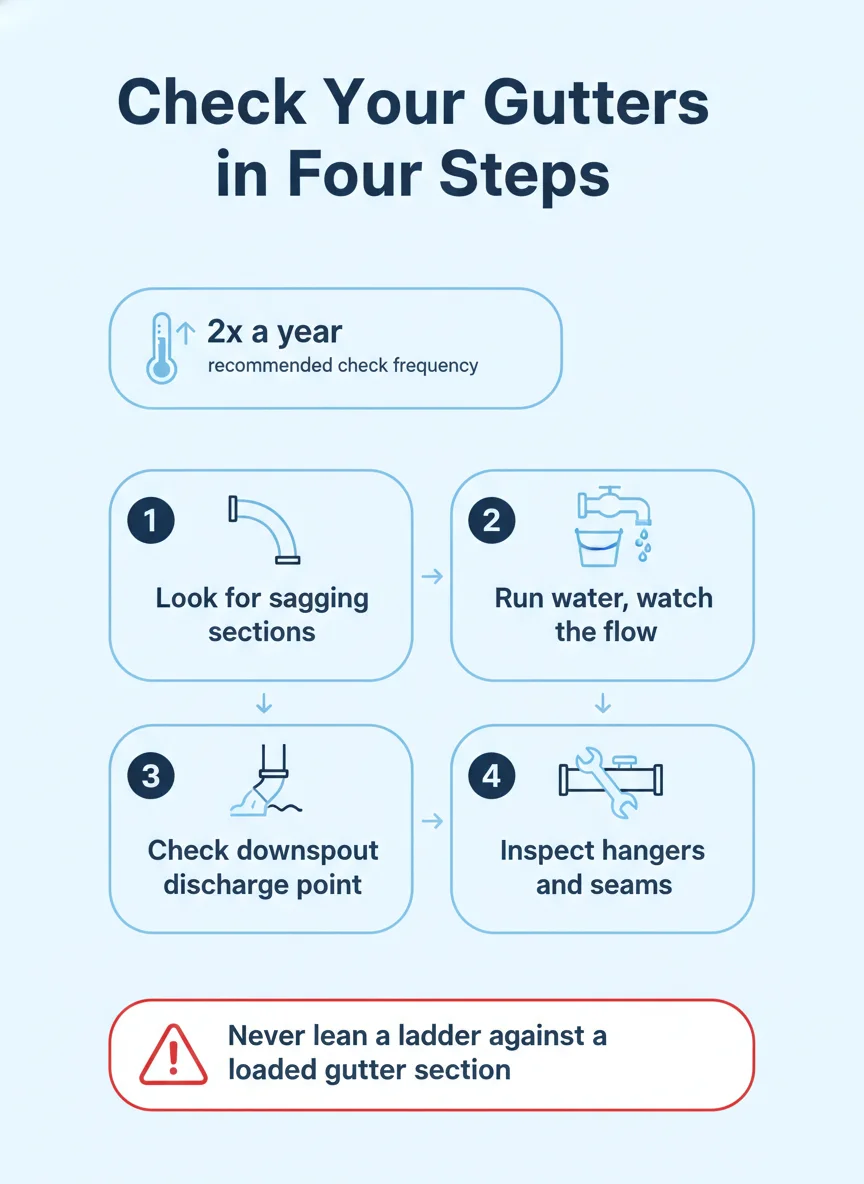
This routine is meant to catch problems early, before they show up as a stain on the siding or a wet spot in the crawlspace. Plan to do it once in spring after pollen and seed drop, and once in fall after the leaves are mostly down.
- Walk the perimeter: Look up at every run from the ground and note any visible sag, separation from the fascia, or standing debris you can see over the edge.
- Check hanger spacing: Look for hangers that have pulled away, bent, or disappeared entirely, especially on longer runs where spacing matters most.
- Run water through it: Use a hose at the high end of each run and watch whether water moves steadily to the downspout or pools anywhere along the way.
- Watch the downspouts: Confirm water exits freely at the bottom and flows away from the foundation rather than pooling right at the base of the house.
- Inspect seams and corners: Look for drip trails or stained wood below any joint, which usually points to a seam that needs resealing.
- Check the fascia board: Press gently on the wood behind the gutter where you can reach it safely, softness or discoloration means moisture has already gotten in.
- Note guard condition: If guards are installed, check for debris sitting on top and confirm water is still making it into the trough underneath.
What the Check Tells You
Signs It's a Simple Fix
A single sagging section, one loose hanger, or a drip at one seam are all localized problems. These are the kind of issues that get resolved by re-securing or resealing the affected area without touching the rest of the system. Catching these early is exactly what the twice-a-year check is for, since they're cheap and quick to address while they're still isolated.
If the fascia board behind a single section feels solid and the rest of the run holds its pitch when you run water through it, you're almost certainly looking at a spot repair rather than anything bigger.
Signs It's Time to Talk Replacement
Widespread sagging across multiple runs, hangers failing in several places, or soft and discolored fascia boards in more than one spot usually mean the system is nearing the end of its service life rather than dealing with an isolated issue. At that point, patching one section just means you'll be back up a ladder fixing the next one within a season or two.
Rust-through on older steel gutters, or seams that keep reopening after resealing, are also signs the material itself is giving out rather than just the installation. That's a good moment to look at a full gutters and metal fabrication replacement instead of continuing to chase individual leaks.
What You Can Check Yourself and What Needs a Pro
The ground-level parts of this routine, watching for sag, running water through a hose, checking where downspouts discharge, are all things a homeowner can reasonably do without climbing anything. If something looks off from the ground, that's useful information even before anyone gets on a ladder.
Getting on a ladder to inspect hangers, seams, and the fascia board up close is a different matter, especially on a two-story home or anywhere the ground isn't level. Working at that height, especially around a loaded or sagging gutter section, carries real fall risk, and a wet or soft fascia board isn't always obvious until you're right up against it.
A full inspection also benefits from eyes that see this exact failure pattern across a lot of different homes every year. What looks like a minor sag to an untrained eye might be the first sign of a fascia board that's already rotting underneath, and catching that difference is where a professional look pays for itself.
Keeping the System Doing Its Job
Gutters are easy to forget about until they stop working, and by then the damage is usually happening somewhere you can't see it from the yard. A simple twice-a-year check, spring and fall, catches sagging, blocked downspouts, and failing seams while they're still cheap, isolated fixes instead of a bigger repair bill down the line.
If your last check turned up sagging runs, pulled hangers, or a system that's clearly past patching, Griffintegrity Roof & Remod installs and repairs gutters and metal fabrication across Coweta County and the towns south of metro Atlanta.
Frequently asked questions
How often should gutters be cleaned?
Most homes in wooded or suburban settings need gutters checked and cleared at least twice a year, typically spring and fall. Homes surrounded by a lot of trees may need it more often, since heavy leaf drop can clog a system within a single season.
Do gutter guards mean I never have to clean my gutters again?
No, guards reduce debris buildup but don't eliminate maintenance entirely. Fine grit, pine needles, and seed pods can still collect on top of or inside most guard systems, so an occasional check is still worth doing.
What causes gutters to pull away from the house?
Pulling away usually comes from failed hangers or fasteners that can no longer support the weight of water and debris. Once a section sags, water pools instead of draining, which adds even more weight and accelerates the problem.
Can bad gutters cause foundation problems?
Yes, when gutters overflow or downspouts dump water right next to the foundation, that water saturates the soil around the house. Over time this can contribute to settling, cracking, or a wet basement or crawlspace.
Should I repair my old gutters or replace the whole system?
It depends on the extent of the damage. A section or two with loose hangers or a bad seam is usually a repair, but widespread sagging, rust, or pulled fasteners across the whole house usually points to full replacement.