
Two Warranties, One Roof
When a homeowner in the Coweta County area gets a new roof, they usually hear the word "warranty" tossed around once and assume it covers everything. In reality, every new roof carries two separate warranties that protect two different things. One comes from the company that manufactured the shingles or metal, and it covers the material itself. The other comes from the roofing contractor, and it covers the labor, meaning how the roof was actually put together.
Understanding which warranty covers which problem matters more than most homeowners realize, especially years down the road when something goes wrong and two different companies are pointing in two different directions. Knowing the split before you sign a contract means you walk into a roof replacement with your eyes open, and you know exactly who to call if an issue shows up five or fifteen years later.
What's the difference between a manufacturer warranty and a workmanship warranty?
A manufacturer warranty covers defects in the product itself, things like shingles that crack prematurely, lose granules at an abnormal rate, or fail to perform as rated under normal conditions. It does not cover a leak caused by a flashing detail that was installed wrong, nails that missed the decking, or ventilation that was never corrected. For that, you need the workmanship warranty, which is the contractor's own promise that the labor was done right.
Material coverage: what the maker is responsible for
Shingle and metal manufacturers test their products for durability under set conditions and stand behind the material for a stated period, sometimes for decades. If a batch of shingles has a genuine manufacturing defect, the maker typically replaces the material, though labor to remove and reinstall is handled differently depending on the specific warranty tier purchased.
This is also where certified contractor programs come into play. Manufacturers often offer an enhanced, longer material warranty exclusively to contractors who've passed their own vetting and installation standards, versus the shorter standard warranty available to any installer. That's one reason it's worth asking which tier of material warranty you're actually getting.
Labor coverage: what the installer is responsible for
A workmanship warranty is the contractor's own commitment that the roof was installed correctly, start to finish. If a leak develops because of a flashing detail, a fastening pattern, or any other installation choice, this is the warranty that applies, and it's the contractor who fixes it, not the shingle maker.
Terms vary a lot from one company to the next. Some contractors offer a year or two, others offer a decade or longer. Ask for the exact term and what it covers in writing before signing anything, since a verbal promise at the kitchen table doesn't hold up when there's a question later.
| Question | Manufacturer warranty | Workmanship warranty |
|---|---|---|
| Who stands behind it | The shingle or metal maker | The roofing contractor |
| What it covers | Material defects, abnormal wear | Installation errors, workmanship issues |
| Typical length | Often decades, sometimes lifetime | Set by the contractor, commonly years to a decade or more |
| What can shrink it | Missed registration, improper ventilation | Varies by contractor, read the fine print |
The parts of your roof each warranty actually reaches
The shingles or metal panels themselves fall under the manufacturer warranty, along with any accessory products from the same maker, like starter strips, ridge cap, and underlayment sold as part of a complete system. Mixing brands or skipping system components is one of the quieter ways homeowners accidentally shrink their own coverage without realizing it.
Everything involving how those materials were put onto your house, the flashing around chimneys and walls, the nailing pattern, the ventilation setup, and the general cleanup and finish, falls under workmanship. A roof can have perfectly good shingles and still leak because of how it was installed, which is exactly why both warranties exist side by side.
Step-by-step: what to confirm before you sign a roofing contract
Before work starts, walk through these points with your contractor so there's no confusion about who covers what if a problem shows up later.
- Ask for both warranties in writing: Get the manufacturer warranty documentation and the contractor's workmanship warranty terms as separate written documents, not a verbal summary.
- Confirm the material tier: Ask whether you're getting the standard manufacturer warranty or an enhanced version tied to a certified installer program.
- Check the registration deadline: Manufacturer warranties often require registration within a set window after installation, so confirm who handles that step.
- Clarify the workmanship term length: Get the exact number of years the contractor stands behind their own labor, since this varies widely company to company.
- Ask about transferability: Find out if either warranty transfers to a new owner if you sell the home, and what the process looks like.
- Keep every document: File the contract, warranty paperwork, and any registration confirmation somewhere you can find it years later.
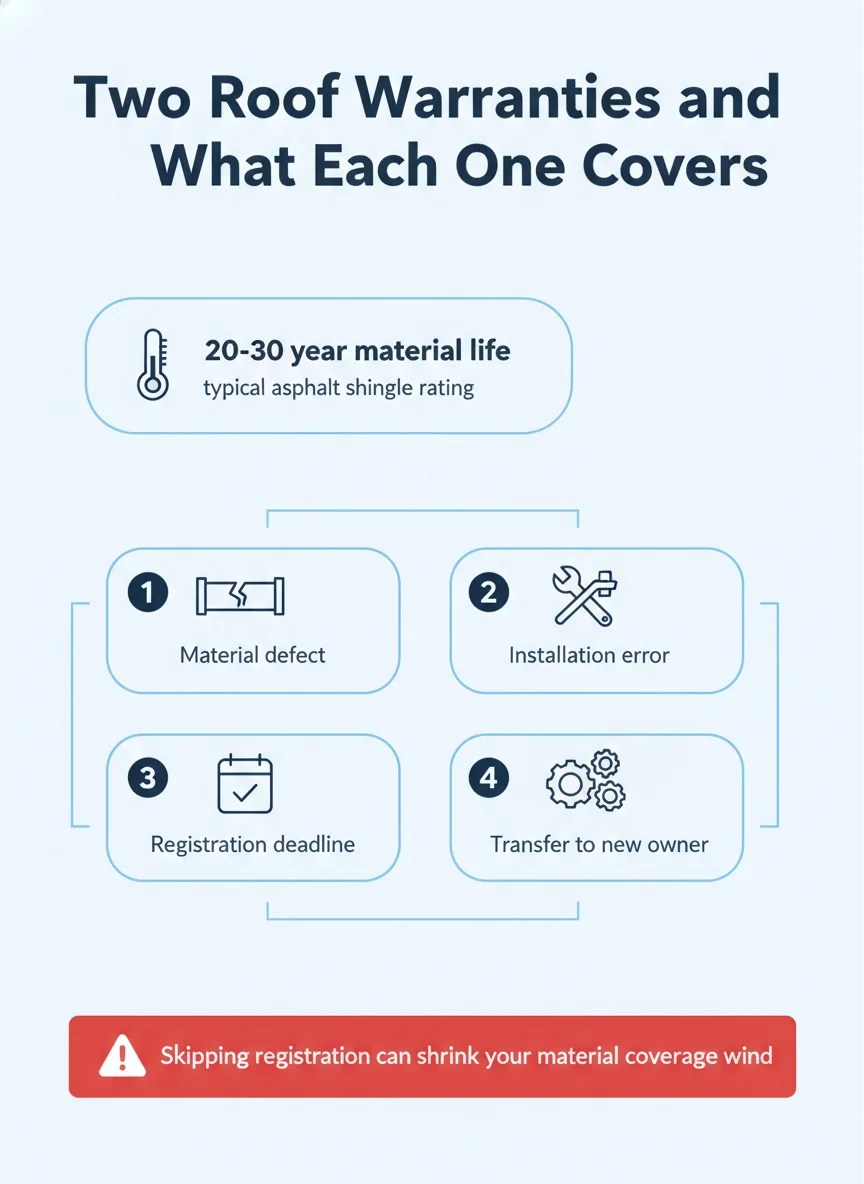
Diagnosing a problem: which warranty applies?
Signs that point to a material issue
Granule loss in patches across multiple shingles, premature cracking that isn't tied to a specific spot, or curling that shows up uniformly across the roof rather than at one seam or edge often points toward a material question rather than an installation one. These patterns tend to show up broadly rather than at a single flashing point or valley.
If you're seeing this kind of widespread wear well before the shingle's expected lifespan, it's worth having your roofer document it and determine whether it looks like a manufacturer defect claim versus normal weathering.
Signs that point to a workmanship issue
A leak at one specific spot, like around a chimney, a skylight, or where two roof planes meet, almost always points to a flashing or installation detail rather than the shingles themselves. Water stains that appear only after wind-driven rain from one direction are another common workmanship clue.
These are the issues a roof repair visit typically resolves quickly, and if the roof is still within its workmanship warranty window, the fix should be covered by whoever installed it in the first place.
DIY vs. calling a pro
There isn't much a homeowner can do to self-diagnose warranty questions beyond basic observation, since telling a material defect apart from an installation issue usually takes someone who's looked at hundreds of roofs. What you can do yourself is keep good records: the original contract, both warranty documents, registration confirmation, and photos from the day the roof was finished.
When a problem does show up, a licensed roofer should be the one inspecting it, documenting what they find, and telling you honestly whether it's a material issue to route to the manufacturer or a labor issue to handle under the workmanship warranty. Climbing up to inspect flashing or ventilation yourself isn't worth the fall risk, and misdiagnosing the cause can delay a legitimate claim.
If you're not sure which bucket your issue falls into, that's a normal question, not a complicated one, and a straightforward inspection should answer it without guesswork.
Get the warranty terms in writing before you need them
The best time to understand your roof's warranty coverage is before the contract is signed, not after a leak shows up. Ask for both documents, confirm the exact terms, and keep them somewhere you'll actually find them years from now.
Homeowners across Coweta County and the towns nearby, including Newnan and Peachtree City, can get straight answers on both material and workmanship coverage from Griffintegrity Roof & Remod before any work begins.
Frequently asked questions
What is the difference between a manufacturer warranty and a workmanship warranty?
A manufacturer warranty covers defects in the shingles or metal panels themselves, things like granule loss or material failure that isn't caused by installation. A workmanship warranty covers the labor, meaning if a leak happens because of how the roof was installed, the contractor who did the work is on the hook to fix it, not the material maker.
Does a roof warranty transfer to a new homeowner?
It depends on the specific warranty terms, and many manufacturer warranties do allow a one-time transfer if you notify them within a set window after the sale. Workmanship warranties vary by contractor, so ask for the transfer terms in writing before you buy or sell a home with a recent roof.
What voids a roof warranty?
Improper attic ventilation, installing a new layer over old shingles instead of a full tear-off, and skipping manufacturer registration are common ways coverage gets reduced or voided. Using an installer who isn't certified by the manufacturer can also limit you to a shorter standard warranty instead of an enhanced one.
How long does a roof warranty usually last?
Material warranties on asphalt shingles commonly run for decades and sometimes for the life of the roof, while workmanship warranties are set by the individual contractor and tend to run anywhere from a few years to a decade or more. Always get the exact term in writing rather than assuming it matches the shingle's rated lifespan.
Who do I call if my roof leaks, the manufacturer or the installer?
Start with your installer, since most leaks trace back to flashing, fasteners, or installation details rather than a defective shingle. Your roofer can inspect the issue and tell you whether it falls under their workmanship warranty or needs to be escalated to the manufacturer.