
Why Valleys Matter on a Georgia Roof
A roof valley is the V-shaped channel formed where two roof slopes meet, and it's one of the busiest spots on any house. Every drop of rain that lands on either adjoining slope funnels down through that valley, which means it handles far more water volume than a flat stretch of shingles ever will. Around Coweta County and the rest of metro Atlanta, where summer downpours can dump an inch of rain in under an hour, a weak valley shows up fast as a stain on a ceiling or a soggy spot in the attic.
Homeowners usually don't think about their valleys until something goes wrong, but the way a valley is built determines how long a roof lasts overall. A tear-off that reuses old valley flashing, or a repair that patches shingles without addressing the metal underneath, tends to leak again within a season or two. Understanding how a valley is supposed to go together helps you ask better questions whether you're getting a roof replacement or a smaller repair.
What Makes a Valley Different From the Rest of the Roof
A valley isn't just two slopes bumping into each other. It's a concentrated drainage path, and water moving through it builds speed and volume that flat roof sections never see. That extra force means standard shingle nailing and overlap patterns aren't enough on their own. The valley needs its own layer of protection underneath the shingles, and the method used there is what separates a valley that lasts decades from one that leaks within a year or two.
Open Valleys
An open valley leaves a strip of metal, usually several inches wide, exposed down the center of the channel. Shingles from each slope are cut back and trimmed at an angle so the metal does the heavy lifting on water flow. Open valleys shed debris and heavy rain well because there's nothing interrupting the water's path to the gutter line, which is part of why they're common on steeper pitches and in regions that see a lot of downpour volume.
Closed Valleys
A closed valley, sometimes called a woven or cut valley depending on the technique, runs shingles across the valley line so the metal underneath is hidden from view. It gives a cleaner, more uniform look across the roof, which is why a lot of homeowners prefer it. The tradeoff is that the shingles themselves are now part of the water management system, so the install has to be precise, and the underlying flashing still matters just as much as it does on an open valley.
| Valley Type | Appearance | Best Suited For |
|---|---|---|
| Open valley | Metal channel visible down the center | Steep pitches, heavy rain volume, metal roofing |
| Closed/woven valley | Shingles cover the metal, uniform look | Asphalt shingle roofs where a seamless look is preferred |
| California cut valley | One slope's shingles run through, trimmed at the other | A middle ground between open and woven methods |
The Flashing Underneath: Where the Real Work Happens
Whatever style sits on top, every durable valley starts with a layer of flashing and an underlayment barrier beneath the shingles. The flashing is typically metal, run in one continuous piece or carefully lapped sections so water never hits a seam that could let moisture underneath. Beneath that, a self-adhered waterproof underlayment gets rolled down the valley centerline before any metal or shingles go on, giving the roof a second line of defense if anything above it ever fails.
This hidden layer is the part homeowners never see and almost never think about, but it's the piece that actually keeps water out of the attic. A valley that looks great from the street can still leak if the underlayment was skipped or the flashing wasn't lapped correctly during installation. It's one more reason a full tear-off, where the old layers come off and everything gets rebuilt from the decking up, tends to hold up better long-term than a roof-over.
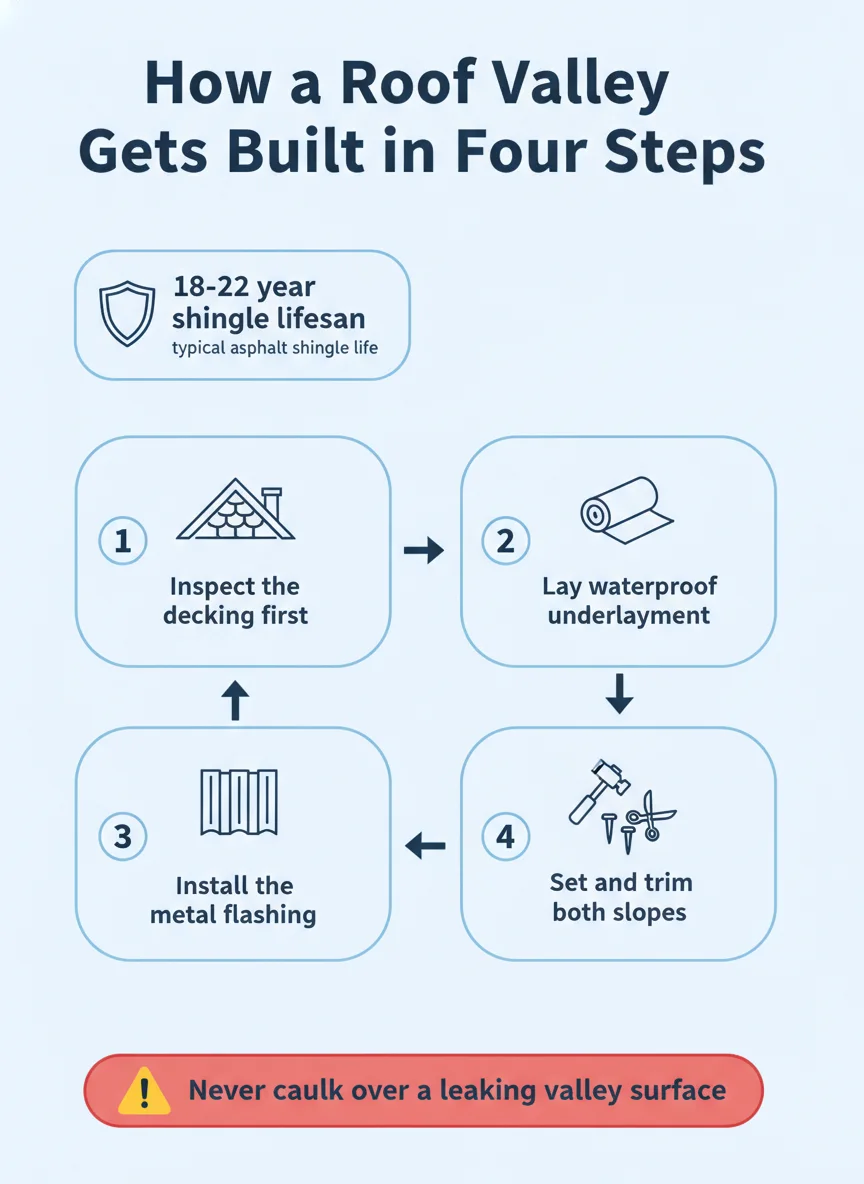
Step-by-Step: How a Valley Gets Built
The exact sequence varies by valley style and material, but the core process a crew follows looks roughly like this from decking to finished shingle line.
- Inspect the decking: The crew checks the wood underneath for soft spots or rot before anything new goes down, since flashing over a bad deck just hides a bigger problem.
- Lay the underlayment: A self-adhered waterproof membrane runs down the center of the valley, overlapping onto both slopes to seal the channel before any metal is installed.
- Install the valley flashing: Metal flashing is set in one run or carefully lapped sections, fastened along the edges only so water can't find a nail hole to travel through.
- Trim and set the first slope: Shingles from one slope are run into the valley and cut to the correct line, whether that's an open reveal or a tight woven edge.
- Trim and set the second slope: The opposing slope's shingles are brought in next, matched to the valley style chosen, with care taken not to nail too close to the centerline.
- Seal the transitions: Any exposed cut edges get sealed with roofing cement or sealant rated for the material, closing off spots where wind-driven rain could sneak in.
What a Failing Valley Looks Like
Valleys don't usually fail all at once. They tend to show small, easy-to-miss signs first, and catching those early is what keeps a $300 repair from turning into a $3,000 one.
Signs From the Ground
From the driveway, look for shingles along the valley line that look curled, cracked, or lighter in color than the rest of the roof, since that area wears faster than flat sections. Granule loss shows up as dark streaking in the gutter or on the ground below the downspout. Rust streaks bleeding down from the valley onto surrounding shingles usually mean the metal flashing underneath is corroding or was the wrong material for the job.
Signs From Inside the Attic
Inside the attic, a flashlight check along the rafters below the valley line can catch problems before they ever reach the ceiling drywall. Look for dark water staining, a musty smell, or insulation that feels damp to the touch even when it hasn't rained in a few days. Any of these point to water finding a path through the valley flashing, and waiting on it only gives the moisture more time to spread into the decking and framing.
DIY vs. Calling a Pro
A homeowner can absolutely handle the ground-level and attic inspections described above. Walking the yard with binoculars, checking the gutters for granules, and poking a flashlight into the attic after a hard rain are all reasonable DIY tasks that cost nothing but time, and they're the best early-warning system a homeowner has.
Actually rebuilding a valley is a different story. It involves working at height on a sloped surface, cutting shingles to precise angles, and lapping flashing correctly so water can't sneak behind it, and a mistake in any of those steps tends to show up as a leak months later rather than immediately. That delayed feedback loop is exactly why valley work is one of the areas where a licensed, insured crew earns its keep.
If you're already noticing streaking, granule loss, or a stain creeping across a ceiling near where two slopes meet, that's worth a professional look rather than a trip to the hardware store for caulk. A proper fix means pulling back the shingles around the valley, checking the underlayment and flashing, and rebuilding the section correctly rather than patching the surface.
Getting a Valley Looked At
Valleys are a small part of a roof's total square footage but a disproportionate share of its leak risk, which is why they deserve attention whether you're scheduling routine maintenance or already dealing with a stain on the ceiling. If it's been a while since anyone looked closely at yours, pair that check with a broader look at the roof's condition, including a read on how roof age affects performance.
Whether the fix ends up being a targeted valley repair or part of a larger re-roof in Newnan or anywhere else across Coweta County, getting eyes on it sooner rather than later keeps a small flashing issue from turning into a decking replacement. Griffintegrity Roof & Remod handles valley work as part of both repairs and full installs across the region.
Frequently asked questions
What is a roof valley and why does it leak so often?
A roof valley is the channel where two roof slopes meet, and it leaks more often than flat areas because it carries the combined water runoff from both slopes. Any gap in the flashing or underlayment beneath the shingles gives that concentrated water a path into the decking.
What's the difference between an open and closed roof valley?
An open valley leaves a strip of metal flashing visible down the center, while a closed or woven valley runs shingles across the channel so the flashing is hidden. Both can perform well when installed correctly, and the choice usually comes down to appearance and roof pitch.
Can I repair a roof valley myself?
You can monitor a valley for warning signs like granule loss, rust streaking, or attic staining on your own, but rebuilding the flashing and shingle lines requires working safely at height and lapping materials correctly. Most homeowners are better off having a licensed roofer handle the actual repair.
How do I know if my roof valley is leaking?
Look for curled or cracked shingles along the valley line, rust streaks bleeding down from the metal flashing, or dark staining and a musty smell in the attic below the valley. Any of these signs mean it's worth a closer inspection before the next heavy rain.
What drives the cost of fixing a roof valley?
Cost depends mainly on how much of the decking underneath has been damaged by prior leaking, the valley's length and pitch, and whether the surrounding shingles need to be replaced to blend the repair in. A valley caught early, before water reaches the decking, is generally a smaller job than one that's been leaking for a while.