
Why Homeowners in Coweta County Look Up How to Roof a House
It's a natural question. You're staring at a roof that's showing its age, you've gotten a quote or two, and you want to understand what you're actually paying for before anyone sets foot on a ladder. Whether you're in Newnan, Peachtree City, or anywhere else across the south side of metro Atlanta, the process itself doesn't change much from house to house. What changes is the condition of the deck underneath, the pitch of the roof, and how much time weather gives the crew to work.
This guide walks through what actually happens during a roof replacement, start to finish, so you know what questions to ask and what a quote should cover. It's written for homeowners trying to understand the process, not as a how-to for tackling the job yourself. Climbing on a roof and tearing it apart is a different animal than most home projects, and the risks go up fast once you're above a single story.
What Actually Goes Into a Roof Installation
A roof is a system, not a single material. The shingles or metal panels you see from the street are the last piece of a stack that includes the deck, an underlayment barrier, flashing at every seam and penetration, and ventilation built into the design. Each layer has a job, and a roof that fails early almost always failed because one of those layers was skipped or installed wrong, not because the shingles themselves were bad.
The Tear-Off and Deck Inspection
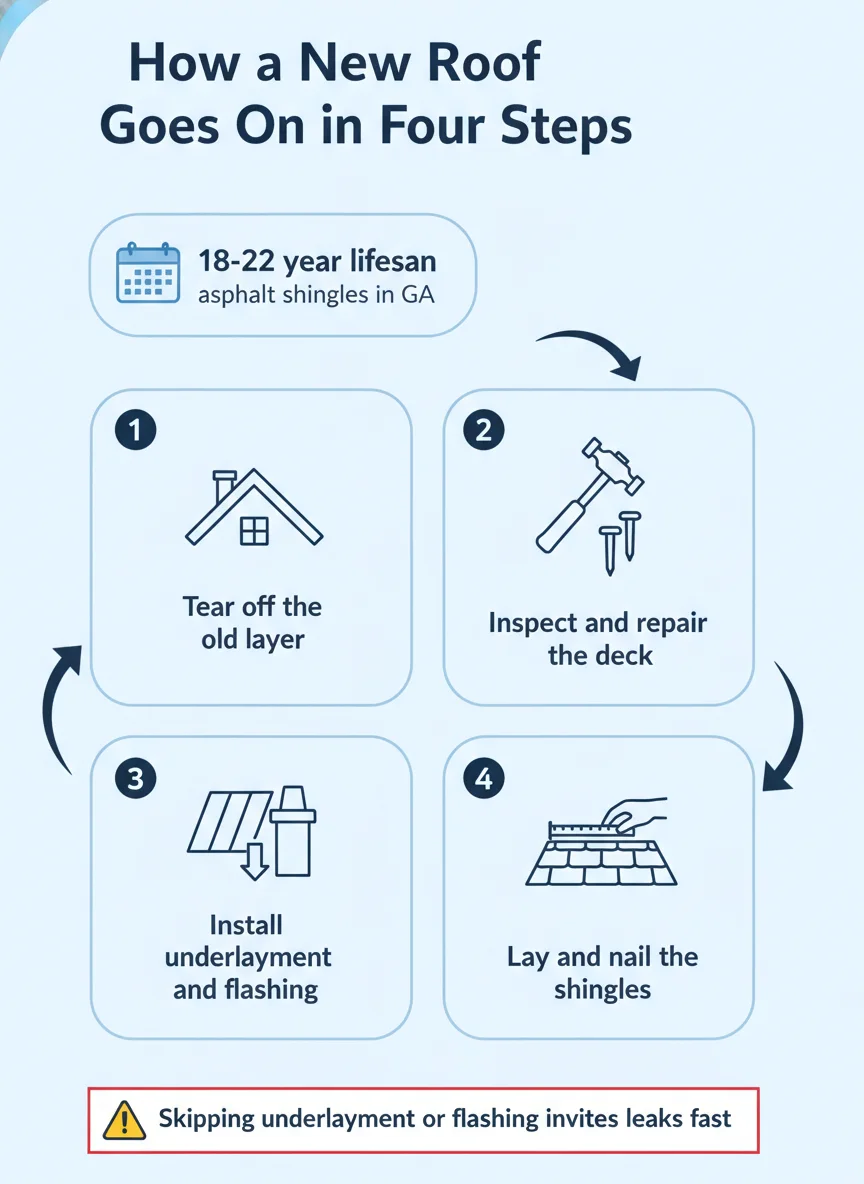
Every legitimate roofing job starts with removing the existing material down to bare decking. This isn't just cleanup. It's the only way to see what's actually underneath: soft spots, rot around vents and chimneys, or decking that's taken on moisture over the years. A crew that skips this step and roofs over the old layer is hiding problems instead of fixing them.
Once the deck is exposed, any damaged sections get cut out and replaced with new plywood or OSB before anything else goes down. This is also when a contractor can give you a real answer on the condition of your roof's structure, not just its surface. It's one of the reasons a roof repair quote and a full replacement quote can look very different once a crew actually gets eyes on the deck.
Underlayment and Flashing
Underlayment is the water-resistant barrier that goes down over the bare deck before any shingles or panels go on. It's the roof's backup plan: if wind ever drives rain up under a shingle, the underlayment is what keeps it from reaching the wood below. Skipping it or using too little is one of the most common corners cut on cheap roofing jobs.
Flashing is the metal installed around anything that interrupts the roof surface, chimneys, vent pipes, skylights, and the edges where two roof planes meet. These spots are where the overwhelming majority of leaks start, not in the middle of a flat shingle field. Proper flashing work takes more time and more skill than laying shingles, and it's usually the clearest sign of whether a crew knows what it's doing.
| Task | DIY Approach | Professional Approach |
|---|---|---|
| Tear-off | Rented dumpster, hand tools, full weekend or more | Crew strips a typical home in hours with the right equipment |
| Deck repair | Hard to spot rot without experience, easy to miss | Trained eye catches soft spots and replaces decking on the spot |
| Flashing | Common source of DIY leaks if bent or improperly sealed | Custom-cut and sealed around every penetration and edge |
| Safety | Fall risk is real, especially on steep or wet roofs | Crew works with harnesses, ropes, and roof experience daily |
The Parts of a Roofing System You're Installing
Beyond the deck, underlayment, and flashing, a finished roof includes drip edge along the perimeter, starter shingles at the eaves, the field shingles or metal panels themselves, ridge capping along the peaks, and ventilation components that let heat and moisture escape the attic. Leave out ventilation and even a perfectly installed shingle roof can cook from the inside, shortening its life well below what the material is rated for.
Gutters aren't technically part of the roofing system, but they work hand in hand with it to move water off the structure and away from the foundation. A lot of roofing projects in this area also involve gutter and metal fabrication work at the same time, since it's far more efficient to handle both while the crew and equipment are already on site.
Step-by-Step: How a Roof Goes On
Here's the general sequence a crew follows on a typical single-family home, assuming decent weather and no major surprises once the old layer comes off.
- Protect the property: Landscaping, siding, and anything below the roofline gets covered or protected before the first shingle comes off.
- Tear off old material: The existing roofing is stripped down to bare decking so the crew can see the condition of the structure underneath.
- Repair the deck: Any rotted, soft, or damaged decking is cut out and replaced with new plywood or OSB before moving forward.
- Install underlayment: A water-resistant barrier goes down over the entire deck as the roof's backup line of defense against moisture.
- Set flashing and drip edge: Metal is installed around every penetration, valley, and edge where water is most likely to find a way in.
- Lay the shingles or panels: Starting at the eaves and working up, the final roofing material goes down course by course to the ridge.
- Clean up and final walk-through: Debris, nails, and packaging are cleared from the yard, and the finished roof gets a last look before the crew leaves.
What You'll Run Into Along the Way
Problems Found Mid-Tear-Off
It's common for a crew to find something during tear-off that wasn't visible from the ground or even from a ladder inspection: a soft spot of decking, an old vent that was never flashed correctly, or a layer of roofing material nobody mentioned when the house changed hands. A good contractor stops, shows you what they found, and gives you a straight answer on what it takes to fix before moving forward, rather than covering it up and hoping it holds.
Weather and Scheduling
Georgia weather doesn't always cooperate with a roofing schedule. Rain can push a start date back, and a crew won't tear off more of a roof than they can dry in before conditions turn. This is normal and it's a sign of a contractor protecting your home, not a red flag. Ask upfront how a company handles weather delays so there are no surprises once the project is underway.
DIY vs Calling a Licensed Roofer
There are small pieces of roof maintenance a homeowner can reasonably handle: clearing debris off a roof from a stable ladder, checking gutters for clogs, or doing a visual inspection from the ground with binoculars after a windstorm. These tasks don't require climbing onto a sloped surface or working with roofing materials directly.
Actual installation, tear-off, flashing work, and deck repair are a different category entirely. These jobs require working at height on an unstable surface, handling heavy materials, and getting details right that aren't visible once the roof is finished, like how flashing is sealed or how many nails are driven per shingle. Mistakes here don't usually show up immediately. They show up as a leak two years down the road when it's much harder to trace back to the cause.
There's also the manufacturer warranty to think about. Most shingle manufacturers require installation by a certified or qualified contractor for their full warranty terms to apply, so a DIY install can leave you without that coverage even if the materials themselves are solid. For most homeowners, the math favors hiring a licensed, insured roofer over taking on the risk and liability of doing it themselves.
Getting a Roof Done Right the First Time
Understanding the process doesn't just satisfy curiosity, it helps you evaluate a quote and ask better questions. A contractor who explains tear-off, deck inspection, underlayment, and flashing without being asked is usually one who does the work the same way every time. One who glosses over those details and jumps straight to color options is worth a second look.
If you're weighing a repair against a full replacement, it helps to read up on how long a roof actually lasts and what determines it before you make the call. And if you're in Newnan or anywhere else across Coweta County, Griffintegrity Roof & Remod Inc handles the full process described above, from tear-off to final cleanup.
Frequently asked questions
Can a homeowner roof their own house?
Technically yes, but it's a demanding, dangerous job that most homeowners are not equipped to do safely or correctly. Steep pitches, heavy bundles, and the risk of a fall make this one of the trades where hiring a licensed pro usually makes more sense than a weekend DIY project.
How long does it take to roof a house?
A straightforward single-family home is often torn off, re-roofed, and cleaned up in a single day by an experienced crew. Larger roofs, steep pitches, multiple layers to remove, or bad weather can stretch that timeline.
What's the first step in roofing a house?
The first step is tearing off the old roofing material down to the deck so the crew can see what they're actually working with. Skipping this and roofing over the old layer hides rot, soft spots, and other problems that will surface later.
Do you need a permit to roof a house?
Most jurisdictions require a permit for a full roof replacement, though requirements vary by county and city. Check with your local building department before work starts, and a reputable roofing contractor should be able to walk you through what's required in your area.
What materials are involved in roofing a house?
A complete roofing system includes the deck, an underlayment layer, flashing around penetrations and edges, and the final roofing material, usually asphalt shingles or metal on a residential home. Each layer does a different job, and missing one weakens the whole system.