
How Long Does a Roof Replacement Really Take in Coweta County?
If you're staring at a leak or a quote and wondering how long your home will be torn open, the short answer is: not as long as you'd think. Most single-family homes across the Coweta County and south metro Atlanta area, from Newnan out to Peachtree City and Senoia, get a full tear-off and new roof installed in a single day, with a crew that stays until cleanup is done. Bigger or more complex homes, or jobs that hit weather or deck problems, can stretch into two or three days.
Timing matters more than homeowners usually expect going in. A roof left partially open overnight because of a rain delay or an undersized crew is a real risk to your ceilings and insulation, so understanding what actually drives the schedule helps you ask better questions when you're comparing quotes. It also helps you plan around the work itself, whether that's boarding a dog for the day or moving cars off the driveway.
What Actually Determines the Timeline
A roof replacement's length comes down to a short list of variables: the size and pitch of the roof, the material going on, how many layers of old roofing have to come off, the condition of the deck underneath, and the weather on installation day. Crew size and experience matter too, since an undermanned job on a complicated roofline will always run long no matter how good the material is.
Roof Size and Pitch
The bigger the roof, the more square footage a crew has to strip, prep, and cover, so square footage is the first thing that scales the timeline. Pitch matters almost as much. A low-slope roof lets crews move quickly and safely, while a steep roof slows everyone down because of the extra safety gear, staging, and care needed to keep material and tools from sliding.
Complex rooflines with multiple valleys, dormers, and transitions take longer than a simple rectangular roof of the same square footage, because every valley and penetration needs its own flashing work done by hand. A quote that accounts for roof complexity, not just square footage, is usually a more honest estimate of the actual days on site.
Material Choice
Asphalt shingles install faster than most other roofing materials because the product comes pre-cut and nails down in a repeatable pattern, which is part of why they're the most common residential choice. Our Roof Replacement & Installation crews typically finish a standard shingle tear-off and reinstall in one day on homes without major complications.
Metal roofing generally takes more time per square foot, since panels have to be measured, cut, and fastened with more precision, and seams and trim pieces require careful layout. That doesn't make metal a worse choice, it just means the schedule should account for the extra labor rather than assuming it moves at the same pace as shingles.
| Factor | Asphalt Shingle Replacement | Metal Roof Replacement |
|---|---|---|
| Average completion time | Typically one day on a standard single-family home | Often one and a half to three days depending on panel style |
| Crew size needed | Standard residential crew handles most layouts | Smaller, more specialized crew works at a slower, precise pace |
| Weather sensitivity | Work pauses for active rain or lightning | Same weather pauses, plus more care needed handling panels in wind |
What's Included in a Full Roof Replacement
A real replacement is more than swapping old shingles for new ones. It starts with a complete tear-off down to the deck, not a layer installed over what's already there, so the crew can see the actual condition of the wood underneath. From there it includes new underlayment, flashing around chimneys, vents, and valleys, and often ridge or soffit ventilation work to keep the attic breathing properly.
Cleanup is part of the job too, not an afterthought. A thorough crew protects landscaping during the tear-off, runs a magnetic sweep for stray nails, and hauls away the old material so you're not left dealing with debris. Asking what's included, specifically whether tear-off and deck inspection are part of the price, is one of the clearest ways to compare two quotes that look similar on paper.
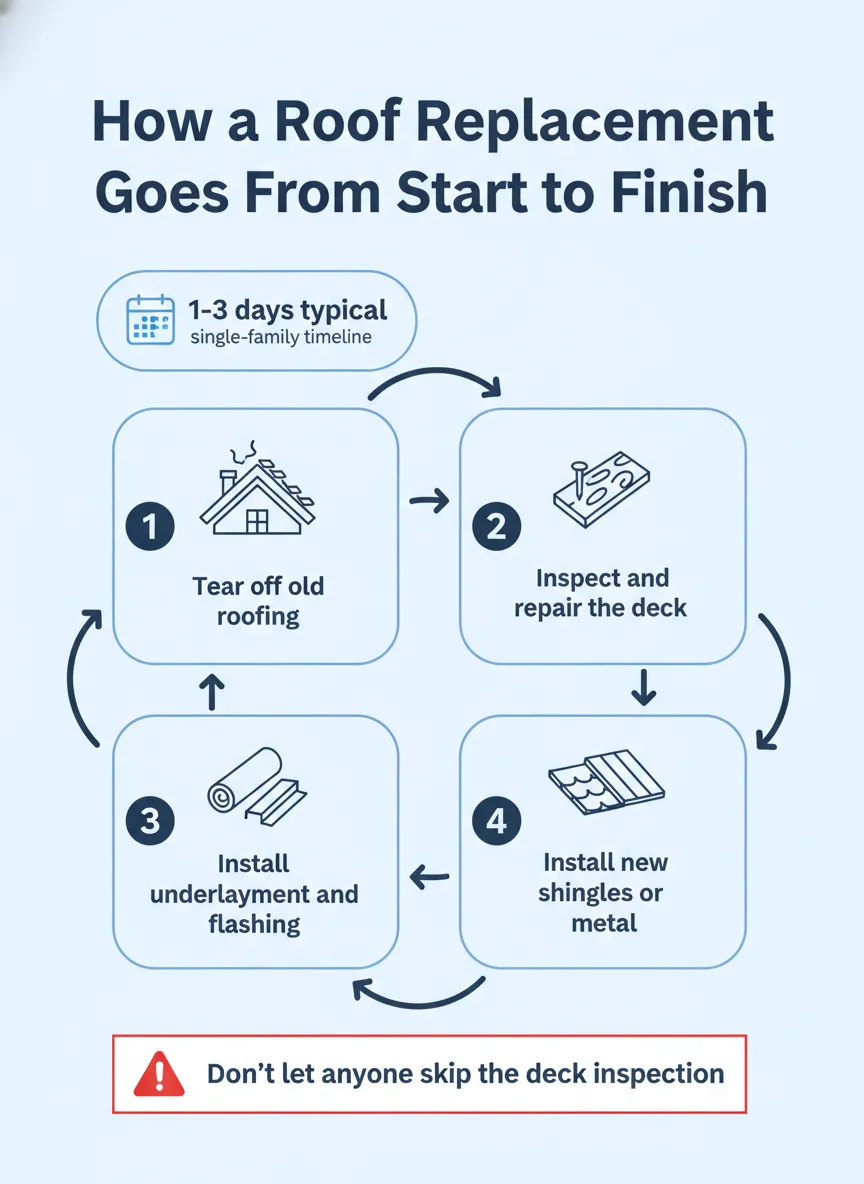
Step-by-step: What Happens on Replacement Day
Here's roughly how a single-day residential replacement unfolds once the crew arrives on site and the material has been delivered and staged in the driveway or yard.
- Setup and protection: The crew sets up safety equipment and lays down tarps or protection around landscaping, siding, and any areas below the work zone.
- Tear-off: Old shingles or roofing material come off down to the bare deck, with debris loaded directly into a trailer or dumpster as it's removed.
- Deck inspection and repair: The exposed deck gets inspected board by board, and any soft or rotted plywood is cut out and replaced before anything new goes down.
- Underlayment and flashing: New underlayment goes down across the whole deck, followed by new flashing at chimneys, valleys, skylights, and vent penetrations.
- New roofing installation: Shingles or metal panels go on according to manufacturer spec, starting at the eaves and working up to the ridge.
- Ridge and ventilation: Ridge vents or caps are installed to finish out the attic ventilation system and give the roofline its finished look.
- Cleanup and walkthrough: The crew does a final nail sweep, hauls away debris, and walks the property with the homeowner before leaving.
What Can Slow a Roof Replacement Down
Weather and Season
Active rain, high wind, or lightning will pause roofing work immediately, since an open deck can't be left exposed and wet material won't seal correctly. A crew with a good eye on the forecast schedules the tear-off for a window with the best chance of staying dry, and will sometimes delay a start date by a day rather than risk leaving your home partially uncovered.
Georgia's heavier storm months make this more relevant at certain times of year than others. Planning a replacement during a calmer stretch of the calendar, when possible, reduces the odds of a multi-day job turning into a week-long one because of repeated weather delays.
Hidden Deck Damage
You can't know for certain what's under the existing roofing until it comes off, and that's usually where timelines move the most. Rotted or soft plywood, often from a long-standing slow leak you never noticed, has to be cut out and replaced before new underlayment and shingles go on, and that repair work takes real time to do correctly.
This is also why a flat, too-good-to-be-true quote should raise a question rather than feel like a win. A contractor who's never seen your deck can't promise zero surprises, and the ones who are upfront about that possibility going in are usually the more honest bid.
DIY vs Calling a Licensed Roofer
A full roof replacement isn't a reasonable weekend DIY project for most homeowners, and it's not just about the physical risk of working at height, though that's real. Correct underlayment overlap, flashing details around penetrations, and proper nailing patterns all affect whether a roof actually sheds water for its full expected lifespan, and getting any of those wrong can void a manufacturer warranty before it ever matters.
Where a homeowner can reasonably step in is in the planning stages: walking your own roof from the ground with binoculars to spot obvious problem areas, researching material options ahead of getting quotes, and asking detailed questions about what a bid includes. That homework makes you a sharper customer without putting you on a ladder.
A licensed, insured roofer handles everything from the tear-off through the final inspection, and carries the insurance that protects you if something goes wrong mid-project. If you're also dealing with storm damage, Storm & Hail Damage Repair work often runs alongside a replacement and benefits from the same crew handling both so nothing falls through the cracks between two different contractors.
Planning Your Roof Replacement Timeline
The honest version of this answer is that most single-family homes in the region are done in a day, and the ones that aren't usually have a clear reason why, whether that's roof size, material, a steep pitch, or deck damage no one could see until the tear-off started. Asking a contractor to walk you through their expected timeline before work begins, rather than finding out mid-project, is the easiest way to avoid surprises. For a closer look at the full sequence once the crew is on site, see What Happens on Roof Replacement Day.
Weather, material choice, and what's hiding under the old roofing are the three biggest swing factors, and none of them are fully predictable from a driveway estimate alone. A straightforward conversation about your specific roof, not a generic timeline, is what actually sets expectations, and that's the kind of conversation Griffintegrity Roof & Remod has with every homeowner before the crew shows up.
Frequently asked questions
How long does it take to replace a roof on an average house?
Most single-family homes with a straightforward layout are torn off and fully re-roofed in a single day. A larger footprint, steep pitch, or multiple layers of old material can push that into a second day.
Does rain delay a roof replacement?
Yes, active rain or lightning stops roofing work for safety and to keep the exposed deck dry. A reputable crew times the tear-off around the forecast so your home isn't left open overnight.
Is metal roofing slower to install than shingles?
Generally yes, metal panels take more layout, cutting, and fastening time than asphalt shingles, so a metal replacement on the same home often runs a day or two longer.
What slows down a roof replacement the most?
Hidden deck damage found under the old material is the most common delay, since rotted plywood has to be replaced before anything new goes on. Steep or complex rooflines and bad weather are the other two big factors.
Can I stay home during a roof replacement?
Yes, most homeowners stay home during the work, though it is loud and you'll hear the crew on the roof most of the day. Pets do better somewhere quiet, and vehicles are usually moved away from the work zone.