
A common decision point for Coweta County homes
When a roof reaches the end of its service life, homeowners across Newnan and the rest of Coweta County run into the same fork in the road: tear the old layer off and start fresh, or install new shingles right over what's already up there. A layover looks like the faster, cheaper option, and in some cases that's exactly what it is. But the decision isn't just about what's visible from the driveway. It's about what's happening under that first layer, where moisture, rot, and failed flashing can sit undetected for years.
This matters more in a humid climate like Georgia's than in drier parts of the country. Heat and moisture work on a roof system from both sides, the sun baking the top layer and condensation building underneath where ventilation is weak. A roof-over traps whatever is already happening down there and adds a second layer of material on top of it, which is why most experienced roofers steer homeowners toward a full tear-off whenever the budget allows it.
Why does a layover hide more than it saves?
A layover hides the one thing that actually determines how long a new roof will last: the condition of the decking underneath. Shingles are only as good as what they're nailed to, and a second layer of shingles on top of a failing deck just delays the moment that failure becomes visible, usually as a sag, a soft spot, or a leak that shows up far from where the actual damage started.
What a tear-off exposes
Stripping the old layer down to bare decking lets a crew see the plywood or OSB in full, board by board. That's when soft spots from long-term moisture exposure, delaminated panels, or old nail holes that never sealed properly come to light. It's also the only point where flashing around chimneys, vents, and valleys can be fully inspected and replaced rather than patched over.
Ventilation is the other piece a tear-off reveals. Intake and exhaust vents that have been blocked by insulation, debris, or a previous installer's shortcuts often aren't visible until the old material comes off. Fixing airflow at tear-off time protects the new shingles from heat buildup that shortens their service life, something a layover can't address since it never touches the attic side of the system.
What a layover leaves behind
A layover leaves the existing deck, flashing, and ventilation exactly as they were, good or bad. If the first layer was installed over sound decking with working flashing, that's a reasonable bet. If it wasn't, the new shingles are now sitting on top of a problem that will keep getting worse, just one layer further from view.
There's also a weight and heat factor. Two layers of shingles add meaningful weight to the structure and hold more heat than a single layer, since there's more material absorbing sun through the day. In Georgia's summer months, that extra heat load works against the shingles from underneath, which can shorten the lifespan of even a quality product installed over an older layer.
| Factor | Roof-Over (Layover) | Full Tear-Off |
|---|---|---|
| Decking inspection | Not possible, deck stays hidden | Full inspection, soft spots replaced |
| Flashing and ventilation | Left as-is, can't be corrected | Replaced and corrected as needed |
| Manufacturer warranty | Often reduced or voided | Full warranty terms typically apply |
| Building code allowance | Limited to one layover in most areas | No layer restrictions, always permitted |
What's actually happening under that first layer
Underneath every shingle roof is a deck, usually plywood or OSB, nailed to the rafters and covered by an underlayment that provides the first real barrier against water intrusion. Flashing seals the transitions, chimneys, skylights, walls, valleys, where water pressure is highest. Ventilation, both intake at the eaves and exhaust at the ridge, keeps air moving through the attic so heat and moisture don't build up against the deck from below.
Every one of those components has a service life of its own, and none of them are visible once new shingles go down over an old layer. A roof that looks fine from the street can have decking that's been absorbing moisture for years around a poorly sealed vent pipe, and a layover installer has no way to catch that before it becomes a bigger repair.
Step-by-step: what a tear-off actually involves
A full tear-off follows a consistent sequence, whether it's a straightforward single-layer home or a more complex roof with multiple valleys and penetrations.
- Strip old material: Crews remove every layer of shingles and old underlayment down to bare decking, bagging debris for disposal as they go.
- Inspect the deck: Every board gets checked for soft spots, delamination, or rot, and any compromised sections are replaced before anything new goes down.
- Check flashing: Flashing around chimneys, vents, skylights, and valleys is inspected and replaced where it's rusted, bent, or no longer sealing properly.
- Confirm ventilation: Intake and exhaust vents are checked for blockages and corrected so attic airflow works the way the system was designed to.
- Install new underlayment: A fresh moisture barrier goes down across the entire deck before any shingles are laid.
- Install the new roofing system: New shingles or metal go on according to the manufacturer's installation requirements, which keeps the full warranty intact.
- Final cleanup and walk-through: Nails and debris are cleared from the yard and landscaping, and the finished roof is reviewed before the crew leaves the property.
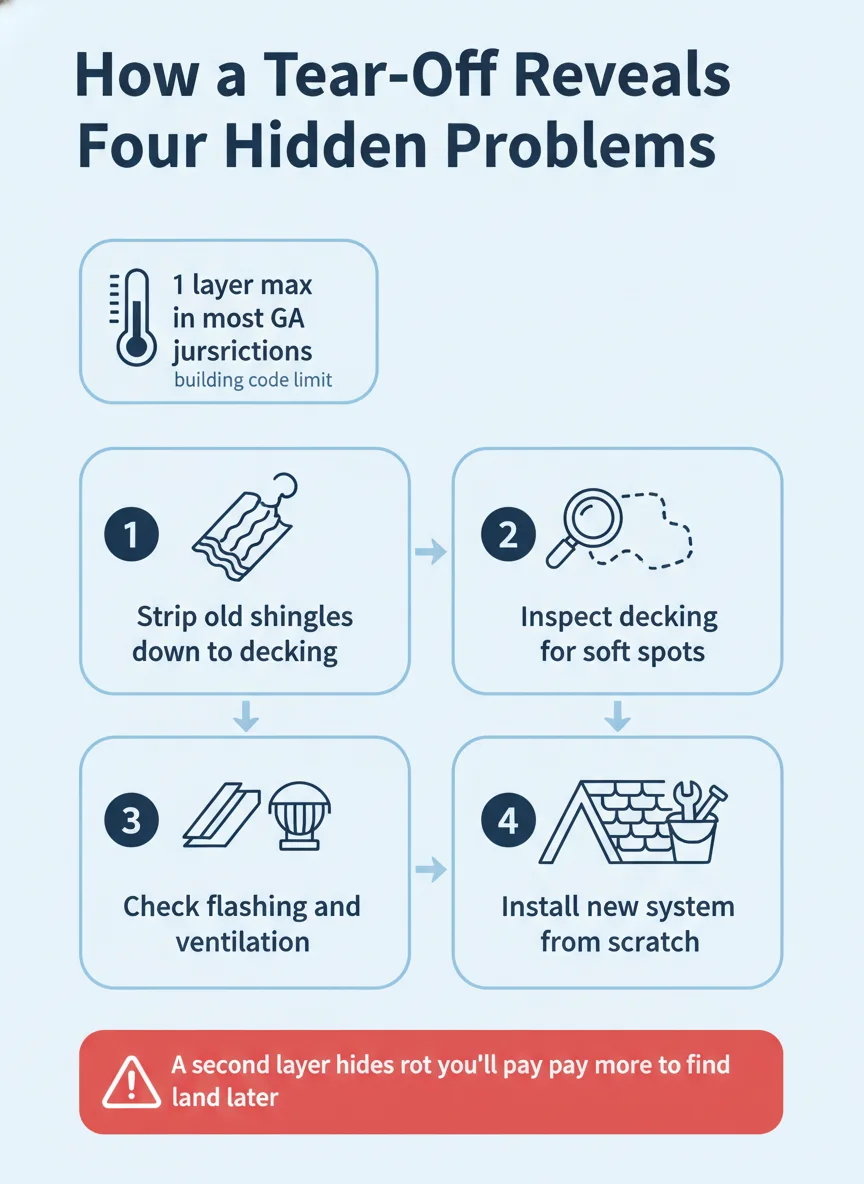
What homeowners typically find once the old layer comes off
It's common for a tear-off to turn up at least one surprise, even on a roof that didn't show obvious signs of trouble from inside the house. Knowing what those surprises usually look like helps set expectations before the crew starts.
Decking issues
Soft or discolored plywood around a chimney, skylight, or old vent pipe is one of the most common finds, usually traced back to a flashing seal that failed years earlier. Replacing those sections during tear-off is straightforward and keeps the problem from spreading once new material goes down.
Less common but more serious is widespread decking failure across a large section of the roof, often from a long-term, slow leak that was never visible from inside the attic. These situations call for a broader conversation about scope and timeline, which a layover would never have surfaced in the first place.
Flashing and ventilation gaps
Flashing that was reused from a previous install, rather than replaced, is a frequent find, especially around older chimneys. Old flashing that's bent, rusted through, or improperly lapped is a leak risk that a layover simply seals over rather than fixes.
Blocked or undersized ventilation shows up almost as often, particularly in homes that have been reroofed once or twice already without anyone addressing airflow. Correcting that during a tear-off protects the new shingles from premature aging caused by trapped heat.
What a homeowner can check and what needs a licensed crew
A homeowner can do some early legwork before calling anyone out. Checking the attic for daylight gaps at the ridge or soffit, looking for water stains on the ceiling, and noting how many times the roof has been replaced (ask the previous owner, check old paperwork, or look at the edge thickness from a ladder) all help frame the conversation with a roofer.
Everything past that point belongs to a licensed, insured crew. Confirming whether a second layover is even allowed by local code, assessing deck condition safely, and correcting flashing or ventilation all require someone who can get on the roof and in the attic without risk to themselves or the structure. This isn't a weekend project a homeowner should take on solo.
The honest answer on cost comes from a crew that actually inspects the roof rather than quoting from a photo. Pricing depends on how many layers are coming off, how much decking needs replacing, the roof's size and pitch, and access around the property, all of which only become clear once someone is up there looking. A detailed breakdown of what drives the cost of roof replacement and installation in GA covers those factors in more depth.
Making the call for your roof
A layover isn't automatically the wrong choice. On a roof with a single existing layer, a sound deck, and intact flashing, it can be a reasonable way to extend a home's protection without the full cost of tear-off. The catch is that none of those conditions can be confirmed without getting under the surface, which is exactly what a layover skips.
For most homes in Newnan and across Coweta County, a full tear-off is the safer long-term bet, since it's the only process that lets a crew catch deck and flashing problems before they're sealed under new shingles for another 15 to 20 years. If you're weighing the two options for your own roof replacement and installation project in Newnan or a nearby town, Griffintegrity Roof & Remod can take a look and give you a straight answer on which way to go.
Frequently asked questions
Is it cheaper to roof over an old roof instead of tearing it off?
A layover costs less upfront because it skips tear-off labor and disposal, but it doesn't fix anything underneath, so any decking rot or flashing failure stays buried. Most homeowners end up paying for a full tear-off anyway within a few years once leaks show up from below.
Can you put a new roof over an old one in Georgia?
Many Georgia jurisdictions allow a single layover if the existing layer is in good shape and the structure can handle the added weight, but most will not permit a second layover on top of two existing layers. Check with your local building department, since rules vary by county and city.
Does a roof-over void the manufacturer warranty?
It depends on the manufacturer, but many shingle warranties are reduced or voided entirely when installed over an existing layer, since the manufacturer can't guarantee the deck underneath is sound. A tear-off lets the installer confirm the deck meets the manufacturer's installation requirements, which keeps the full warranty intact.
How do I know if my roof already has two layers?
A roofer can tell from the ground in some cases by looking at the edge thickness and the rake line, but the only sure way is to check the attic for daylight gaps or pull a small section at the edge. If your home has been reroofed before without a full tear-off, assume there could be two layers until it's confirmed.
What problems does a tear-off find that a roof-over misses?
A tear-off exposes the full deck, so a crew can find soft or rotted plywood, rusted or missing flashing, and blocked ventilation before any of it gets sealed under new material. A layover covers all of that up, which means those issues keep working against the new shingles from day one.