
Replacement day in Coweta County
Once materials are ordered and a date is on the calendar, replacement day itself moves fast. For homes across Newnan, Sharpsburg, Peachtree City, and the rest of the south metro Atlanta area, a single-family roof typically goes from old to new in one working day, weather permitting. Knowing the order of operations ahead of time means you're not standing in the yard wondering why there's a dumpster, a trailer, and six people on your roof before 9am.
It matters because replacement is one of the bigger disruptions a homeowner signs up for on purpose. There's noise, there's debris coming off the house, and there's a window where your home has no roofing material on part of it at all. A crew that communicates the sequence clearly, and works it in the right order, keeps that exposed window short and keeps your property protected the whole time.
Why the sequence matters
Roofing isn't just stacking new material on old. Every step in the sequence exists to protect the layer underneath it, which is why skipping or rushing one step can undo the benefit of everything installed after it.
Protecting the structure underneath
Before a single new shingle or panel goes down, the old layer has to come off completely so the crew can see the decking, the plywood or OSB layer that the whole roofing system attaches to. Hidden damage, soft spots, or old leaks only show up once the surface is stripped bare, which is why tear-off happens first and inspection happens second, not the other way around.
Any decking that's soft, rotted, or delaminated gets replaced on the spot rather than covered over. This is one of the reasons estimates sometimes include an allowance for decking repair. A roof is only as good as what it's nailed into, so this step isn't optional even though it adds time to the day.
Building in layers, not shortcuts
After decking is confirmed solid, the crew builds the system back up in layers: underlayment first, then drip edge at the eaves and rakes, then the field material, then ridge components last. Each layer overlaps the one below it so water runs down and off, never underneath. This shingled, overlapping approach is standard across the roofing industry because it's the only way to keep wind-driven rain from working its way backward under a seam.
Flashing around chimneys, vents, skylights, and wall intersections goes in as the field material reaches those points, not as an afterthought at the end. These transition points are where most leaks start on any roof, old or new, so they get attention during the build rather than being patched in later.
| Stage | What's happening | What you'll notice |
|---|---|---|
| Morning setup | Yard protection, dumpster placement, material staging | Trucks and a trailer parked near the driveway |
| Tear-off | Old roofing stripped down to decking | Noise, debris coming off the roof edges |
| Dry-in | Underlayment, drip edge, and flashing installed | Roof looks bare but weather-protected |
| Finish | New shingles or metal installed, ridge capped, cleanup | Crew doing a final walk and magnet sweep |
The system that goes on your roof
A roofing system is more than the visible shingle or metal panel. It includes an underlayment layer that acts as a secondary water barrier, drip edge metal that directs runoff into gutters instead of behind fascia boards, flashing at every penetration, and ridge components that ventilate the attic below. Each piece is manufactured to work with the others, which is part of why a reputable installer sticks to one system rather than mixing and matching components from different manufacturers.
If your project also involves gutters and metal fabrication, that work typically happens after the new roofing material is on, since fascia and gutter runs tie into the drip edge and final roof line. Coordinating that sequencing in advance avoids having a crew out twice for work that could be finished in one visit.
Step-by-step: what the day looks like
Every roof is a little different, but the order below is close to what you can expect for a standard single-family tear-off and replacement.
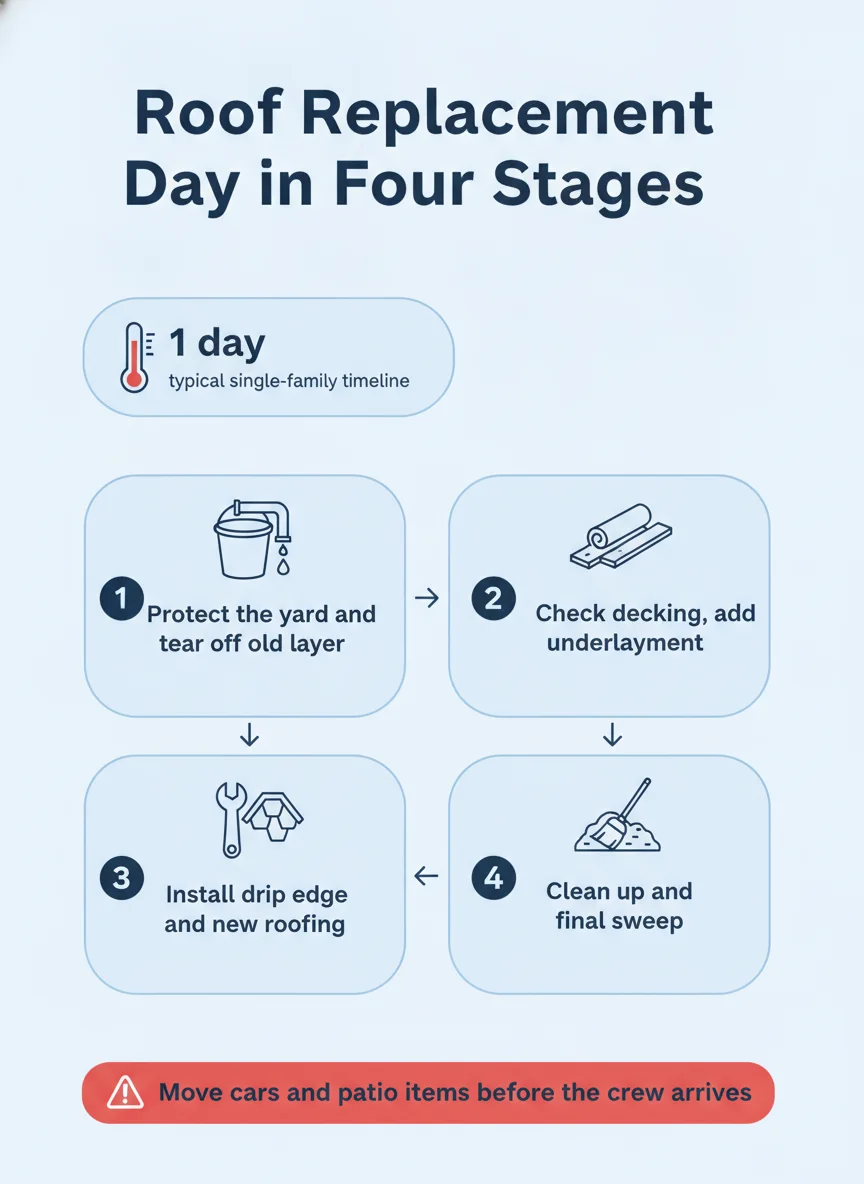
- Site protection: Tarps go over landscaping, AC units, and any outdoor furniture near the home before tear-off starts.
- Tear-off begins: Old roofing material is stripped from the decking and loaded directly into a dumpster or trailer.
- Decking inspection: Exposed decking is checked for soft spots or rot, and any damaged sections are replaced.
- Underlayment and drip edge: A water-resistant underlayment and metal drip edge go down to protect the decking and direct runoff.
- Flashing installed: Metal flashing is set at chimneys, vents, skylights, and wall intersections to seal those vulnerable points.
- New roofing installed: Shingles or metal panels go on in overlapping courses from the eaves up to the ridge.
- Cleanup and magnet sweep: Debris is hauled away and a magnetic roller sweeps the yard and driveway for stray nails.
What you'll find once it's done
A finished roof line
When the crew wraps up, you should see clean, straight shingle or panel lines, properly capped ridges, and flashing that's tucked neatly rather than caulked over as a patch. Gutters and downspouts, if they were part of the scope, should be reattached and draining correctly away from the foundation.
A short walk-around with the crew before they leave is standard practice. This is your chance to look at the finished work up close, ask about any decking repairs that were made, and get clarity on what warranty coverage applies to the materials and the installation.
A cleaned-up property
Cleanup isn't just stacking the dumpster neatly. It includes raking the yard for debris, checking gutters for stray granules or nails, and running a magnetic sweep across the driveway and lawn. Pets and bare feet find stray roofing nails fast, so this step protects your family after the trucks pull away, not just your curb appeal.
If anything looks incomplete, whether that's a missed section of flashing or debris left in a flower bed, it's reasonable to point it out before the crew leaves for the day rather than waiting a week to call about it.
What's yours to handle and what isn't
Homeowners can handle the prep work: moving cars, clearing the yard, taking down wall decor that might shake loose, and letting neighbors know there will be noise and a dumpster for a day. Covering patio furniture and moving grills away from the house is also worth doing yourself the night before.
Everything from the actual tear-off forward belongs to a licensed, insured crew. That includes working at height, handling decking repairs, cutting and setting flashing, and making sure the system ties together correctly at every seam. This isn't a weekend DIY project. A single missed overlap or poorly set flashing point can cause a leak that doesn't show up for months, by which point water has already found its way into framing or insulation.
If you're still weighing whether your current roof needs a full tear-off at all versus a targeted fix, it's worth reading when a roof is past the point of repair before committing to a replacement date.
Getting ready for your own replacement day
Knowing the sequence ahead of time turns a loud, disruptive day into a predictable one. You'll know why the crew tears off before they inspect, why flashing goes in before the field material, and why the magnet sweep matters as much as the shingles themselves.
If you're planning a roof replacement for a home in Newnan, Sharpsburg, or anywhere else in Coweta County, Griffintegrity Roof & Remod walks you through this sequence before the crew ever shows up, so replacement day holds no surprises.
Frequently asked questions
How long does a roof replacement take on a single-family home?
Most single-family homes in the Coweta County area are torn off, re-roofed, and cleaned up in a single day. Larger roofs, steep pitches, or multiple layers of old material can stretch the job into a second day, and a good crew will give you a realistic timeline before work starts.
Do I need to be home during roof replacement?
You don't have to be home, but it helps if someone can be reached by phone in case the crew finds something unexpected under the old layer. Many homeowners go to work and come back to a finished job, as long as access to the yard and any gates is arranged ahead of time.
What should I move before roof replacement day?
Move vehicles out of the driveway, take down anything hanging on exterior walls, and clear patio furniture or grills away from the house. Vibration from tear-off can knock loose items off walls and shelves inside, so securing picture frames and light fixtures is a smart precaution too.
Will replacing my roof damage my landscaping?
A careful crew protects landscaping with tarps and plywood before tear-off begins, but falling debris and foot traffic around the home's perimeter is unavoidable with any full tear-off. Walking the property with your crew beforehand to flag anything fragile, like a new flower bed, helps prevent surprises.
How do I know the new roof was installed correctly?
A final walk-around after installation should cover flashing at every penetration, straight ridge lines, and a magnetic sweep of the yard for stray nails. Ask your contractor to show you the completed work and explain what warranty coverage applies before they leave the site.