
Why Georgia's Seasons Each Put Different Stress on a Roof
Homes across Coweta County and the south side of metro Atlanta deal with a wider swing of weather than a lot of homeowners realize. Spring brings fast-moving thunderstorms with wind and hail, summer brings sustained heat and UV exposure that most shingles have to shrug off for months at a time, fall drops a steady load of leaves and pine straw onto roofs and into gutters, and winter brings overnight freezes that stress flashing, sealant, and any spot where water has a chance to sit.
A roof built and installed correctly for this region should handle all four seasons without drama. But a once-a-year glance from the driveway isn't enough to catch the small stuff, a lifted shingle tab, a clogged downspout, a hairline gap at a flashing seam, before it turns into a stain on a ceiling. A seasonal calendar gives you a reason to actually look twice a year instead of waiting until there's a leak.
What's Actually Happening to the Roof Through the Year
A roofing system is made of layers working together, and each layer reacts differently to heat, cold, wind, and moisture. Understanding what each season does to those layers is what turns a generic checklist into a useful one.
Spring: Wind and Hail Are the Main Threats
Spring storm systems in Georgia can bring straight-line wind gusts and hail with little warning. Wind gets under shingle edges that have already started to lift, and hail bruises or cracks the surface of asphalt shingles in ways that aren't always visible from the ground. This is the season most likely to cause damage you don't notice until weeks later when a leak finally shows up inside.
It's also the best time for a proactive look, since catching a few lifted shingles or a dented vent cap right after a storm is a much smaller job than waiting for water to find its way into the attic. If you want a read on what to look for after a specific storm, see After the Storm: A Roof and Gutter Checklist for the Next Morning.
Summer: Heat and UV Wear Down Materials Slowly
Georgia summers push attic temperatures well above outdoor air temperature, and that heat works against shingles from underneath while UV rays bake them from above. Over years this is what drives granule loss and brittleness, the slow kind of wear that doesn't show up as an obvious problem until a roof is well into its service life.
Summer is also a good season to check attic ventilation, since poor airflow traps more heat and moisture than the system was designed to handle. A roof that's properly ventilated ages more evenly and holds up longer against the same sun exposure a poorly vented one struggles with.
| Season | Main risk | What a check should catch |
|---|---|---|
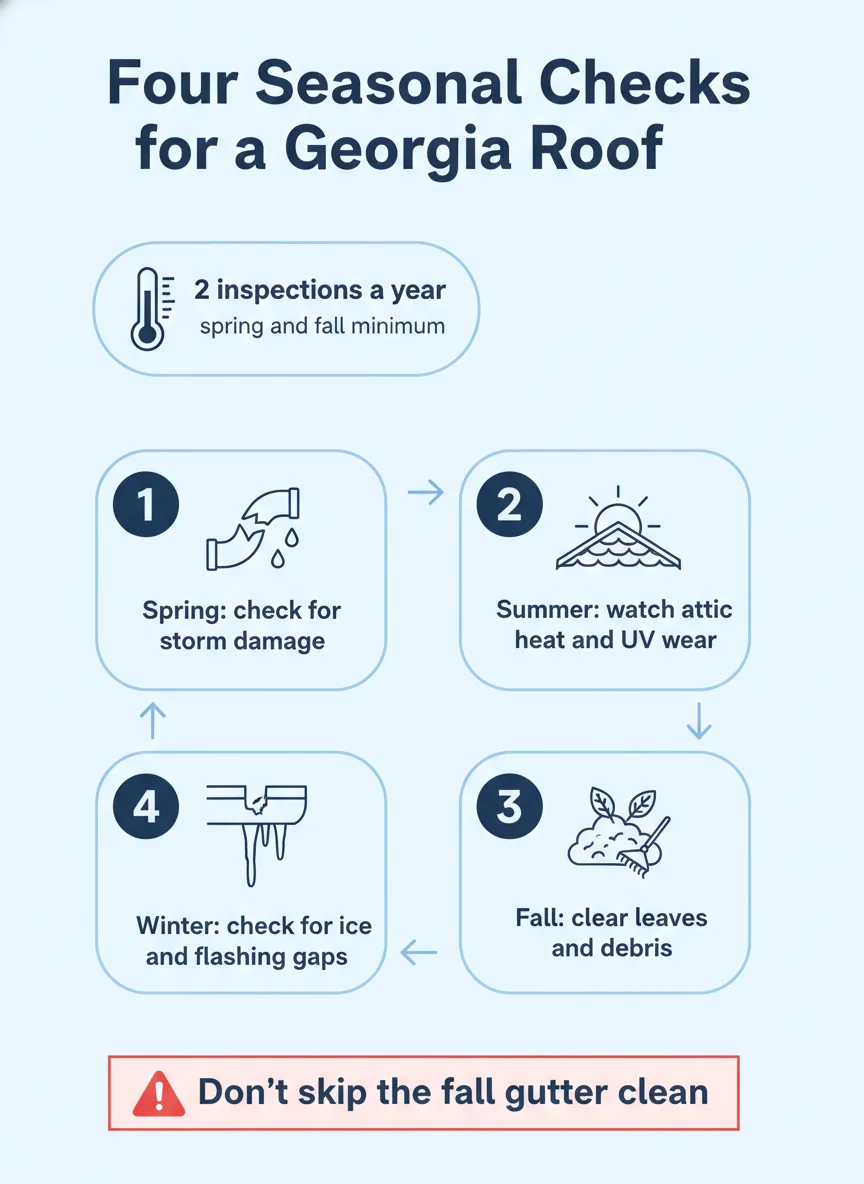
| Spring | Wind and hail damage | Lifted or missing shingles, bruised shingle surfaces, dented flashing |
| Summer | Heat and UV wear | Granule loss, attic ventilation issues, early blistering |
| Fall | Debris buildup | Clogged gutters, leaf piles on low-slope sections, pine straw mats |
| Winter | Freeze-thaw stress | Flashing gaps, cracked sealant, ice buildup at valleys |
The Parts of the Roof a Seasonal Check Should Cover
A thorough seasonal check isn't just a glance at the shingles. It covers the flashing around chimneys, vents, and skylights, which are the most common places for a small gap to turn into a slow leak. It covers the gutters and downspouts, since standing water or overflow at the roofline backs up under shingles and against fascia boards. And it covers the attic, where stains, damp insulation, or daylight coming through the decking tell you something is wrong well before it shows up on a ceiling below.
If your home has metal fascia, panels, or fabricated gutters, those components age differently than asphalt and should get their own look each season, particularly at seams and fasteners. Gutters & Metal Fabrication work is often the first thing to show wear before the roofing surface itself does, which makes it a good early warning sign.
Step-by-Step: A Four-Season Roof Check
You don't need to climb on the roof to run through most of this. A pair of binoculars from the yard, a ladder at the gutter line, and a flashlight in the attic cover the majority of what a seasonal check calls for.
- Walk the perimeter: Look up from the ground at each side of the house for missing, curled, or discolored shingles, and note anything that looks out of place compared to last season.
- Check the gutters: Clear leaves, pine straw, and granules from gutters and downspouts so water has a clear path off the roof instead of backing up at the edge.
- Inspect flashing points: Look at chimneys, skylights, and vent pipes for gaps, rust, or lifted edges where water could work its way underneath.
- Look inside the attic: Use a flashlight to check for water stains, damp insulation, or daylight coming through the roof deck, all signs of a leak that hasn't shown up downstairs yet.
- Check for sagging: Stand back and look at the roofline for any dip or wave, which can signal structural wear underneath the surface.
- Note storm damage: After any significant wind or hail event, add an extra check focused on bruised or missing shingles and dented metal components.
- Schedule a professional look: Bring in a roofer for a closer inspection at least once a year, and twice if the home has had a rough storm season.
What a Seasonal Check Usually Turns Up
Minor Findings That Are Easy to Fix
Most seasonal checks turn up small stuff: a few granules in the gutter, a loose fastener on a vent cap, a little moss starting on a shaded north-facing slope. These are the findings that are cheap and quick to address when they're caught early, which is really the whole point of checking on a schedule instead of waiting for a problem to announce itself.
Catching these small issues also tells you something about the roof's overall condition. A roof that's only throwing off minor findings season after season is aging normally and holding up the way it should.
Bigger Findings That Call for a Closer Look
Sometimes a seasonal check turns up something more serious, a soft spot in the decking, a section of shingles that's clearly curling or cracking across a wide area, or a stain in the attic that's spreading rather than staying put. These are signs the roof may be approaching the end of its service life or that a specific area took real damage, and they're worth a professional opinion rather than a guess from the ladder.
If you're trying to figure out whether what you're seeing is a simple fix or something bigger, Roof Replacement & Installation: Repair Or Replace? walks through how that decision usually gets made.
What You Can Check Yourself vs. What Needs a Professional
A homeowner can safely handle a lot of the ground-level and gutter-line work: clearing debris, looking for obvious missing or damaged shingles from the yard, and checking the attic with a flashlight. These checks don't require getting on the roof itself and they catch a large share of the issues that come up season to season.
Getting onto the roof surface to check flashing details, walk the ridge line, or examine shingle condition up close is a different matter. Steep pitches, wet or mossy surfaces, and the risk of causing damage by walking on brittle or aging shingles make this a job better left to someone with the right equipment and experience. A professional also knows what a subtle problem looks like versus normal wear, which isn't always obvious from a quick look.
The honest answer for most homeowners is: do the easy ground-level checks yourself every few months, and bring in a professional for the twice-a-year closer look, plus anytime a storm raises a specific concern. That combination catches almost everything before it turns into an indoor repair.
Keeping the Calendar Simple
A seasonal roof calendar doesn't need to be complicated to work. Spring and fall are the two checks that matter most, summer is worth a quick look at attic heat and ventilation, and winter calls for an eye on flashing and any spot where water could sit and freeze. Sticking to that rhythm catches the slow stuff early and keeps a storm from turning into a bigger repair than it needed to be.
Homeowners in Newnan and across the surrounding area can get a free seasonal roof check from Griffintegrity Roof & Remod, a straightforward way to know exactly where things stand before the next season's weather arrives.
Frequently asked questions
How often should I have my roof checked in Georgia?
Most homes in Georgia do well with two checks a year, one in spring after storm season starts and one in fall before leaves pile up. A third check after any major wind or hail event is a good idea too, since damage from one storm can go unnoticed for months.
What time of year is roof damage most common in Georgia?
Spring and early summer bring the most roof damage in Georgia because that's when thunderstorms, wind, and hail are most active. Winter can add its own wear through freeze-thaw cycles on flashing and sealant, even though snow and ice are less frequent here than up north.
Does the age of my house tell me the age of my roof?
No, and this trips up a lot of homeowners. A house built decades ago may have had the roof replaced once or twice since, so the only reliable way to know your roof's actual age is a receipt, a permit record, or a professional's visual read of the materials and wear pattern.
Can I do a seasonal roof check myself?
You can handle a lot of it from the ground and from a ladder at the gutter line, things like looking for missing or curled shingles, debris buildup, and obvious sagging. Getting on the roof itself, checking flashing details, and diagnosing less obvious leaks is safer and more accurate left to a professional.
What's the single most important season to inspect in Georgia?
Fall tends to matter most because it sets up the roof for both the leaf and debris load of autumn and the freeze cycles of winter. A clean fall inspection with cleared gutters and sealed flashing prevents a lot of the problems that show up as leaks in January and February.