
Why Georgia Roofs Get Streaked
If you've noticed dark, almost sooty-looking stripes running down the north or shaded side of your roof, you're looking at algae, not dirt tracked in by weather. It's an extremely common sight across Coweta County and the rest of the south Atlanta metro, because the combination of humidity, tree cover, and mild winters gives airborne algae spores exactly the conditions they need to take hold on a roof.
The streaks tend to show up heaviest on north-facing slopes and anywhere shade lingers longest after a storm, since that's where moisture sits on the shingles the longest between dry spells. Homes tucked under mature trees in neighborhoods around Senoia and Peachtree City see it earlier than homes out in full sun, and it's rarely an emergency, but it is worth understanding before you reach for a hose.
What Is Actually Growing on the Shingles?
The organism behind nearly all roof streaking is a blue-green algae called Gloeocapsa magma. It doesn't eat the asphalt itself, it feeds on the limestone filler that manufacturers mix into shingles for weight and fire resistance, and as colonies mature they produce a dark, protective pigment that shows up as the streaking you see from the driveway.
How It Spreads Across a Roof
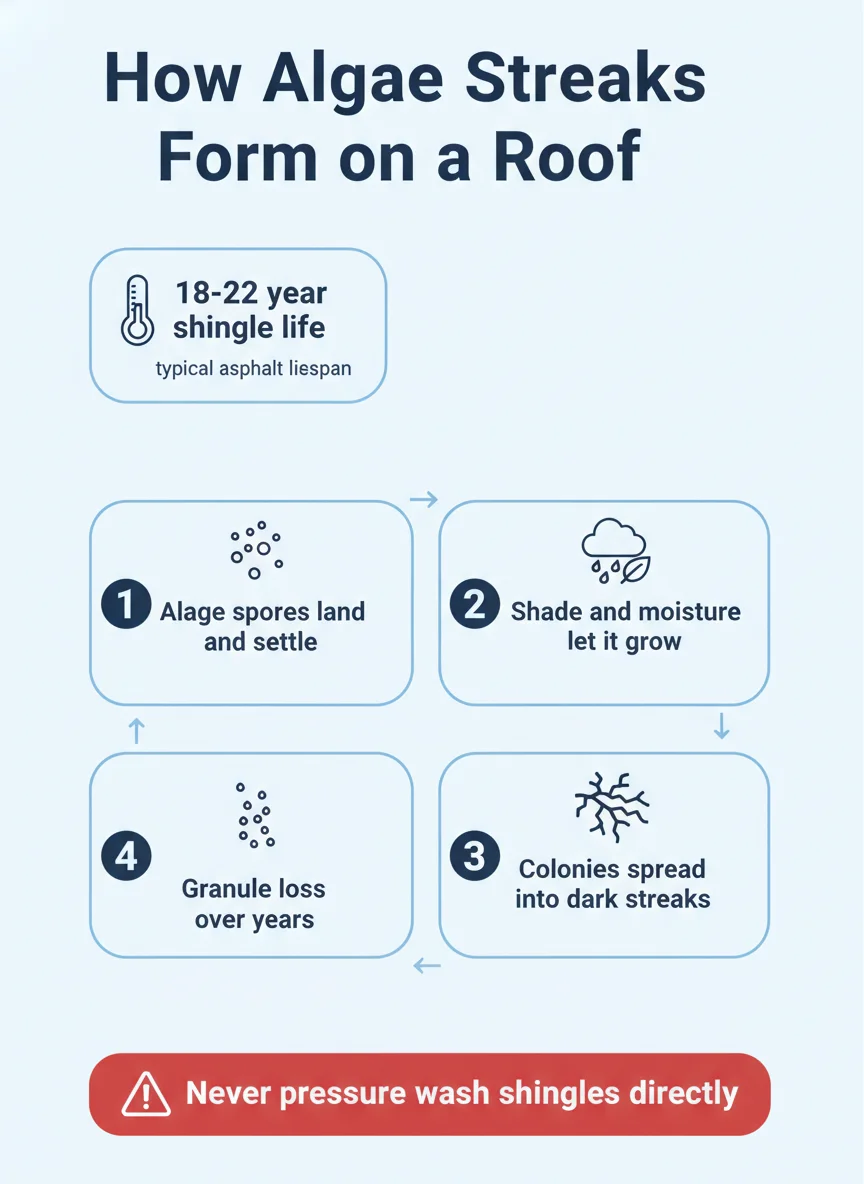
Algae spores travel on the wind and land on roofs everywhere, but they only establish a visible colony where conditions favor them, meaning shade, moisture, and a rough surface to grip onto. Once a colony starts, it spreads outward and downward as rain washes spores from an established patch onto the shingles below it, which is why streaks almost always run in vertical lines rather than random spots.
Neighboring homes with the same roof age, pitch, and tree exposure often develop streaking around the same time, since they're dealing with identical spore pressure and moisture conditions. It's part of why algae staining reads as a neighborhood-wide pattern rather than a flaw specific to one house or one installation.
Cosmetic Stage vs. Long-Term Growth
In the early going, algae staining is purely cosmetic. It doesn't compromise the shingle's ability to shed water, and it doesn't void a manufacturer's waterproofing warranty on its own. The bigger concern is what happens if it's left unaddressed for years at a stretch.
Thick, long-established algae mats hold moisture against the shingle surface longer than a clean roof would, and that sustained dampness can accelerate granule loss in the affected area. Granules are what protect the asphalt layer underneath from UV breakdown, so a roof that's lost granules to years of algae growth will age faster in that spot than the rest of the field.
| Stage | What It Looks Like | What It Means |
|---|---|---|
| Early | Faint gray or green haze on shaded slopes | Cosmetic only, no action required |
| Established | Dark vertical streaks, visible from the street | Good time to clean, still cosmetic |
| Long-term | Thick black mats, some granule bald spots | Accelerated wear, worth a roof repair check |
What's Actually on Your Shingles and Why It Matters
Asphalt shingles are built in layers: a fiberglass mat, asphalt coating, and a top layer of mineral granules that give the shingle its color and its UV protection. Algae lives entirely on that top granule layer, which is good news, because it means treating the growth doesn't require stripping or damaging the shingle underneath.
Some newer shingle lines include copper or zinc granules mixed into the surface specifically to resist algae growth, since both metals are naturally toxic to the organism in small, steady doses as rain washes over the roof. These algae-resistant shingles cost more upfront but hold their clean appearance much longer in a humid climate, which is worth asking about if you're planning a roof replacement anyway.
Step-by-Step: Treating Algae Streaks Safely
The goal with any algae treatment is to kill and loosen the growth with a chemical solution, then rinse it away with low pressure rather than blasting it off mechanically. Here's the general sequence a careful cleaning follows.
- Protect landscaping first: Wet down plants and shrubs below the roofline and cover anything delicate, since cleaning solutions can be hard on foliage if they drip down unprotected.
- Apply a roof-safe cleaner: A solution formulated for asphalt shingles, applied with a low-pressure sprayer, is left to sit and work on the algae for the time the product specifies.
- Let it dwell: Most cleaners need several minutes of contact time to break down the algae's protective coating before rinsing, so patience here matters more than scrubbing.
- Rinse from the top down: A garden hose or low-pressure rinse, working from the ridge down toward the gutters, carries the dissolved algae off the roof without forcing water under the shingle tabs.
- Check the gutters: Algae residue and cleaning runoff collect in the gutter system, so a quick flush afterward keeps downspouts from clogging with the debris.
- Reassess after it dries: Streaks often look worse wet than they will once the roof fully dries, so it's worth waiting a day before deciding if a second treatment is needed.
How Do You Tell Algae Streaks From Real Roof Damage?
Algae streaks stay on the surface and don't change the shape or texture of the shingle underneath, which is the main thing that separates them from actual wear. If you run a hand along a streaked area and the shingle still feels intact and flat, you're looking at a surface issue rather than a structural one.
Signs It's Still Just Algae
The streaking follows a clear vertical pattern from a high point downward, it's concentrated on shaded or north-facing slopes, and the shingles beneath it still lie flat without curling, cracking, or missing granules in large bald patches. This is the version you can treat on your own timeline without urgency.
Color alone, even dense black streaking, isn't a sign of leaking or structural trouble. Plenty of roofs in good working condition carry heavy algae staining simply because of how much shade and humidity they sit under year-round.
Signs It's Turned Into Something Else
Curling tabs, visible bald spots where the granules have worn through to bare asphalt, or soft spots when you press on the roof from inside the attic all point to wear that's gone past a surface stain. These are the signals worth getting a second opinion on rather than treating as algae alone.
If streaking shows up alongside a recent storm, granule buildup in the gutters beyond what's normal, or a new interior stain on a ceiling, that combination points toward storm-related wear rather than ordinary algae growth, and it's worth a proper roof repair evaluation rather than a cleaning.
Can You Clean Algae Off Yourself, or Does It Need a Pro?
A light coating of algae on a single-story home with easy roof access is a reasonable DIY project for a homeowner comfortable on a ladder, using a roof-safe cleaner and a garden hose rather than a pressure washer. The main risk isn't the chemistry, it's the footing, since wet shingles get slick fast and a fall is the real hazard here.
Steep pitches, two-story homes, or roofs with heavy, long-established algae mats are where it makes more sense to call a professional. A trained crew knows how to work safely on pitched surfaces, how long to let a cleaner dwell without damaging the shingle coating underneath, and how to spot the difference between a cosmetic stain and early wear while they're already up there.
It's also worth having a professional look if the streaking shows up on a roof that's getting up toward the end of its expected life, since algae on an aging roof sometimes coincides with other wear that's easy to miss from the ground. A combined cleaning and inspection visit covers both at once.
Keeping Streaks From Coming Back
Algae growth is a recurring issue in a humid climate, not a one-time fix, so homeowners who clean their roof once usually see some regrowth within a few years, especially on shaded slopes. Trimming back overhanging tree limbs to let more sun and airflow reach the roof surface slows regrowth more than almost anything else you can do without replacing shingles.
If you're due for a new roof regardless of the algae, asking about algae-resistant shingle options is worth the conversation, since they hold their clean look far longer in a climate like Coweta County's. Griffintegrity Roof & Remod Inc can walk you through what's involved in either a cleaning or a longer-term shingle upgrade.
Frequently asked questions
Are black streaks on a roof actually mold?
No, the dark streaks are almost always a type of algae called Gloeocapsa magma, not mold or mildew. It feeds on the limestone filler in asphalt shingles and spreads as dark colonies rather than the fuzzy growth typical of mold.
Do black streaks mean my roof is failing?
Not by themselves. Algae staining is cosmetic in its early stages and doesn't mean the shingles have lost their waterproofing ability, though long-term growth can trap moisture against the surface and accelerate granule loss over time.
Can I pressure wash the streaks off myself?
We don't recommend it. A pressure washer forces water under the shingle tabs and strips the protective granules, which shortens the roof's life even though it clears the streaks temporarily.
What's the safest way to clean algae off shingles?
A low-pressure application of a cleaning solution designed for roofs, applied from the ground or a ladder and rinsed gently, is the standard safe method. Many professionals use a soft-wash approach rather than anything with mechanical force.
Will new shingles stop the streaking from coming back?
Algae-resistant shingles, which have copper or zinc granules mixed in, slow regrowth significantly compared to standard shingles, though no shingle is permanently immune in a humid climate like Georgia's.