Why This Decision Matters More in Georgia
Homeowners across Coweta County and the south side of metro Atlanta deal with a specific mix of weather: long, humid summers that bake a roof in direct sun, spring storm systems that bring hail and heavy wind, and enough annual rainfall to punish any material with weak flashing or poor drainage. The roofing material you choose has to handle all of that, not just look good on the day it goes on.
Asphalt shingles remain the most common choice on Georgia homes because they're familiar, widely available, and work with almost any roof style. Metal roofing has grown in popularity for homeowners who plan to stay put for decades and want to stop thinking about roof replacement. Neither material is universally better, the right pick depends on your budget, your timeline, and what you want out of the house.
How Each Material Actually Performs
The core difference comes down to how each material sheds water, handles impact, and ages under UV exposure. Shingles are layered, overlapping pieces that rely on granule coating and asphalt saturation to stay watertight. Metal is a continuous or near-continuous surface that relies on seams, fasteners, and coatings instead.
Asphalt Shingles in Georgia Heat and Storms
Asphalt shingles across the industry typically run 18-22 years of service life in Georgia's UV and heat conditions, though that range shifts with shingle grade and attic ventilation. Architectural shingles hold up better than basic three-tab in wind, and impact-resistant versions are built specifically to handle hail bruising. Heat does shorten lifespan over time because repeated expansion and contraction stresses the asphalt.
On the plus side, shingles are easier and generally less costly to repair section by section after storm damage, since a roofer can replace a damaged area without redoing the whole field. They also come in more color and texture options, which matters if you're trying to match a specific architectural style or HOA requirement.
Metal Roofing Through Georgia Seasons
Metal roofing, whether standing seam or screw-down panel, is built for a much longer service window, often cited publicly in the 40 to 70 year range depending on the coating and gauge. It sheds heavy rain fast, handles wind uplift well when installed correctly, and resists the granule loss and curling that eventually age out a shingle roof.
The tradeoff is a higher upfront investment and a narrower pool of installers who do it correctly. Standing seam in particular requires precise seaming and fastening details, and a poor install shows up later as leaks at the seams or around penetrations rather than as a simple missing shingle.
| Factor | Asphalt Shingles | Metal Roofing |
|---|---|---|
| Typical lifespan | 18-22 years | 40-70 years |
| Upfront cost | Lower | Higher |
| Noise in rain | Quiet with standard decking | Quiet with solid decking and underlayment |
| Hail behavior | Bruising, granule loss | Denting, generally structural integrity holds |
What's Actually Happening Underneath the Surface
Whichever material sits on top, the roofing system underneath does most of the real work. Underlayment, flashing around chimneys and vents, and proper attic ventilation all affect how long either material lasts and how well it resists leaks. A premium metal panel installed over poor underlayment will still leak, and a basic shingle installed with careful flashing and good ventilation can outperform expectations.
This is why the installer matters as much as the material. Both systems depend on correct fastening patterns, properly lapped underlayment, and flashing details at every valley, wall, and penetration. A roof replacement & installation project should cover all of this regardless of which material you choose, not just the visible top layer.
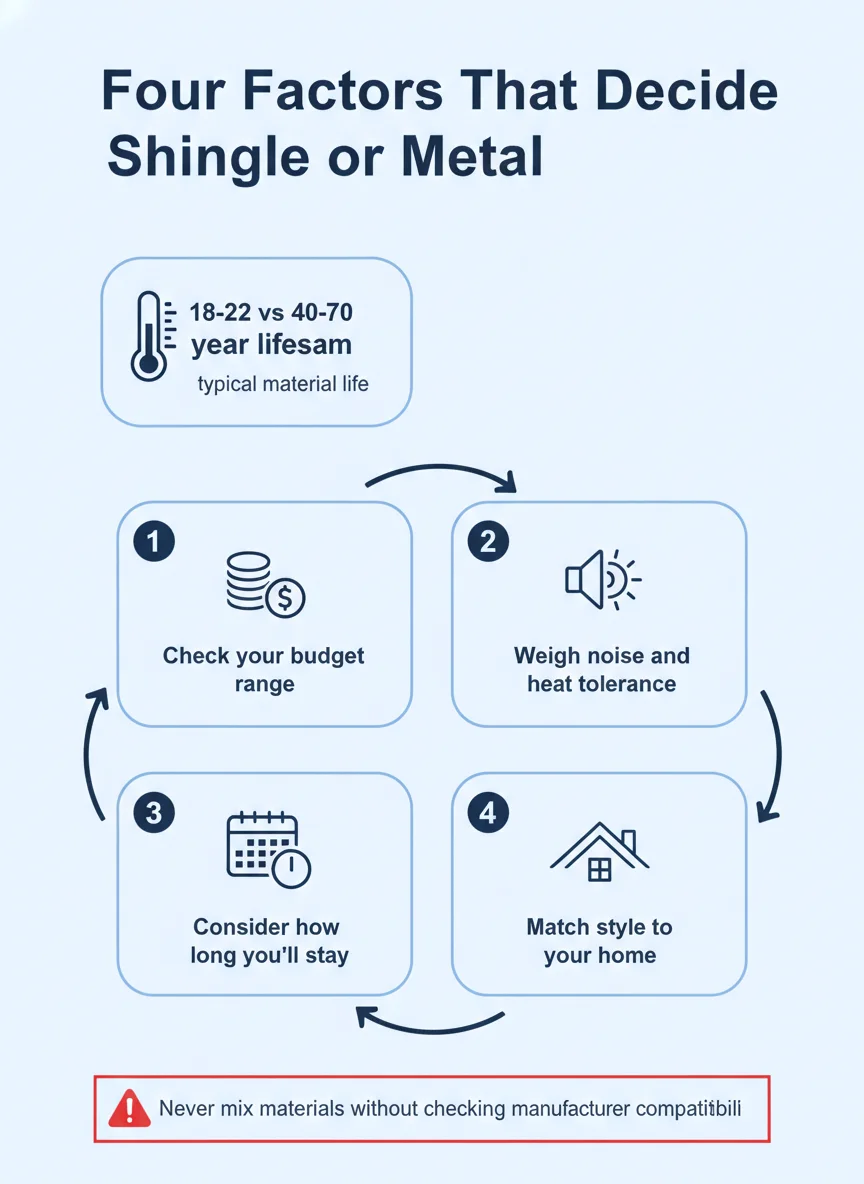
Step-by-Step: How to Decide Between the Two
Walking through a short sequence of questions makes the decision clearer than comparing price tags alone.
- Set your timeline: Decide how many more years you plan to live in the house. A shorter timeline favors the lower upfront cost of shingles.
- Check your budget range: Metal carries a higher material and labor cost, so confirm it fits before falling in love with the look.
- Think about noise and heat: Both perform well with proper decking and insulation, but ask your installer specifically what's planned for your attic.
- Consider resale expectations: Metal roofing is often seen as a selling point in listings, while a newer shingle roof also reassures buyers.
- Match your home's style: Metal fits modern and farmhouse aesthetics well; shingles blend more easily into traditional subdivisions.
- Ask about local installers: Confirm whoever you hire has real experience with the specific material, standing seam work is a different skill set than shingle work.
- Get it in writing: Whatever you choose, get the materials, warranty terms, and scope spelled out clearly before work starts.
What You'll Notice Once It's Installed
The differences between the two materials become most obvious in the first year or two of ownership, particularly during the first hard rain and the first real heat wave.
Living With a Shingle Roof
Shingle roofs blend into the neighborhood and rarely draw attention, which some homeowners prefer. You'll want to keep an eye out for granule buildup in gutters, curling edges, and any missing tabs after wind events, since those are early signs of wear worth addressing before they become leaks.
Maintenance is generally straightforward: periodic inspections, prompt repair of any storm damage, and keeping gutters clear so water doesn't back up under the shingle edges.
Living With a Metal Roof
Metal roofs typically need less routine attention once installed correctly. You'll mostly be watching for loose fasteners over time, scuffed coating from debris, and making sure sealant at penetrations stays intact during annual checks.
Because metal roofing is less common in most Georgia subdivisions, some homeowners also enjoy the distinct look it gives a home among a street full of shingle roofs.
What You Can Check Yourself vs What Needs a Pro
Homeowners can reasonably do a visual check from the ground: look for missing or curling shingles, rust streaks on metal, sagging sections, or debris buildup in valleys. Binoculars make this easier and safer than climbing up yourself.
Anything involving walking the roof surface, assessing flashing integrity, or evaluating decking condition should go to a licensed roofer. Both materials hide problems well from the ground, and a bad flashing detail or soft decking spot won't show up until water is already getting in.
Material selection itself is also worth a professional conversation, since local wind exposure, roof pitch, and attic ventilation all affect which option makes more sense for your specific house rather than a generic recommendation.
Making the Final Call
There's no universally correct answer between asphalt shingles and metal roofing, only the right answer for your budget, timeline, and taste. Shingles remain the practical, cost-effective choice for most Georgia homes, while metal pays off for homeowners planning to stay long term and wanting to minimize future roof decisions.
Whichever direction you lean, get a clear look at your current roof's condition first, since that often influences timing more than the material debate itself. Griffintegrity Roof & Remod installs both asphalt shingle and metal roofing systems across Coweta County and can walk through which one fits your home.
Frequently asked questions
Is metal roofing worth it in Georgia?
It can be, especially for homeowners planning to stay in the house long term since metal typically lasts far longer than asphalt. The upfront investment is higher, so the math depends on how many years you expect to get out of the roof.
Does metal roofing attract lightning?
No, metal does not attract lightning any more than other roofing materials, and it is non-combustible, which is actually a safety advantage in a strike. This is a common myth that isn't backed by how lightning actually behaves.
Is a metal roof noisier in the rain?
With proper solid decking and underlayment, a metal roof is not noticeably louder than asphalt shingles in a typical rainstorm. The noisy-metal-roof reputation mostly comes from older barn-style installs without decking underneath.
Can you put metal roofing over existing shingles?
Some metal systems can go over an existing layer, but a tear-off gives a better long-term result because it lets the installer check the decking underneath. [Roof-over or tear-off](/blog/roof-over-or-tear-off-why-most-roofers-recommend-removing-the-old-layer) covers why most roofers lean toward removal.
Which material handles Georgia hail better?
Both can take hail damage, but impact-resistant shingle options and standing seam metal panels each have different failure patterns. Metal tends to dent rather than crack, while shingles can bruise or lose granules, so the repair approach differs between the two.