
Why Attic Airflow Matters in a Georgia Climate
Coweta County summers push attic spaces well above outdoor temperatures when there's nowhere for hot air to go, and the humid stretches that follow give trapped moisture a place to settle. A roof's job is usually described as keeping water out, but what happens underneath the shingles, in the attic itself, has just as much influence on how long that roof lasts. Most homeowners never think about attic air until a cooling bill jumps or a contractor points out staining on the underside of the decking.
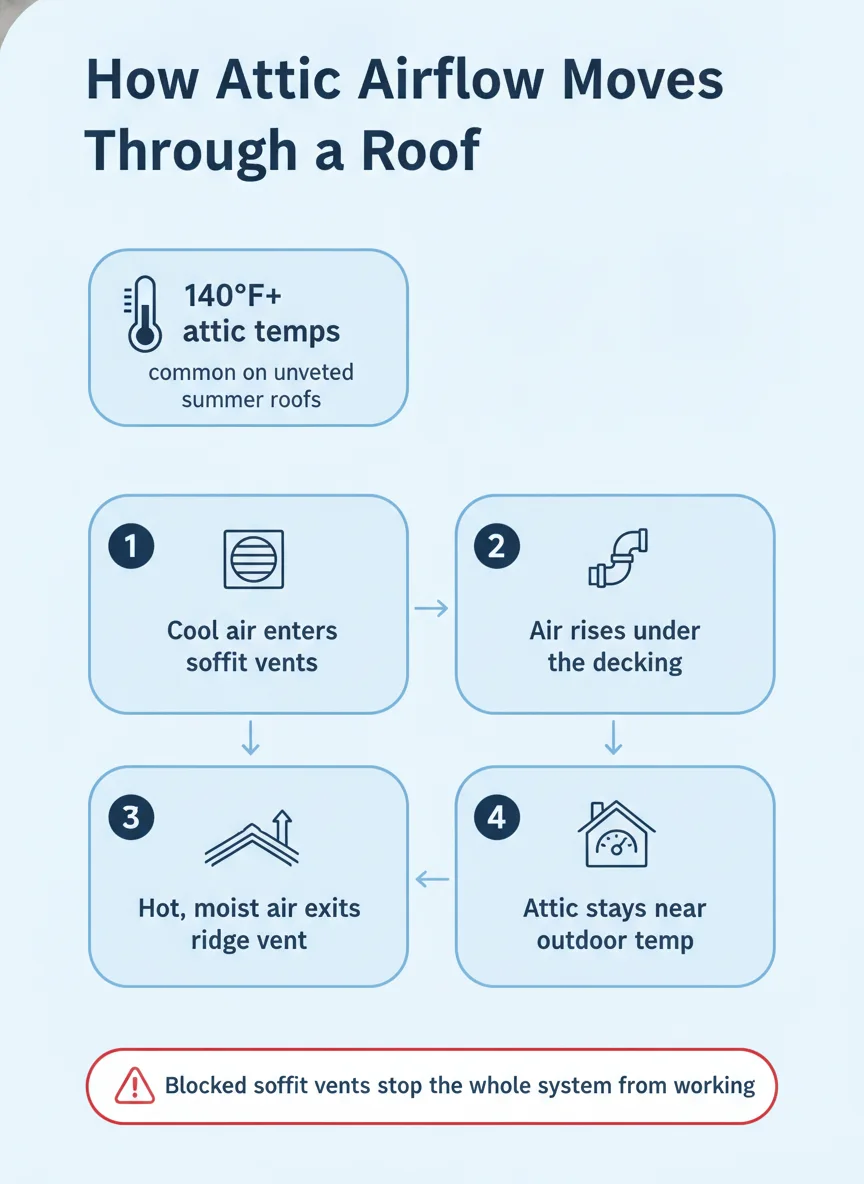
Ventilation isn't a single part you can point to, it's a system of intake and exhaust working together to keep air moving through the space above the insulation. When that system is working, the attic stays close to outdoor temperature year-round. When it isn't, heat and moisture build up right against the materials that are supposed to be protecting the house, and the effects show up slowly, which is exactly why they get missed.
How Does Attic Ventilation Actually Work?
A balanced ventilation system moves outside air in through low points on the roof and pushes it back out near the top, carrying heat and moisture with it. It relies on two matched pieces doing different jobs, and if either one is undersized or blocked, the whole system underperforms no matter how good the other half is.
Intake Vents: Where Fresh Air Gets In
Intake typically happens at the soffit, the underside of the roof overhang, through continuous vents or individual vent openings cut into the material. This is the lowest point of the attic airflow path, and it's where cooler, drier outside air enters the space before it has a chance to warm up near the roofline.
The most common failure point in older homes is insulation that's been added over the years and pushed too far into the eaves, physically covering the soffit vents from the inside. A vent can look clear from outside and still be completely blocked a few inches in, which is why an attic walk-through matters more than a glance at the roofline.
Exhaust Vents: Where the Heat Escapes
Exhaust is usually handled at or near the ridge, either through a continuous ridge vent that runs the length of the peak or through individual roof-mounted vents spaced across the upper slopes. Warm air naturally rises, so placing the exhaust at the highest point lets the system work with physics instead of against it.
A house with strong exhaust but weak or blocked intake will often pull conditioned air from inside the living space through ceiling gaps instead, which drives up cooling costs without actually solving the attic's heat problem. The two sides have to be sized and balanced together, not addressed one at a time.
| Condition | What's Happening | What It Costs You |
|---|---|---|
| Balanced intake and exhaust | Air moves continuously through the attic near outdoor temperature | Normal shingle life, stable energy bills |
| Blocked soffit, open ridge | Exhaust pulls conditioned air from the house instead of the attic | Higher cooling bills, little attic cooling benefit |
| No ridge venting, open soffit | Fresh air enters but has nowhere to exit, heat pools at the peak | Hot spots under decking, faster shingle aging |
| Both blocked or undersized | Little to no airflow, moisture and heat both build up | Decking damage risk, higher chance of premature roof wear |
What a Hot or Damp Attic Actually Does to a Roof
Shingles are engineered to handle heat from above, from direct sun, but they age faster when heat also builds up from underneath with nowhere to dissipate. Sustained high attic temperatures bake the asphalt from the back side, and over years that shows up as curling, cracking, or granule loss well ahead of the material's expected lifespan.
In colder stretches, a different problem shows up: warm, moist air from the living space rises into the attic and condenses on the cold underside of the decking, especially near the eaves. That moisture can appear as frost on nail tips on a cold morning, or as dark staining and softening on the plywood itself if it happens repeatedly. Wood decking that stays damp for long periods is also more hospitable to mold and, eventually, rot.
Step-by-Step: Checking Your Attic's Ventilation
Most of this can be done with a flashlight and ten minutes in the attic on a day with decent weather. It won't replace a professional assessment, but it will tell you whether it's worth scheduling one.
- Pick a hot afternoon: Check the attic on a sunny day when the heat difference between inside and outside the attic will be most obvious.
- Feel the temperature: If the attic feels dramatically hotter than the outdoor air within a minute or two of entering, airflow is likely restricted.
- Look at the soffits: From inside the attic, check whether insulation is covering the vent openings at the eaves; daylight should be visible through them.
- Check for staining: Look at the underside of the decking near the ridge and eaves for dark streaks, soft spots, or old frost marks.
- Note any smell: A musty or damp smell in the attic, even without visible staining, often points to trapped moisture.
- Check the ridge line: From outside, confirm there's a visible ridge vent or roof-mounted vents; a solid ridge cap with nothing else is a sign of exhaust-only or no mechanical ventilation.
What You'll Typically Find: Reading the Signs
Heat-Related Wear
Shingles that are curling at the edges, losing granules faster near the ridge than at the eaves, or noticeably faded compared to a shaded section of the same roof are often showing heat damage from below rather than sun damage from above. This pattern is worth mentioning to whoever inspects the roof, since it points the diagnosis toward ventilation rather than just the shingles themselves.
Moisture-Related Wear
Dark water-stain rings on the decking, soft or spongy plywood when pressed, or visible mold growth on the underside of the roof sheathing all point to condensation rather than an active leak, especially if there's no corresponding stain on the shingles outside. This distinction matters because the fix for condensation is airflow, not a patch.
What a Homeowner Can Check vs. What Needs a Roofer
The attic walkthrough described above is something most homeowners can do safely, it just takes a flashlight, a dust mask, and caution around exposed insulation and ceiling joists. Spotting obvious signs like blocked soffits, visible daylight gaps, or staining is well within reach for anyone comfortable in an attic.
Calculating the right balance of intake to exhaust for a specific attic, cutting new vent openings without compromising the roof deck's structure, and correcting insulation that's blocking airflow without reducing R-value are jobs for a licensed roofing contractor. Getting the ratio wrong, or cutting vents in the wrong spot, can create new leak points or leave the imbalance unresolved.
Ventilation corrections are also something worth bringing up during any larger roof work, since adding or upgrading vents is far simpler while the shingles are already off than as a standalone repair later. It's a natural add-on to a roof replacement rather than a separate project.
Keeping an Eye on It Going Forward
Attic ventilation isn't something that needs constant attention, but it's worth a look whenever insulation gets added, after any roof work, and anytime cooling bills jump without an obvious cause. A few minutes in the attic twice a year, paired with the seasonal roof checklist, catches most problems while they're still cheap to fix.
Homeowners in Newnan and the surrounding towns dealing with high attic heat, visible staining, or shingles aging faster than expected can have Griffintegrity Roof & Remod take a look at the whole system, not just the shingles on top of it.
Frequently asked questions
How do I know if my attic has bad ventilation?
The clearest signs are a cooling bill that seems high for the house's size, visible frost or dark staining on the underside of the roof decking in winter, and shingles that look curled or faded faster than the rest of the neighborhood. A quick look in the attic on a sunny afternoon, if it feels noticeably hotter than outside, that is a sign air isn't moving through like it should.
Can too much insulation cause roof problems?
Yes, when insulation is pushed all the way to the roofline it can bury the soffit vents and cut off the intake air the system depends on. Attic insulation should stop short of the eaves, or use baffles to hold a clear air channel open above it.
What is the difference between intake and exhaust vents?
Intake vents, usually in the soffit or eaves, pull cooler outside air into the lowest part of the attic. Exhaust vents, typically along the ridge or through roof-mounted vents, let that air (now warmer and carrying moisture) escape near the peak, and the two have to work together or neither does much good.
Does poor attic ventilation shorten shingle life?
It can. Sustained heat buildup under the decking accelerates the breakdown of asphalt shingles from underneath, and trapped moisture in winter can warp decking and feed mold, both of which show up as premature aging rather than a sudden failure.
Should I add ridge vents to an older house?
In many cases, yes, older homes in this area were often built with minimal or no ridge venting, and adding it alongside working soffit vents is one of the more cost-effective upgrades available during a [roof replacement](/services/roof-replacement-installation) or re-roof.