
When a Storm Opens Your Roof in Coweta County
Georgia sees its share of straight-line wind, fast-moving thunderstorms, and the occasional tree limb that doesn't survive a wet spring. When one of those events tears off shingles or drops a branch through the decking, the clock starts running. Every hour that opening sits exposed is another hour water can work its way into insulation, drywall, and framing.
Homeowners across Newnan, Sharpsburg, Peachtree City, and the rest of Coweta County deal with this more than people expect, usually right after a line of storms rolls through. What you do in the first 24 hours matters more than almost anything that happens after, because it's the difference between a contained repair and a ceiling that has to come down.
Why Those First Hours Matter So Much
Water doesn't wait for a convenient time to find the path of least resistance. Once it's inside the roof assembly, it spreads along joists and travels well past the point where the opening is, which is why a hole that looks small from the ground can soak a much larger section of ceiling than you'd guess.
What happens if the opening sits overnight
A single night of rain through an open section can be enough to saturate insulation and stain drywall, and saturated insulation loses most of its effectiveness even after it dries. If the water finds its way to a light fixture or outlet, you've also got an electrical hazard on top of the water damage.
The longer wood framing stays wet, the more likely it starts to swell, warp, or grow mold, none of which show up on day one. That's the real argument for getting a tarp on fast rather than waiting to see how bad it looks in daylight.
What a fast response actually prevents
Getting ahead of the water keeps the damage contained to the area the storm actually hit, instead of letting it spread into rooms that were never touched. It also keeps your options open. A roof that's caught early is often a repair, while one left open for days can turn into something bigger.
Fast action also matters for your insurance claim. Most policies expect you to take reasonable steps to prevent further damage, and documented, prompt action on your part supports a smoother claim rather than a disputed one.
| Situation | What You're Likely Looking At | What to Do |
|---|---|---|
| Small hole, caught same day | Localized water intrusion, minor staining | Catch water, call a crew, tarp within hours |
| Hole left overnight in rain | Saturated insulation, ceiling stains spreading | Tarp immediately, expect interior drying time |
| Large opening, multiple days exposed | Framing wet, possible mold risk, wider interior damage | Tarp and call a crew the same day, document everything |
What a Tarp Is Actually Doing Up There
A tarp isn't a repair. It's a temporary barrier that keeps rain out of an opening while you wait for a crew to do the real fix. A good tarp job covers the damaged area with margin on every side, runs underneath the surrounding shingles or panels rather than just laying on top, and gets anchored down with boards or straps so wind can't get under an edge and rip the whole thing loose.
That last part is where most DIY tarp jobs fail. A tarp that isn't properly secured at the edges turns into a sail in the next gust, and a loose tarp flapping in the wind can do more damage pulling at nails and flashing than the original opening did.
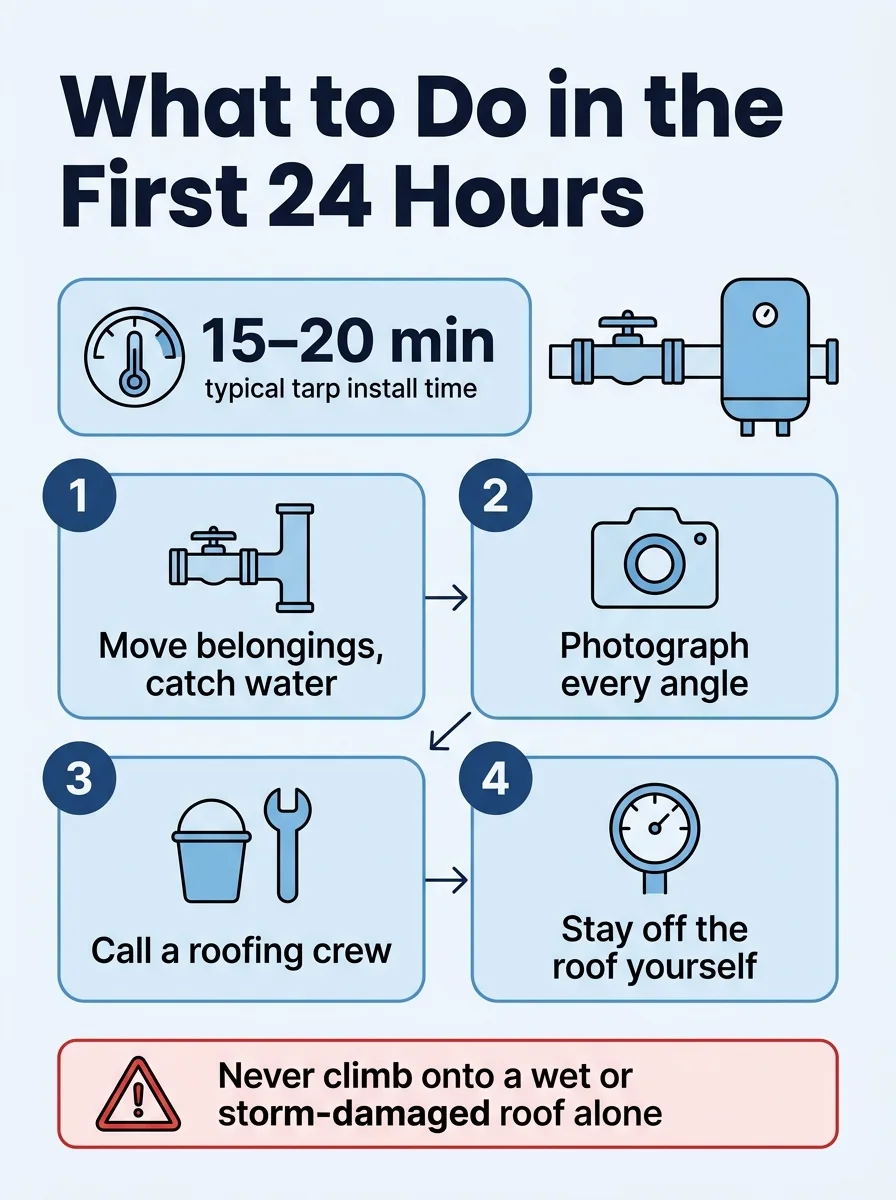
Step-by-Step: What to Do in the First 24 Hours
Here's the order that actually protects your home and your claim, from the moment you notice the damage to the point a crew arrives.
- Get everyone clear: If there's an active leak or visible structural damage, move people and pets out of that room until it's assessed.
- Move belongings out: Pull furniture, electronics, and anything valuable away from the drip line before it spreads further across the ceiling.
- Catch the water: Set buckets, trash cans, or towels under the leak, and if the ceiling is bulging with trapped water, poke a small controlled hole to let it drain in a contained spot.
- Photograph everything: Take wide shots and close-ups of the damage, inside and out, before anyone touches or covers it. This is what your insurer will want to see.
- Call a roofing crew: Reach out to a professional team for emergency tarping rather than attempting it yourself, especially if the deck is wet or the pitch is steep.
- Stay off the roof: Leave the climbing to a trained crew with the right equipment. A storm-damaged roof can hide soft spots you can't see from the ground.
- Schedule the real repair: Once the tarp is up, get a full inspection scheduled so the opening gets a permanent fix before the tarp wears out.
What You'll Find Once the Tarp Comes Off
When a crew pulls the tarp back for the actual repair, the damage underneath often looks different than it did the night of the storm. Wet decking can show soft spots that weren't visible before, and what looked like a single broken shingle from the ground sometimes turns out to be a cluster of lifted or cracked ones nearby.
Signs the damage goes beyond the visible hole
Dark staining that extends well past the opening, a soft or spongy feel underfoot on the decking, and granule loss on shingles near the damaged area are all signs the storm affected more than the obvious spot. These usually point to a repair that's bigger than a single-shingle patch.
If you're seeing signs of storm or hail damage spread across a wider section of the roof rather than isolated to the limb strike or wind tear, that's worth flagging to whoever does your inspection so it gets documented for insurance purposes.
When the opening is isolated
Sometimes you get lucky and the damage really is contained to the one spot the branch hit or the wind tore loose. In that case the fix is usually straightforward, matching materials and sealing the area back up without touching the rest of the roof.
Either way, the tarp did its job if the interior stayed dry and the opening didn't grow while you waited. That's the whole point of getting one up fast.
What You Can Handle Yourself vs. What Needs a Pro
The ground-level steps, moving belongings, catching water, taking photos, and making calls, are all things any homeowner can and should do right away. None of that requires getting on a ladder or touching the damaged area itself.
Actually getting on the roof is where it stops being a DIY job. Wet shingles, soft decking, and the pitch itself all add up to a real fall risk, and a tarp that isn't anchored correctly can rip loose and make the opening worse instead of better. This is work for a crew with harnesses, the right fasteners, and experience reading a damaged roof surface.
The permanent repair afterward almost always needs a licensed roofer too, both for the quality of the work and because insurance claims typically want documentation from a professional inspection rather than a homeowner's own assessment.
Getting Through the First Day
The first 24 hours after a tree limb or a bad storm opens up your roof are about containment, not perfection. Catch the water, document the damage, keep people off the roof, and get a professional tarp up as fast as you can. Everything after that, the full inspection, the insurance conversation, the actual repair, moves a lot smoother when that first day was handled right.
If you're dealing with storm damage anywhere in Coweta County or the towns around Newnan, Griffintegrity Roof & Remod is a call away for emergency tarping and the inspection that follows.
Frequently asked questions
What should I do first if my roof is leaking during a storm?
Move furniture, electronics, and anything valuable out from under the leak, then set a bucket or trash can to catch the water. Do not go on the roof while it's raining or windy. Once the water is contained, call a roofing company to get a tarp on before the next round of weather.
How long does a tarp stay on a roof before it needs to be replaced?
A properly installed tarp is a short-term fix meant to hold for days to a few weeks, not a season. Wind, sun, and rain wear tarps down fast, so the opening still needs a permanent repair as soon as a crew can get to it.
Can I tarp my own roof after storm damage?
It's not recommended. A storm-damaged roof deck can be soft, slick, or structurally weakened in ways you can't see from the ground, and a fall from that height is a serious injury risk. A trained crew knows how to anchor a tarp so it doesn't rip loose in the next gust, which is the main reason DIY tarp jobs fail.
Will my insurance cover emergency tarping?
Most homeowner policies cover reasonable steps to prevent further damage after a covered event, which is exactly what emergency tarping is, but coverage details vary by policy. Keep every photo and receipt, and ask your adjuster directly if tarping costs are reimbursed separately from the repair.
What does a tarp actually protect against?
A tarp keeps rain out of an open section so water doesn't soak into insulation, drywall, and framing while you wait on a permanent fix. It does not restore structural integrity, stop every drop in a sideways downpour, or replace the need for a real repair.