
Why roof lifespan looks different in Georgia
A roofing material's advertised lifespan is usually a lab number or a national average, and Georgia's climate rarely plays along with either one. Summers in Coweta County and across the metro Atlanta area push attic temperatures well past what shingles are rated for, and that heat cycles up and down with every thunderstorm and cold front that rolls through. Add in the humidity that never fully lets up and you get a climate that's harder on roofing material than the sunbelt average the manufacturers usually quote.
That doesn't mean every roof in Georgia fails early. A well-ventilated attic, quality materials, and a clean installation can push a roof toward the top of its expected range even here. But it does mean a homeowner comparing their roof's age to a national chart should expect to land on the lower half of that range rather than the upper half, especially if the attic has never been checked for ventilation.
What actually determines how long a roof lasts
Lifespan isn't just about the material on top. It's a combination of what the material is, how it was installed, and what conditions it's been living in since the day it went up. Two identical shingle roofs installed the same week can age at very different rates depending on these factors.
Climate and sun exposure
UV exposure breaks down the oils and resins in asphalt shingles over time, which is why a south-facing slope with no tree cover often shows wear years before a shaded north slope on the same house. Georgia's long, intense summers accelerate this more than a milder climate would, and repeated thunderstorm cycles add wind and moisture stress on top of the UV load.
Metal, tile, and slate resist UV breakdown far better than asphalt, which is a big part of why their lifespans run so much longer. But even those materials depend on the fasteners, flashing, and underlayment beneath them holding up, and those components age on their own timeline regardless of what's on the surface.
Ventilation and installation quality
A hot, poorly ventilated attic bakes the underside of the roof deck and the back of the shingles simultaneously, which shortens lifespan from both directions at once. Proper intake and exhaust ventilation keeps attic temperatures closer to outdoor air and is one of the few factors a homeowner can control without replacing anything on the roof itself.
Installation quality matters just as much. Nailing patterns, flashing details around chimneys and valleys, and starter course placement all affect how a roof performs over decades, not just in the first few years. A rushed or undersized crew can turn a premium material into a roof that underperforms its rating by a decade or more.
| Material | Typical lifespan range | What shortens it in GA |
|---|---|---|
| Three-tab asphalt shingles | 18-22 years | Intense sun exposure, poor attic ventilation, thin material |
| Architectural asphalt shingles | 24-30 years | Same heat cycling, but thicker construction resists it longer |
| Metal roofing (standing seam or screw-down) | 40-70 years | Coastal-style salt air is not a factor here, but fastener and sealant wear over decades still applies |
| Tile or slate | 50-100+ years | Underlayment and flashing failure long before the tile or slate itself wears out |
| Flat/low-slope membranes (TPO, EPDM, modified bitumen) | 15-25 years | Ponding water, seam failure, and direct UV exposure on a flat plane |
The roof system, not just the surface layer
What you see from the ground is only part of the roof. Underneath the shingles, metal, or tile sits an underlayment layer that acts as the real waterproof barrier, along with flashing around every penetration, chimney, and valley where water wants to find a way in. The surface material gets the attention, but the system beneath it is what actually keeps a house dry.
This matters for lifespan because the underlayment and flashing often age faster than the visible material, especially on tile and slate roofs where the surface can easily outlast the layer protecting the deck beneath it. A roof that looks fine from the street can still be due for attention if the underlayment has reached the end of its own service life.
Step-by-step: how to estimate your roof's remaining life
You don't need to climb up with a tape measure to get a reasonable read on where your roof stands. These checks, done from the ground and the attic, will tell you most of what you need to know before deciding whether it's time for a closer look.
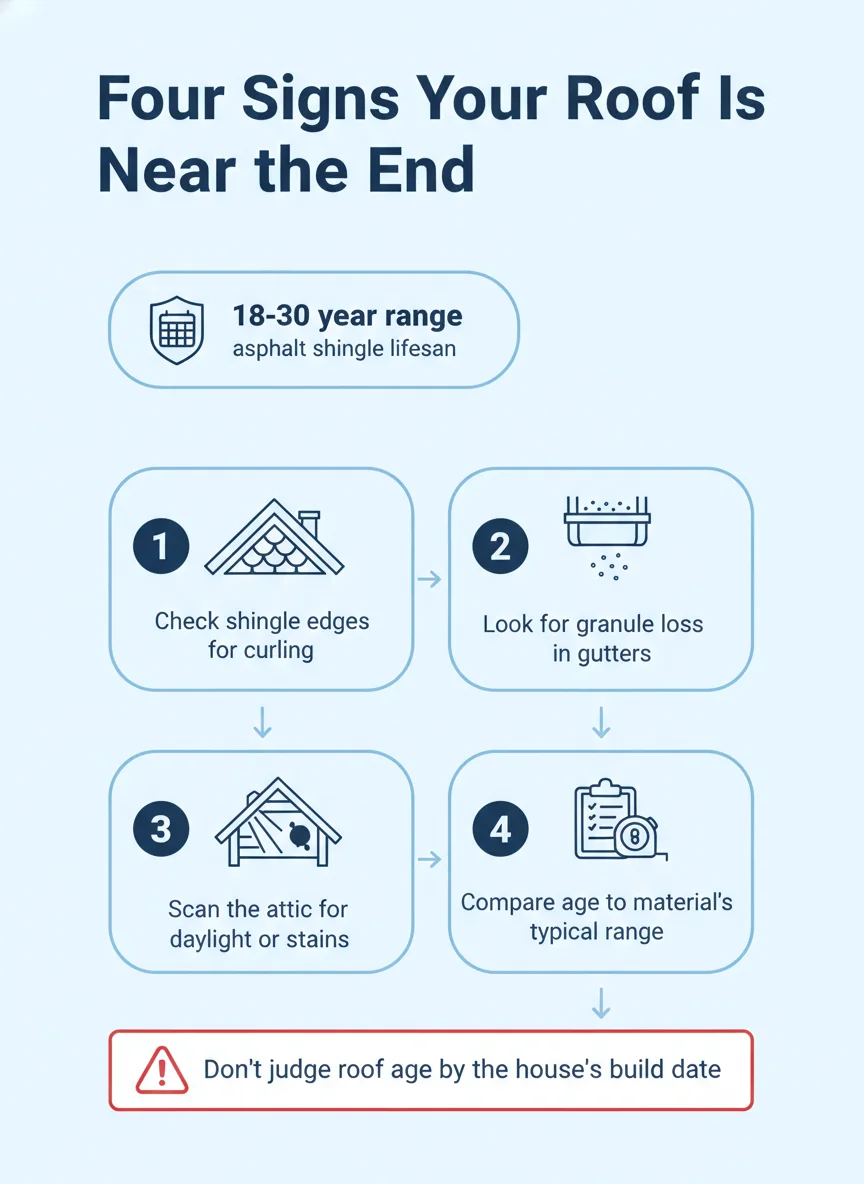
- Find the install date: Check closing paperwork, a permit record, or a past receipt rather than assuming the house's build date is the roof's age.
- Match material to range: Compare the material installed against the lifespan ranges above to get a rough sense of where it sits in its expected life.
- Check shingle condition: Look for curling edges, cracked tabs, or bald spots where granules have worn away, especially on sun-facing slopes.
- Inspect the gutters: Heavy granule buildup in the gutters is a sign the shingles are shedding material faster than normal.
- Walk the attic: Look for daylight through the decking, water stains on the rafters, or a noticeably hot, stuffy attic that suggests poor ventilation.
- Note any recurring leaks: A leak that shows up in a new spot each time it rains usually means the underlayment is failing broadly, not just at one point.
- Get a second opinion: If two or more of these signs show up together, it's worth having a roofer take a direct look before the next storm season.
What the warning signs actually tell you
Not every sign points to the same conclusion, and reading them correctly saves money on both ends, whether that means avoiding an unnecessary replacement or catching a real problem before it spreads.
Signs that usually mean repair is enough
A single leak traced to one damaged section, a handful of missing shingles after a windstorm, or isolated flashing failure around one chimney are typically repairable without touching the rest of the roof. These issues tend to stay contained if they're addressed before water has time to spread under the surrounding material.
Minor granule loss on a roof that's still within its expected age range is also usually not urgent on its own. It's worth monitoring, but it doesn't automatically mean the whole system is failing.
Signs that usually mean it's time to replace
Widespread curling or cracking across multiple slopes, soft or spongy decking felt underfoot, and leaks that keep reappearing in different rooms all point toward a roof that's past the point where repairs make sense. At that stage, patching one area often just shifts the problem to the next weak spot.
A roof that's already near or past the top of its material's expected lifespan combined with any of these signs is a strong case for planning a full replacement rather than another round of repairs.
What a homeowner can check versus what needs a pro
Ground-level and attic checks are safe and useful for any homeowner. Looking at shingle condition through binoculars, checking the gutters for granules, and walking the attic for daylight or stains all give you real information without putting anyone on a ladder or a roof deck.
Climbing onto the roof itself is a different matter. Walking a roof safely, especially a steep or aged one, takes the right footwear, harness points, and knowledge of where the decking is still sound, none of which a one-time visit from a homeowner is set up to handle safely.
A licensed roofer can also spot things a homeowner would miss entirely, like flashing that's been improperly sealed, ventilation that's inadequate for the attic size, or decking that's soft in a spot that looks fine from above. Those are the details that actually determine whether a roof has years left or months.
Getting a straight read on your roof's age
The chart above gives you a starting point, but every roof's real story is in its own condition, not just its material or its calendar age. A ten-year-old shingle roof with poor attic ventilation can be in worse shape than a twenty-year-old one that's been properly vented and maintained the whole time.
If you're not sure where your roof stands, a direct look settles it faster than guessing from the driveway. For more on weighing repair against full replacement, see Roof Replacement & Installation: Repair Or Replace?, and homeowners in Peachtree City and across Coweta County can reach out to Griffintegrity Roof & Remod for a free, no-pressure look at where their roof actually stands.
Frequently asked questions
How long does a roof last in Georgia?
It depends heavily on the material. Asphalt shingles typically run 18 to 30 years depending on grade, metal roofing can reach 40 to 70 years, and tile or slate can exceed 50 years, but Georgia's heat, humidity, and summer storms tend to push actual lifespans toward the shorter end of each range.
Does the age of my house tell me the age of my roof?
No, and this trips up a lot of homeowners. A house built decades ago may have had the roof replaced once, twice, or never, so the only reliable way to know a roof's real age is a receipt, a permit record, or a physical inspection rather than the year on the deed.
What shortens a roof's lifespan the most in Georgia?
Heat cycling and poor attic ventilation are the two biggest factors, since repeated expansion and contraction dries out shingle material faster than in milder climates, and a hot, poorly vented attic bakes the underside of the roof deck year-round.
Can a metal roof really outlast three sets of asphalt shingles?
In terms of raw material life, yes, since quality metal roofing commonly reaches 40 to 70 years against 18 to 30 for asphalt, though the upfront cost and the fact that most homeowners don't stay in one house that long are worth weighing too.
How do I know if my roof needs replacing instead of repair?
Widespread granule loss, curling or cracked shingles across large sections, soft spots in the decking, or recurring leaks in different locations usually point to replacement, while an isolated leak or a handful of damaged shingles is often still repairable.