Why Roof Warranties Confuse Homeowners in Coweta County
Most homeowners across Newnan, Peachtree City, and the rest of the south Atlanta metro sign a roofing contract expecting one warranty and end up with two or three stacked documents that cover different things. The shingle brochure talks about a lifetime warranty, the contractor mentions a separate workmanship guarantee, and somewhere in the paperwork is language about an extended or enhanced tier that requires specific certification to even qualify for. None of that is unusual. It's how the roofing industry structures coverage, and understanding the layers before you sign protects you far better than reading them after a leak shows up.
The confusion matters because each warranty type has its own claims process, its own exclusions, and its own fine print about what voids it. A homeowner who assumes one warranty covers everything can find out the hard way that a ventilation problem the installer created isn't the manufacturer's responsibility, or that a repair done by an unrelated handyman quietly voided a workmanship guarantee. Knowing which warranty covers which failure mode is the single most useful thing you can learn before a new roof goes on.
How the Two Main Warranty Types Actually Work
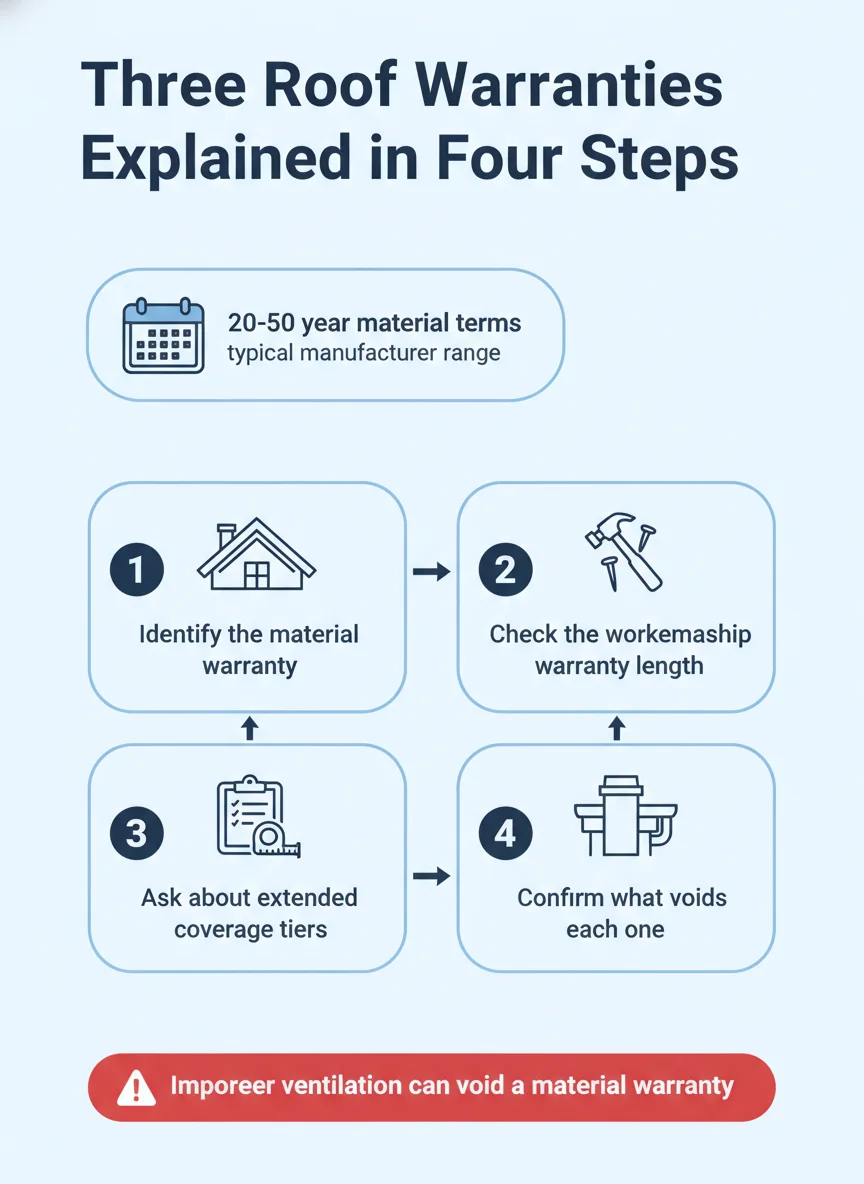
Every new roof carries at minimum a material warranty and, separately, some form of workmanship coverage, and the two protect against completely different failure points.
Material Warranties
A material warranty is issued by the manufacturer, not the installing contractor, and it covers defects in the product itself: granule loss that happens too early, cracking, or a shingle that fails to perform as the manufacturer specified. Standard material warranties on asphalt shingles are commonly written for the lifetime of the product as published by the maker, though coverage often steps down in value after the first several years under a prorated schedule.
What a material warranty does not cover is installation error. If shingles are nailed incorrectly, starter courses are missed, or flashing details are done wrong, that's an installation problem, not a product defect, and the manufacturer will typically deny a claim rooted in installer error. This is exactly why the second type of warranty exists.
Workmanship Warranties
A workmanship warranty is issued by the contractor who did the install, and it covers mistakes in how the roof was put on rather than defects in the shingles themselves. Griffintegrity Roof & Remod, Inc. offers a 10 year workmanship warranty on roof replacements, which means if a leak traces back to an installation issue within that period, the fix is on us, not a new invoice for you.
Workmanship warranty length varies a lot by contractor, and it's one of the clearest signals of how confident a company is in its own crews. A contractor offering one year of workmanship coverage is telling you something different than one offering ten. Ask for the term in writing before work starts, not as a verbal promise during the sales pitch.
| Warranty Type | Who Issues It | What It Covers |
|---|---|---|
| Material | Shingle or product manufacturer | Product defects, premature wear, granule or seal failure |
| Workmanship | Installing contractor | Installation errors, flashing mistakes, nailing pattern issues |
| Extended/System | Manufacturer, through certified contractors | Broader system coverage, often including labor, with stricter installer requirements |
What an Extended or System Warranty Adds
Beyond the base material and workmanship warranties, manufacturers often offer an extended or system-level tier that bundles broader coverage, sometimes including labor costs for a covered repair, not just the shingles. These enhanced tiers are usually only available through contractors who've been vetted and certified by the manufacturer, since the manufacturer is extending more trust and more financial exposure to that installer's work.
Being an Owens Corning Preferred Contractor is the kind of certification that unlocks these enhanced tiers, because it means the installer passed a workmanship review and meets the manufacturer's standards before being allowed to offer the extended coverage to customers. If a contractor quotes you an enhanced or system warranty, it's fair to ask what certification backs it up and how long the company has held it.
Step-by-Step: How to Verify a Roof Warranty Before You Sign
Reading warranty paperwork can feel like legal homework, but working through it in order keeps you from missing the part that matters most.
- Ask for both documents: Request the manufacturer's material warranty and the contractor's workmanship warranty separately, in writing, before the contract is signed.
- Check the term length: Note how many years each warranty runs and whether coverage steps down or prorates after an initial period.
- Confirm certification status: If an extended or enhanced tier is quoted, ask what manufacturer certification the contractor holds that qualifies them to offer it.
- Read the voiding clauses: Look specifically for ventilation requirements, approved accessory lists, and language about repairs by other contractors.
- Ask about transferability: Find out whether either warranty transfers to a new owner if you sell the home, and what paperwork that transfer requires.
- Keep the paperwork: Store both documents with your closing or renovation records since a warranty claim years later will require proof of the original terms.
What Usually Shows Up When a Warranty Claim Gets Denied
Ventilation and Installation Gaps
The single most common reason a material warranty claim gets denied is inadequate attic ventilation, since excess heat and moisture trapped under the roof deck can cause shingles to fail in ways manufacturers specifically exclude from coverage. This is a design and installation issue, which is why it falls on the contractor's side of the warranty split, not the manufacturer's.
Flashing errors around chimneys, skylights, and valleys are the second most common denial point, and they're almost always a workmanship issue rather than a product defect. A homeowner filing a claim on the wrong warranty type for this kind of failure will get bounced back and forth unless the contractor steps up under their own workmanship terms.
Unapproved Repairs and Modifications
Having a different company perform a repair, even a minor one, can void an enhanced or system-level manufacturer warranty because the manufacturer's terms often require that all work on the covered roof be done by a certified installer. This catches homeowners off guard when they call a handyman for a quick fix without realizing it affects coverage on the whole roof.
Modifications like adding solar panels, satellite mounts, or additional roof penetrations without notifying the manufacturer or contractor can also create a gap in coverage for anything related to that new penetration point. It's worth a phone call before any addition goes onto a roof that's still under warranty.
DIY Warranty Checks vs. When to Call a Pro
A homeowner can absolutely review warranty paperwork on their own, compare term lengths, and ask pointed questions before signing a contract. Reading the exclusions section line by line and keeping a folder of the documents is something anyone can do without a license.
Where it gets harder is interpreting whether a specific failure, like a slow leak two years into a new roof, falls under material defect, workmanship error, or something outside both warranties entirely. That diagnosis usually needs an experienced eye on the roof, because the visual difference between a product flaw and an installation mistake isn't always obvious from the ground.
If you're mid-claim and getting conflicting answers from a manufacturer and a contractor, a second licensed opinion can clarify which warranty actually applies before you spend money out of pocket. This is also a good moment to compare a roof repair quote against what the warranty should be covering, so you know whether you're paying for something that shouldn't be a bill at all.
Reading the Fine Print Before the Crew Shows Up
The best time to understand your roof warranty is before the first shingle goes down, not after a leak appears. Ask for every document in writing, confirm the certification behind any enhanced coverage, and keep a copy of the terms somewhere you'll actually find it years later. Homeowners in Newnan and nearby towns who want a plain-language walkthrough of what's in their quote, including the related topic of manufacturer warranty versus workmanship warranty, can ask for that breakdown before signing anything.
A roof is a long-term investment, and the warranty behind it is only as good as your understanding of what it actually promises. Griffintegrity Roof & Remod, Inc. walks every Coweta County customer through these terms in writing before the first tear-off begins.
Frequently asked questions
What is the difference between a material warranty and a workmanship warranty?
A material warranty comes from the manufacturer and covers defects in the shingles or roofing material itself, while a workmanship warranty comes from the contractor and covers mistakes made during installation. You can have a flawless product fail because of a bad install, which is exactly what a workmanship warranty is meant to catch.
Can I transfer my roof warranty if I sell my house?
Many manufacturer warranties allow one transfer to a new homeowner, usually within a limited window after the sale and sometimes for a reduced coverage term. Workmanship warranties vary by contractor, so ask directly whether it's transferable and get the terms in writing.
What can void a roof warranty?
Common voiders include improper attic ventilation, using an uncertified installer for a manufacturer's enhanced warranty tier, unapproved repairs by another contractor, and skipping manufacturer-specified accessories like starter strips or ridge caps. Reading the fine print before the install starts, not after a leak shows up, is how you avoid this.
How long should a roof warranty last?
It depends on the tier: standard material warranties often run the lifetime of the shingle while workmanship warranties are shorter and set by the contractor, commonly in the range of a few years up to a decade or more. Extended or system warranties that combine both tend to carry the longest terms but come with stricter installer requirements.
Does a roof warranty cover storm damage?
No, standard material and workmanship warranties cover defects and installation errors, not wind, hail, or falling debris. Storm damage is typically a homeowner's insurance matter, which is a separate process from warranty coverage.