
Why Knowing Your Roof's Age Actually Matters
If you've ever been asked by an insurance agent, a buyer, or a roofer how old your roof is and had to shrug, you're not alone. Plenty of homeowners in and around Coweta County inherited a roof from a previous owner, bought a house with no paper trail attached, or simply never thought to write the date down. It feels like a small gap until you need the answer for something that matters.
Insurance companies use roof age to set premiums and sometimes to decide whether a policy renews at all. Buyers and their inspectors ask about it before closing. And if you're trying to figure out whether a leak is a quick fix or a sign the whole system is near the end, age is one of the first things a roofer will want to know. The good news is that the real answer is usually findable.
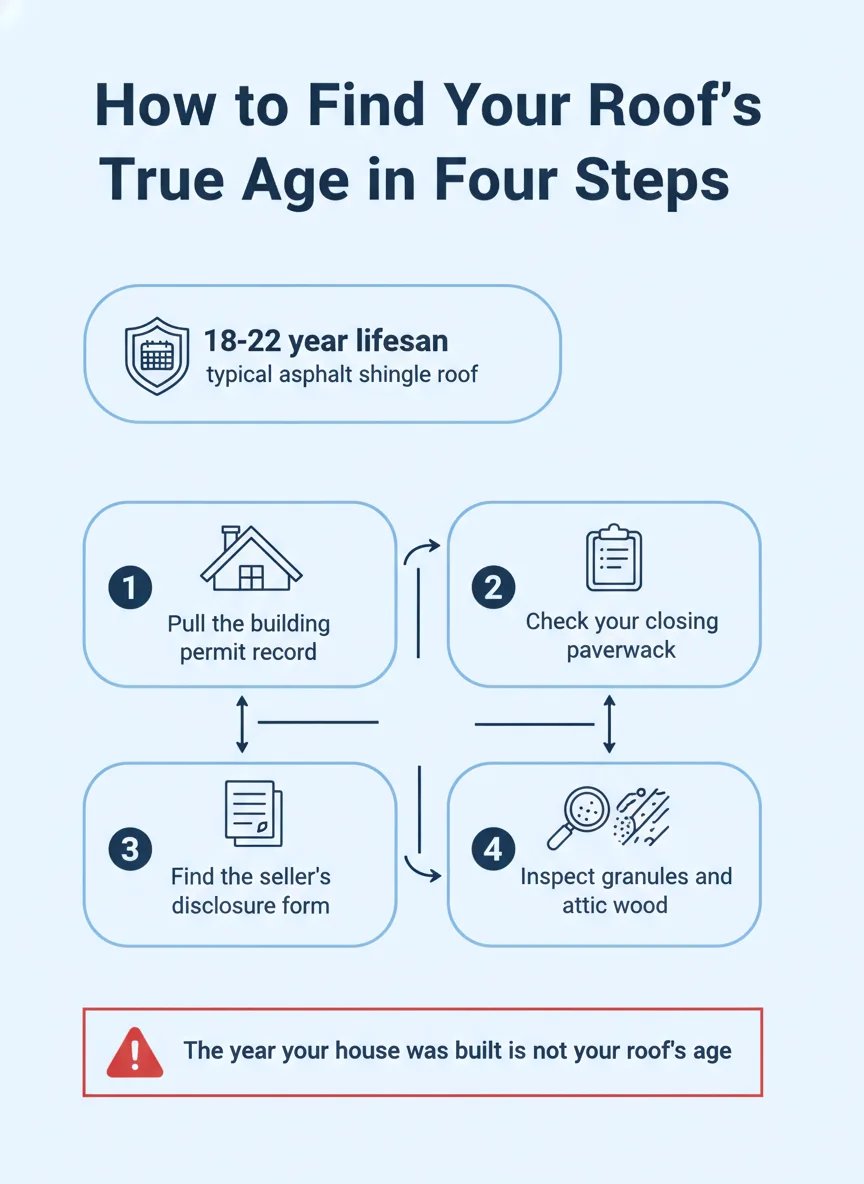
Why the Build Year on File Isn't the Same as Roof Age
The single most common mistake is pulling up the county tax record, seeing the year the house was built, and assuming that's the roof's age too. For a lot of homes that number is decades off. Roofing material has a working lifespan, and a 1985 house has almost certainly had at least one full roof replacement since, possibly two.
Homes Get Re-Roofed More Than Once
Asphalt shingles, the most common roofing material on homes in this part of Georgia, typically last somewhere in the range covered in our roof lifespan guide by material. A house that's 40 or 50 years old has had time for two or even three full tear-offs and replacements, each one resetting the clock on the roof's actual age without changing the year the house was built.
That's why the build year, while useful background, tells you almost nothing about the roof overhead right now. The only way to know the real install date is to trace the roofing work itself, not the house's original construction date.
Additions and Renovations Add Confusion
If a home has had an addition, a garage conversion, or a major remodel, there's a good chance part of the roof is a different age than the rest. A kitchen bump-out or a new second story often comes with its own roofing section, tied into the existing roofline but installed years apart from the original material.
This matters when you're trying to pin down a single age for insurance or resale purposes. In some cases the honest answer is a range, with one section older than another, and that's worth noting rather than averaging out or guessing at a single number.
| Where to Look | What It Tells You | How Reliable |
|---|---|---|
| Building permit record | Exact date work was permitted and often finaled | High, when a record exists |
| Closing or purchase documents | Roof age or replacement date as disclosed at sale | Moderate, depends on seller accuracy |
| Seller's disclosure or prior invoice | Specific install date or contractor name | High, if the document survived |
| Visual inspection of shingles and attic | General age range based on wear | Moderate, best used to confirm paperwork |
What a Permit Record Actually Shows
In most Georgia counties and cities, a full roof replacement requires a building permit, which gets logged with the local building or planning department. That permit typically lists the date it was pulled, the scope of work, and sometimes the contractor who did the job. For homes in Newnan and the surrounding towns, this record is held at the applicable county or municipal office and can usually be requested by address.
Not every roof job gets permitted, especially older repairs or smaller patch work, and some older permit records weren't digitized and can be harder to track down. But when a permit exists, it's about as close to a birth certificate as a roof gets, since it ties an exact date to the actual work performed rather than an estimate.
Step-by-step: Tracking Down Your Roof's Real Install Date
Work through these sources roughly in order. You're looking for the first one that gives you a confirmed date, then using the others to double-check it.
- Check the county permit office: Call or search online for your city or county's building department and ask for permit history tied to your address, specifically for roofing work.
- Pull your closing paperwork: Look through your home inspection report, seller's disclosure, or purchase agreement for any mention of roof age or replacement date.
- Ask the previous owner: If you're still on friendly terms or can track them down, a direct question about when they had the roof replaced is often the fastest answer.
- Search for old invoices: Check any paperwork left in the attic, garage, or a folder from the previous owner, since contractors often leave an invoice or warranty card behind.
- Check your insurance file: Your homeowner's insurance policy may list a roof age or replacement year that was recorded at underwriting, especially if a roof inspection was required.
- Look for a dated label: Some shingle bundles are stamped with a manufacture date, and if attic access allows a look at the underside of the decking, you may spot a stamped date there too.
- Get a professional read: If none of the above pans out, a roofer can look at wear patterns and give you a reasonable estimated range to work from.
How to Tell If a Roof Is Nearing the End, Even Without Paperwork
Granule Loss and Curling Edges
Asphalt shingles shed granules as they age, and you'll often see them collecting in gutters or at the base of downspouts well before a leak shows up. Shingles that are curling at the corners, cracking, or losing their color uniformity are typically well into the back half of their expected lifespan.
None of these signs give you an exact year, but they're a useful cross-check against whatever date you dig up on paper. If the paperwork says a roof is 8 years old but it's already showing heavy granule loss, something doesn't add up, and it's worth getting a second opinion.
Interior Signs in the Attic
An older roof often shows itself from underneath before it shows itself from the curb. Dark staining on the underside of the decking, sagging between rafters, or daylight visible through the roof boards all point to a system that's been through a lot of wear, regardless of what the tax record says about the house.
If you have attic access, a flashlight check takes a few minutes and can tell you a lot. Moisture staining concentrated around vents, chimneys, or valleys often lines up with trouble spots that develop years before a visible leak reaches the living space below.
Should You Climb Up and Check Yourself, or Call a Pro?
Checking gutters for granules, glancing at shingles with binoculars from the ground, and poking around the attic with a flashlight are all things most homeowners can safely do on their own. These give you a general sense of condition without needing to get on a ladder or walk the roof surface.
Actually walking the roof, especially a steep or multi-story one, is a different matter. Loose or aging shingles can be slippery and deceptively fragile, and an inexperienced foot can do more damage than good. This is also where a trained eye picks up details a homeowner might miss, like soft decking underfoot or flashing that's pulled away at a seam.
If you've gone through the paperwork trail and still aren't sure how old your roof is, or the visible signs have you concerned, a straightforward next move is a professional roof repair inspection. A roofer who regularly works on homes in the region can usually narrow down the age range within a visit and tell you honestly whether you're looking at a repair or something bigger.
Putting the Pieces Together
Most of the time, the real age of a roof is sitting in a file somewhere, whether that's a county permit record, a folder from closing, or an old invoice tucked in a drawer. The build year on your house is almost never the right answer, and leaning on it can lead to bad assumptions about how much life is left overhead.
Homeowners in Newnan and the surrounding towns dealing with an unknown roof age don't have to guess forever. Between a permit search, a look through old paperwork, and a visual check of the shingles and attic, most people can land on a reliable answer, and Griffintegrity Roof & Remod Inc is happy to help confirm it in person when the paper trail runs dry.
Frequently asked questions
Does the year my house was built tell me how old my roof is?
No, and this is the single biggest mix-up homeowners run into. A house built decades ago may have had its roof replaced one or several times since, so the build year on the deed or tax record only tells you when the structure went up, not when the current roofing material was installed.
Where is a roof replacement actually recorded?
Most roof replacements require a building permit, and that permit is kept on file at the county or city building department where the home is located. Pulling that record, when one exists, is usually the most reliable way to find an exact install date.
What if there's no permit on file for my roof?
That doesn't necessarily mean no work was done, since older replacements or smaller repair jobs aren't always permitted or the record didn't survive digitization. In that case your closing documents, a seller's disclosure, or a leftover invoice from a previous owner are the next best sources.
Can a roofer tell how old a roof is just by looking at it?
A roofer can usually give you a reasonable range by checking granule wear, shingle curling, nail patterns, and attic conditions, but it's an estimate built on experience, not an exact date. Paperwork, when it exists, is always more precise than a visual read.
Why does it matter if I know my roof's exact age?
Knowing the age helps you plan for replacement before a leak forces the decision, and it matters for manufacturer warranty claims, insurance underwriting, and getting an accurate quote. A roofer who knows the install date can tell you how much useful life is realistically left.