
Why Roof Pitch Comes Up So Often in Georgia
If you've gotten a quote for a new roof, had an adjuster walk your property, or just looked up how steep your house is, you've probably run into the term roof pitch. It shows up in two different languages: degrees, which is how most homeowners think about angles, and rise-over-run, which is the fraction roofers actually use on the job. A 30 degree pitch sits right in the range where it stops being a gentle slope and starts being a roof that needs real planning around materials, safety, and water flow.
Across Coweta County and the towns south of metro Atlanta, from Newnan and Sharpsburg out toward Peachtree City and Senoia, you'll see everything from low, modern rooflines to traditional steep gables. Pitch isn't just a cosmetic choice. It affects how fast rain clears the surface, how much attic space you get, and which materials actually hold up long term in Georgia's mix of summer heat and winter freeze-thaw swings.
How Roof Pitch Is Actually Measured
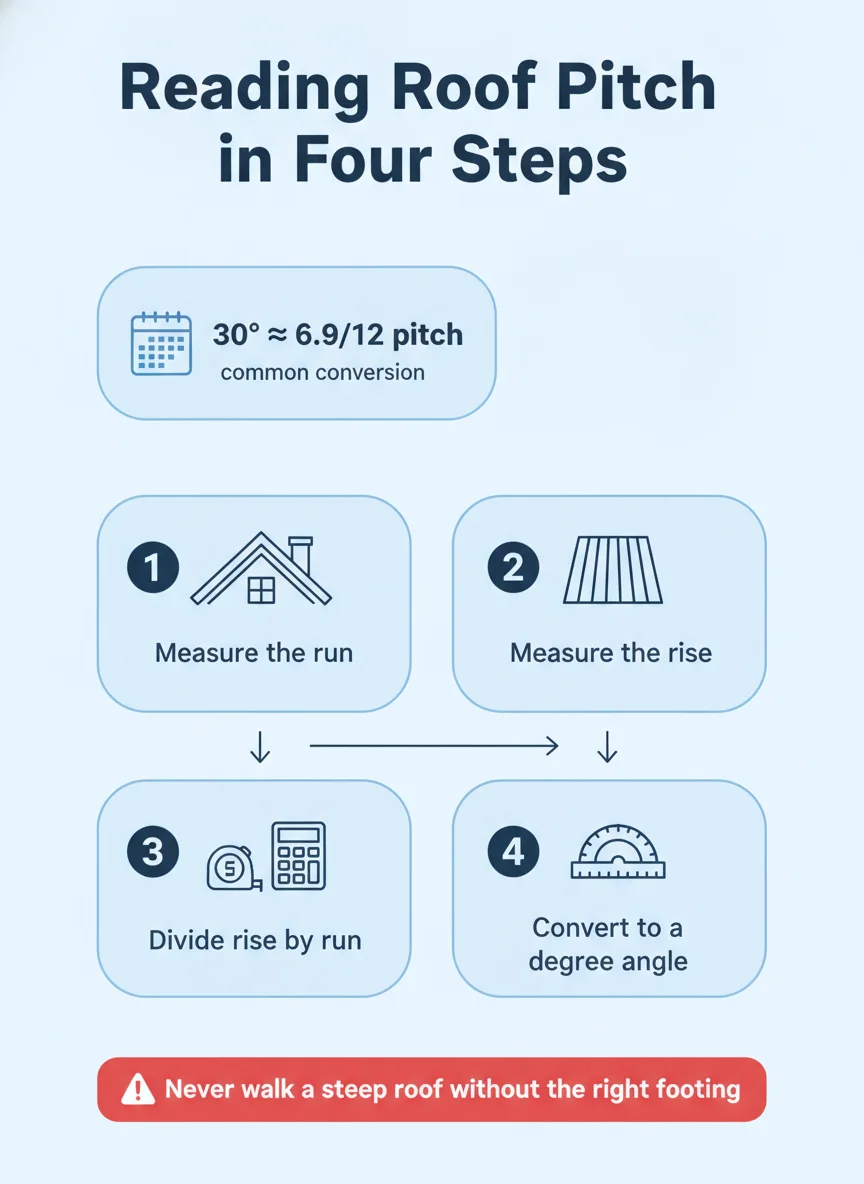
Pitch describes the steepness of a roof as a ratio of vertical rise to horizontal run, almost always expressed per 12 inches of run because 12 inches is the standard length on a framing square. A 6/12 pitch rises 6 inches for every 12 inches it runs horizontally. Degrees measure the same slope as an angle instead of a fraction, and the two describe exactly the same thing from two different angles of math.
Converting Degrees to Rise-Over-Run
The conversion uses basic trigonometry: multiply the tangent of the angle by 12 to get the rise. For 30 degrees, the tangent works out to roughly 0.577, so you get about 6.9 inches of rise per 12 inches of run, which rounds to close to a 7/12 pitch in practical terms. Roofers don't usually sit down and do this math on site, they keep a conversion chart or reference it from memory, but it's worth knowing the math if you're trying to make sense of a quote or a code document.
Why Both Numbers Still Get Used
Architects, surveyors, and some code documents lean on degrees because it's a cleaner way to describe an angle mathematically. Framers, roofers, and material manufacturers lean on rise-over-run because it maps directly to how a roof gets built, measured, and cut on site. When you're comparing a quote or a spec sheet, it helps to know which language is being used so you're not comparing a degree figure to a rise-over-run figure and assuming they're wildly different roofs.
| Pitch in Degrees | Approx. Rise/12 Equivalent | Typical Description |
|---|---|---|
| 10° | 2/12 | Low slope, common on porches and additions |
| 20° | 4/12 | Moderate slope, common on ranch-style homes |
| 30° | 7/12 | Steep standard pitch, common on traditional gables |
| 45° | 12/12 | Very steep, sometimes called a classic A-frame angle |
What a 30 Degree Pitch Means for the Roof System
A roof built at this pitch sits in a sweet spot for a lot of residential construction. It's steep enough to shed water and debris efficiently, which cuts down on the kind of standing moisture that leads to granule loss or wood rot over time. It also opens up more usable attic space than a low-slope roof of the same footprint, since the rafters rise at a sharper angle.
On the flip side, a pitch in this range is steeper than a lot of walkable low-slope roofs, which affects how a crew works on it. Installers need proper footing, harnesses, and roof jacks to move around safely, and that factors into how a job gets staged. It's also steep enough that most warranty programs and manufacturers consider it a standard-slope application for shingles rather than requiring special low-slope modifications.
Step-by-Step: How a Roofer Confirms Your Actual Pitch
If you want a precise number instead of an estimate, here's generally how a contractor nails it down during a visit.
- Walk the roof safely: A roofer gets on the surface with the right footwear and fall protection rather than guessing from the ground.
- Set a level on the slope: A torpedo level or a roofing square is placed flat against the surface to find a true horizontal reference line.
- Measure 12 inches of run: The crew marks a 12 inch horizontal distance along the level from the roof surface.
- Measure the rise: They measure the vertical distance from that 12 inch mark down to the roof surface to get the rise number.
- Record the rise/12 ratio: The rise measurement becomes the pitch, written as rise over 12, like 7/12.
- Convert if needed: If a degree figure is needed for a code document or spec sheet, the ratio gets converted using the arctangent of rise divided by run.
What You'll Typically Find at This Pitch
Material Options That Fit
At a pitch around 30 degrees, asphalt shingles and metal panels both perform well, since the slope sheds water fast enough to avoid the kind of ponding that low-slope membrane systems are designed to handle. This is the range where most traditional residential roof replacement and installation projects land, whether the home is getting architectural shingles or a metal system.
It's also steep enough that visibility from the ground is usually decent, which is part of why curb appeal and color choice matter more at this pitch than on a flatter roof that's barely visible from the street. Homeowners often spend more time thinking about shingle color and style here than they would on a low-slope roof tucked behind a parapet wall.
Maintenance Considerations at This Angle
A steeper roof like this tends to clear leaves and pine straw faster than a low-slope roof, but valleys and the area around penetrations like vents and chimneys still collect debris and need periodic attention. Because the surface isn't flat, homeowners should never attempt to walk it themselves for cleaning or inspection without the right equipment.
If you notice granules collecting in gutters, shingles that look curled at the edges, or soft spots when a roofer walks the surface, those are signs worth having checked regardless of pitch. A steep slope doesn't make a roof immune to wear, it just changes how that wear shows up and where water tends to find its way in if something fails.
DIY vs. Calling a Pro
Figuring out your rough pitch from the ground is something most homeowners can attempt. A smartphone level app held against a photo of the gable end, or simply comparing your roofline to a known reference angle, gets you in the ballpark for conversation purposes.
Getting an exact number, though, means getting on the roof with a level and tape measure, and at a pitch around 30 degrees that's not a casual walk. It calls for the kind of footing, harness setup, and experience that a professional brings as a matter of routine, not as an afterthought.
The same goes for anything beyond measurement, like deciding whether your pitch is suited to a material change, or whether an older roof repair is masking a bigger issue tied to how water moves across that slope. A licensed roofer can measure, inspect, and recommend in one visit rather than leaving you to guess.
Putting the Number to Use
Knowing your roof sits around 30 degrees, or roughly a 7/12 pitch, is useful shorthand whether you're comparing material options, reading a quote, or just trying to understand why your roof looks steeper than your neighbor's. It's a common, practical angle that balances water shedding, usable attic space, and standard material compatibility without pushing into the territory that requires specialty systems. For a deeper look at how pitch and material choice affect how long a roof actually lasts in this climate, see how long each roof type lasts in Georgia.
If you're trying to pin down your own roof's exact pitch, whether for a renovation, a material change, or just peace of mind, it's worth having someone measure it in person rather than estimating from a photo. Griffintegrity Roof & Remod serves homeowners around Newnan and the surrounding towns and can confirm your pitch during a straightforward inspection.
Frequently asked questions
What does a 30 degree roof pitch look like?
A 30 degree pitch is a noticeably steep roof, somewhere around a 7/12 rise-over-run in the measurement most roofers use day to day. It's steeper than the gentle ranch-style roofs common in a lot of older neighborhoods, but it's not an extreme A-frame angle either. It's a common pitch on traditional gable homes across Georgia.
How do you convert roof pitch from degrees to rise-over-run?
You take the tangent of the angle in degrees and multiply it by 12, since rise-over-run is expressed per 12 inches of horizontal run. A 30 degree angle works out to roughly 6.9 inches of rise for every 12 inches of run, which roofers round to about 7/12. Most contractors use the rise-over-run number day to day because that's what their levels and squares are marked in.
Is a steeper roof pitch better for shedding water?
Generally yes, a steeper pitch sheds rain and debris faster than a low-slope roof, which is part of why steep roofs are less prone to ponding and granule buildup. That said, steeper isn't automatically better for every home. Wind exposure, attic design, and the materials you choose all factor into whether a steeper pitch actually improves performance.
Does roof pitch affect what materials can be installed?
Yes, pitch is one of the main things that determines which materials are a good fit. Very low slopes typically need membrane systems, while moderate to steep pitches like 30 degrees can usually run asphalt shingles or metal without special modifications. A roofer can confirm what your specific pitch supports before you pick a material.
Can I measure my own roof pitch safely from the ground?
You can get a rough estimate from the ground using a smartphone level app or by eyeing the gable end against a reference line, but it won't be precise. An accurate measurement usually means getting on the roof with a level and tape measure, which is a job better left to someone with the right fall protection and footing. If you just need the number for a quote, a roofer can measure it during an inspection.